
Why Do Mailing List Counts Change?
Key Takeaways
- Mailing list counts change due to factors like changing purchasing behavior, new data sources being added or removed from a list, or people passing away.
- If data isn’t updated, then a mailing list could suffer from significant data decay.
Introduction
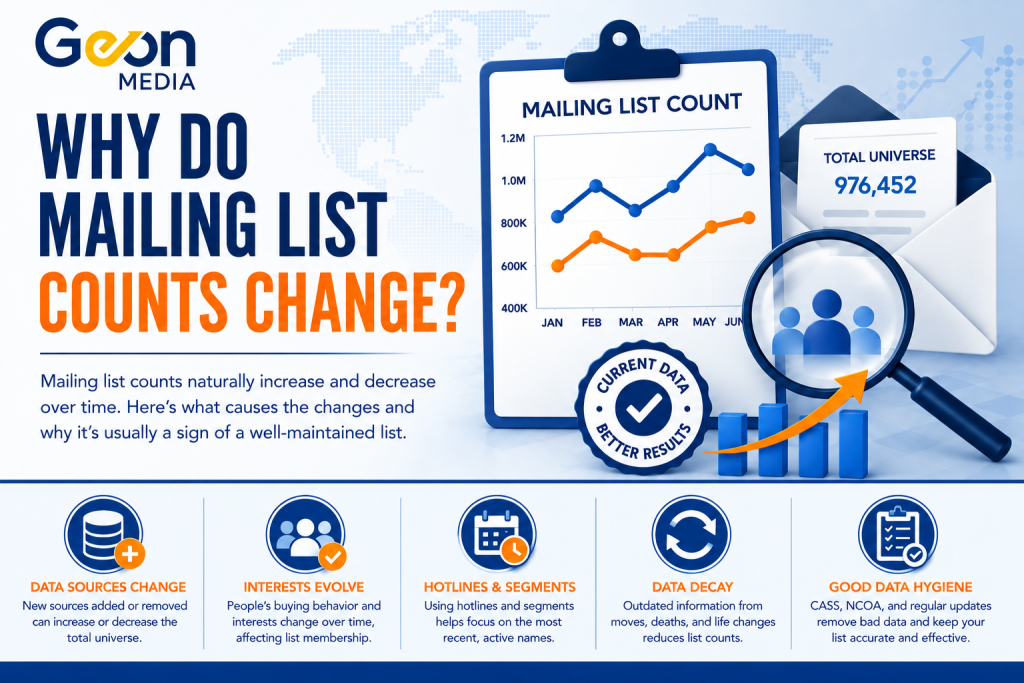
When doing research into a mailing list for a direct mail campaign, you might notice that the total universe of the mailing list isn’t the same as the last time you looked at the mailing list. At first glance, this could appear to be strange, and the sign of a mailing list that you shouldn’t use. Why do mailing list counts change, and is that a positive or a negative?
Why Do Mailing List Counts Change?
There are several reasons why a mailing list count might change. One reason a mailing list count might change is a mailing list owner gaining or losing access to a source of their data. Reputable mailing list owners will gather their data from several sources to build and maintain their lists and files. If a mailing list owner loses access to a data source, they might remove the data from the overall count for a certain list. Conversely, if a data source is obtained from a reputable source, the mailing list owner might be able to increase the total universe for a mailing list.
Another reason that a mailing list count might fluctuate is based on the purchasing behavior of the individuals on the mailing list. As time passes, the interests of consumers are going to change. An item that you purchased five years ago might not interest you now, just as you are likely to buy something now that you wouldn’t have five years ago. When a consumer no longer fits the criteria for a particular mailing list, that record might be removed from the list’s total universe. Likewise, a consumer might be added to a mailing list as their interests or purchasing behavior change.
There are ways to ensure that a mailer gets the most up to date names for their mailing campaign. Some mailing lists have segments attached to them. Segments are optional enhancements that can refine the rented names in a mailing list. You might find a segment called a hotline. A hotline is a defined period of time that the consumers on the mailing list have interacted with the service or product that the mailing list is based on.
For example, a consumer on a one-month hotline for a mailing list for DVD collectors would have made a purchase for a DVD or similar product within the past month. Hotlines are able to help mailers focus on the most recently active names on a list, which could make those records more relevant to a mailing campaign. For more information on mailing list segments, read Geon’s article on mailing list segments here.
What is Data Decay?
The last major reason that a mailing list’s overall count might change is because the data isn’t current, so the old data should be removed. This is what is known as data decay. Data becomes decayed if it hasn’t been updated on a regular basis. Natural data decay doesn’t mean that the mailing list’s owner has neglected the mailing list, it just is something that happens over time. Data might become old due to an individual moving to a new address, somebody passing away, or a consumer changing their name due to getting married or divorced.
There are ways to combat natural data decay, mainly getting data processed through Coding Accuracy Support System (CASS) Certification address-matching software, and running data through a National Change of Address (NCOA) database. Other pieces of data hygiene include Delivery Point Validation (DPV), address standardization and verification, and merge/purge. Both CASS Certification, NCOA, and DPV are offered through the USPS and help standardize and update addresses respectively. By updating the data and updating/removing addresses, mailing list owners can practice what is known as data hygiene. If a mailing list owner has good data hygiene for their mailing lists, the list counts will naturally change.
FAQ
- Q: How often should a mailing list count change?
- A: There isn’t an overall time that the mailing list count “should” change. If you have any questions about the update frequency of a mailing list, contact the list owner, and they will be able to answer your questions.
- Q: Is a declining mailing list count a sign of a bad mailing list?
- A: Not necessarily. A smaller overall count might simply mean that outdated, duplicate, or records that don’t fit the list owner’s standards have been removed from the count. The important question to think and ask is why the count changed, and how the list is being maintained.
- Q: Why might a mailing list owner lose access to a data source?
- A: One big reason that a mailing list owner would lose access to a data source is that the supplier of the data either doesn’t want to sell it anymore or they go out of business. If this happens, the list owner is no longer able to verify it, so they should pull it out of any mailing lists or databases that are under their ownership.
Conclusion
A change in a mailing list’s overall count doesn’t necessarily mean that the mailing list is unreliable or inaccurate. The count on any given mailing list is going to rise and fall as new records are added, removed, updated, or reclassified. In many cases, a changing count on a mailing list is a good sign that the list is actively being maintained, and that good data hygiene practices are being utilized.
Geon reviews your intended audience and mail piece to identify additional criteria that can help refine your mailing list selection. This helps us select names that more closely align with your offer and campaign goals.
Learn why mailers choose Geon Media.
New to Direct Mail?
Are you running your first direct mail campaign?
Read Geon’s beginner’s guide for to direct mail here.
Return to Mailing List Fundamentals, or browse Geon’s Learning Center.
Recent Comments