
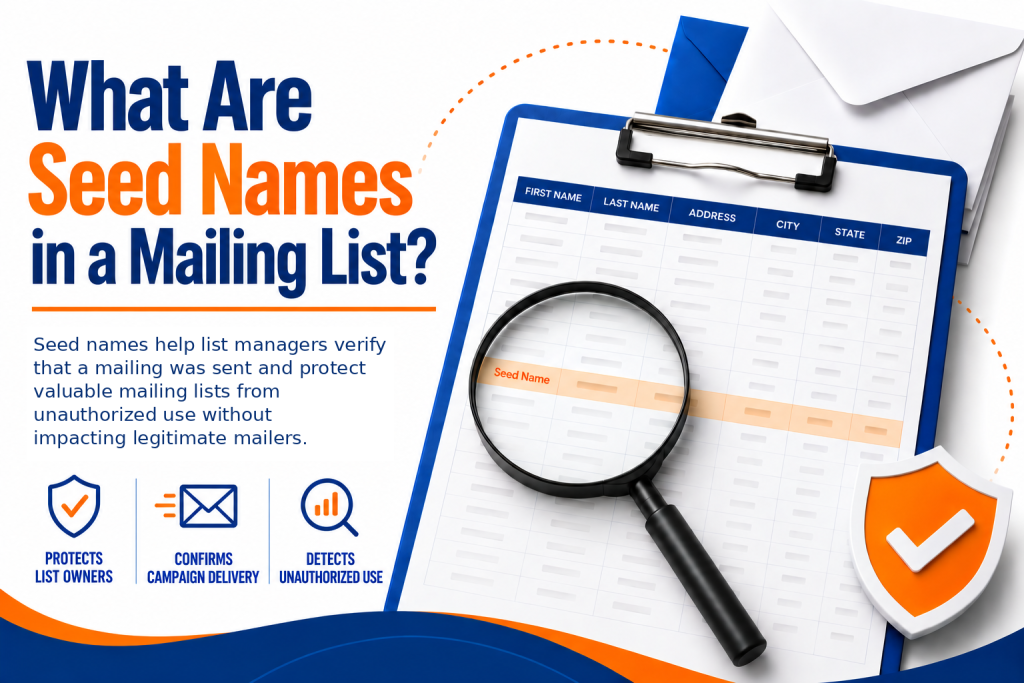
What Are Seed Names in a Mailing List?
Key Takeaways
- Seed names in a mailing list are fake names and addresses that are intentionally inserted into mailing lists.
- Seed names help mailing list managers verify that a campaign was successfully mailed, as well as protecting against unauthorized of the mailing list.
- All of the seed names in a mailing list have no negative impact on legitimate direct mail campaigns.
What Are Seed Names in a Mailing List?
The seed names in a mailing list are fake names and addresses that are intentionally placed into mailing lists that result in either the mailer themselves, or a contact that the list manager trusts, receiving the mail piece. If you have heard of the concept of a copyright trap that publication companies place in articles that talk about false upcoming products, releases, or general information, seed names are the direct mail industry’s equivalent of that concept.
Why Are Seed Names Used?
Seed names are used for three predominant reasons. The biggest reason that seed names in a mailing list are used is to protect the mailing list manager’s property. Mailing lists are typically allowed to only be used a limited number of times (for more information on that, read Geon’s article on mailing list reuse here LINK). So, if the seed name that the mailer has control over receives more mailings than the rental agreement between the mailer and list owner allow, the list manager is able to take appropriate action.
Once the seed name has received the mail piece, they can know that the mail piece did indeed go out, which could prevent a misunderstanding about list usage down the road.
Seed names will also some benefit to the mailer as well. Once the seed name has received the mail piece, the mailer can be confident that their mail piece went out without any issues. Seed names are in place to protect both the mailer and the list manager from having allegations of misuse, inaccuracy with the mailing list, as well as the list manager’s property.
Seed names can also help confirm when different regions of the campaign will approximately start receiving the mail piece. While not a direct replacement for USPS tracking, seed names provide another way to confirm that the mail piece is moving through the postal system as expected.
Where Are Seed Names Placed?
Seed names are usually scattered throughout an ordered mailing list, rather than being clumped together in one section. They are inserted in a way that makes the names blend in with the remainder of the records, and the mailer won’t have a way of knowing which names are seeds, and which names are legitimate.
All of the seed names in a mailing list represent a small fraction of the total number of names. As an example, a campaign which contains 15,000 names might only have a handful of seed names. Due to the fact that they make up such a small percentage of the overall mailing, seed names have virtually no significant impact on a campaign’s performance and success.
Do Seed Names Impact Legitimate Mailers?
No, seed names in a mailing list do not impact legitimate mailers. Even when list managers practice having excellent data hygiene, there are going to be some names and addresses on the mailing list that are going to not be delivered. This could be because individuals might pass away or move away without going through the correct channels and following the change of address procedures. Due to this, having one or two seed names in a list of several thousand names is unlikely to impact the mailer or their engagement rate in any meaningful way.
If a mailer wants to have the most accurate list possible, they should work with a reputable list broker or list manger who regularly performs data hygiene on their mailing lists. This includes updating their mailing lists through the USPS National Change of Address (NCOA) process and then standardizing addresses using CASS Certification, as well as Delivery Point Validation (DPV), merge/purge, address verification, and address standardization. By doing this, the incorrect names and addresses in a mailing list are removed.
FAQ
- Q: Does every list manager include seed names in their mailing lists?
- A: No, not every list manager includes seed names. Depending on the rental agreement of the list rental, the list manager might not include seed names in a mailing list. The manager also might not worry about misuse of their mailing lists.
- Q: Why don’t list managers just simply trust mailers to not misuse the mailing lists?
- A: Mailing lists are the list managers’ intellectual property. Seed names provide a simple and easy way to verify that rental agreements are being honored by both parties, while requiring almost zero effort from legitimate mailers.
- Q: Could I ask the mailing list manager to not include seed names in my order?
- A: You shouldn’t. Seed names are mainly in place to give list managers peace of mind knowing that their mailing lists are not being misused. As mentioned, seed names don’t impact the mailer’s campaign in any sort of statistically significant way.
Conclusion
Just as publishers sometimes will include “copyright traps” intentionally to detect unauthorized copying, mailing list managers will use seed names to help protect the value of their mailing lists. For legitimate mailers, the seed names in a mailing list are a normal part of renting a mailing list, and have virtually no impact on the mailer’s campaign performance.
Return to Launching Your Campaign, or browse Geon’s Learning Center.
Recent Comments