
Consumer vs. Business Mailing Lists
Key Takeaways
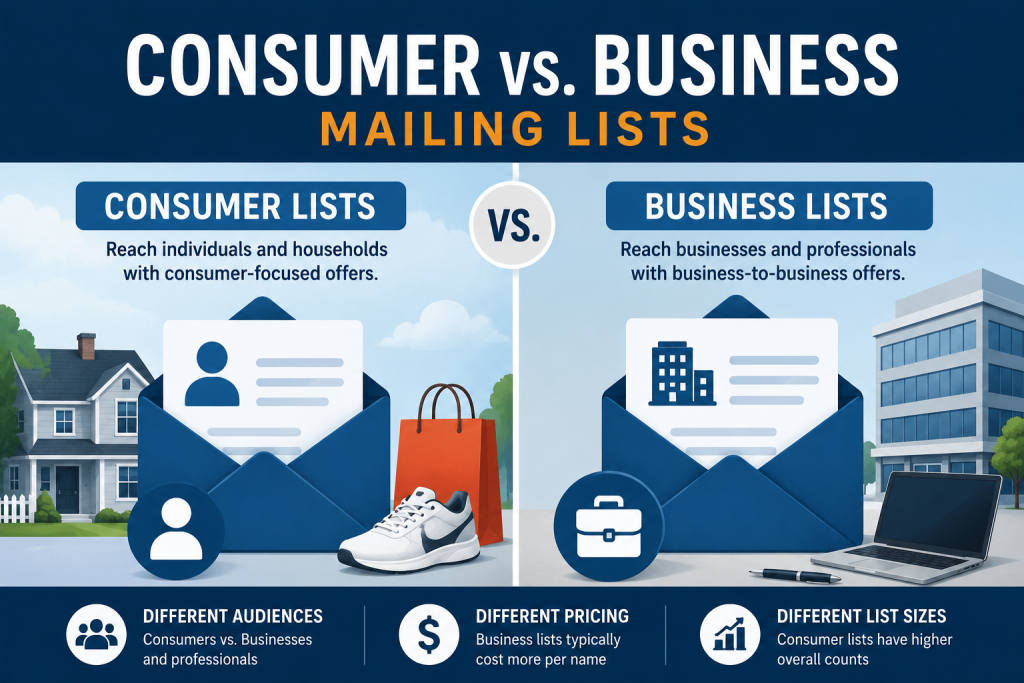
- The target audience between the two lists is different.
- Business mailing lists are typically a bit more expensive.
- Consumer lists typically have a higher overall count.
Introduction
A successful direct mail campaign depends on more than just a great offer. Even the best mail piece or offer can fail if it reaches the incorrect audience. That’s why one of the first decisions every mailer needs to make is whether their campaign is a better fit for consumer vs business mailing lists. Knowing who and what falls into either category can increase your chances of having an engaged audience, saving costs, and a successful campaign.
Consumer and business mailing lists exist because these two audiences are very different. A company that is trying to advertise a new business opportunity at a conference that they’re hosting is not going to advertise to the same group of people that would be interested in sports memorabilia. If you’re interested in learning more about different types of mailing list categories, check out Geon’s page about mailing list categories.
What are the Main Differences Between Consumer vs Business Mailing Lists?
At the core of the concept, the two lists appeal to their respective targets. Business mailing lists target companies and professionals. Audiences that you would find in business mailing lists include business owners, executives, and other occupation-related individuals. Those that would be on business mailing lists could be interested in payroll services, commercial insurance, and office equipment, for example.
Consumer mailing lists, on the other hand, are going to appeal more to a consumer target audience, with overall categories of mailing lists such as those based on interests, demographics, purchasing behaviors, hobbies, lifestyle, or life events. Some of the mailing lists that you might expect to find include sporting spectators, as seen on TV product buyers, collectors of a specific item, and individuals who enjoy living luxury lifestyles.
Are There Any Other Big Differences Consumer vs Business Mailing Lists?
One of the other big differences between consumer vs business mailing lists are the prices. Typically, business mailing lists are going to be on the higher end of the spectrum when it comes to how much each name costs on a mailing list when compared to consumers mailing lists. While prices are going to vary from list to list and on the quality of the data, consumer mailing lists are generally less expensive than business mailing lists due to their larger audiences. Consumer mailing lists often cost anywhere from two cents a name to about nine or ten cents per name, whereas business mailing lists start at around eight cents per name, and will go up to about twenty cents per name, with some premium lists costing more than that.
Another difference between consumer vs business mailing lists is the number of names that are present in the mailing lists. Consumer mailing lists often contain hundreds of thousands of names to even millions, whereas business mailing lists are often significantly smaller. Business lists are typically smaller due to the fact that they target a much more narrow audience.
FAQ
- Q: Are individual people going to be on both business mailing lists and consumer mailing lists?
- A: Yes, most individuals are going to be on both types of mailing lists. The same person that enjoys budget travel might also be interested in stocks and bond investments, so they would be on both types of lists.
- Q: Could a mailing list contain both business and consumer data?
- A: Yes, while you are able to get a list that has both types of data, it typically would be much more expensive and would be more practical to get a list containing one or the other.
- Q: I’m unsure if I should be using a consumer vs business mailing list for my mailing campaign.
- A: No worries, Geon can help you! Contact us here, and we would love to work with you.
- Can I use both consumer and business mailing lists in the same campaign?
- Of course! There are times when a campaign would benefit from reaching both professionals and companies, depending on the mail piece and the product or service that is being offered, so you don’t need to make the difficult decision of choosing between consumer vs business mailing lists. Some mailing lists offer additional selects or segments that allow you to just order from one list. For more info on selects or segments, read about them from Geon’s article on mailing list pricing.
Conclusion
While there are many ways to maximize the performance of your mailing campaign, making sure the correct audience gets the mail piece is arguably the most important. When looking at the differences between consumer vs business mailing lists, they begin with finding and understanding your ideal customer. Once you’ve figured out your ideal customer, choosing between consumer vs business mailing lists becomes much more straightforward.
Geon reviews your intended audience and mail piece to identify additional criteria that can help refine your mailing list selection. This helps us select names that more closely align with your offer and campaign goals.
Learn why mailers choose Geon Media.
How Ordering Works
1. Tell us about your campaign. Share your intended audience, quantity, and a sample of your mail piece.
2. Review your options. We help you choose a mailing list and any suitable selects or segments.
3. Confirm your order. Review and approve the final pricing and rental terms.
4. Receive your list. We prepare your selection and deliver you with a spreadsheet containing your mailing list.
Learn more about ordering a mailing list.
New to Direct Mail?
Are you running your first direct mail campaign?
Read Geon’s beginner’s guide for to direct mail here.
Return to Mailing List Fundamentals, or browse Geon’s Learning Center.
Recent Comments