
What Makes a Good Mailing List?
Key Takeaways
- No matter how good your offer is, if you have a poor target audience, the offer isn’t going to get many responses.
- When looking at lists, compare aspects of the list like update frequency, pricing, and the overall count to determine whether the list will work.
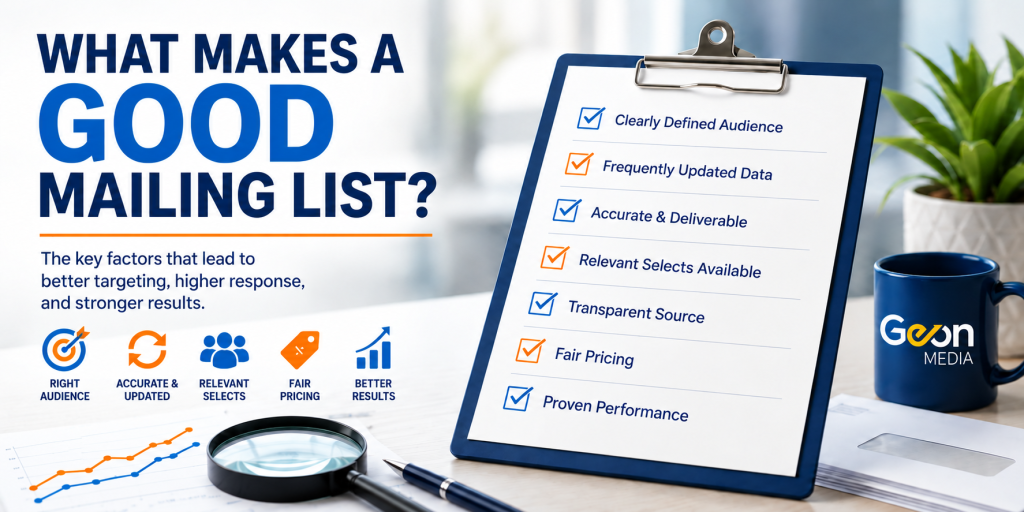
- A quality mailing list has its target audience clearly defined, is updated on a regular basis, and aligns with the mailer’s campaign goals.
Introduction
What makes a good mailing list? Choosing the correct mailing list is one of the most important decisions in any direct mail campaign and that can be a daunting task. After all, searching for a general term can result in hundreds, if not thousands of different mailing lists. Mailing lists can come in all shapes and sizes, so it can be intimidating looking at the wall of lists.
What makes a list stand out from the rest? There are several factors that can help you evaluate the quality of a mailing list, and choosing a good mailing list can heavily increase the amount of engagement that your mail piece gets, as well as saving money from reducing postage on mail pieces that are sent to the wrong people. Understanding what makes a good mailing list from a bad one can help make the campaign a success. It can also be helpful to understand why direct mail still works and what makes it an effective marketing channel.
What Makes a Good Mailing List?
A good mailing list should define exactly who the target audience of the list is. While this sounds like an obvious factoid, mailing lists can sometimes use vague language, be inconsistent on the contents of the list, or can be not detailed enough to answer the question of who the target audience is, that might be a list that you want to avoid.
If the mailer has had positive experiences in the past with a specific list manager, then the list manager’s other lists will probably give you good results as well. (For information on what a list manager is, check out our article on list brokers and list managers.) Another aspect to consider is the list manager’s willingness to answer questions and work with the mailer through the process. If the list manager can answer where the data was sourced from, the accuracy of the data, and is positive to work with, that’s a good sign that the mailing list will be a list that you’re going to want to use.
What Makes a Good Mailing List From a Bad One?
The easiest and number one factor to look at when trying to determine if a mailing list is quality is the update date. When was the last time that the list was updated? There isn’t a set amount of time that a list needs to be updated, but a good rule of thumb is that lists are to be updated monthly or quarterly. If you see a list that was last updated two years ago, that probably isn’t going to be a list that you’re going to want to go with.
Another good thing to remember is the old rule of if something is too good to be true, it probably is. If you see a mailing list charge twenty or thirty dollars cheaper than every other list per thousand names, or if you see a total universe count that is significantly higher or lower than the competition, it’s worth asking why that is. Depending on the list manager’s answer, it could we worth avoiding that mailing list.
Red Flags When Choosing a Mailing List
The mailing list:
- hasn’t been updated recently.
- has an unknown data source, according to the list manager.
- has a much lower price when compared to other lists in the same industry.
- has a manager that doesn’t care about having good data hygiene.
How Do I Compare Between Mailing Lists?
Having an idea of who your target audience is and working backwards from that can be an effective way of comparing between different mailing lists. Doing that while keeping your budgetary restraints, knowing the amount of mail pieces that are going to be sent out, and making sure that the mailer services the area(s) that the mail piece will be sent to are great ways to narrow down which mailing list you’re going to be using. Knowing when to change mailing lists can be a good way to test to see if a new mailing list will perform better. Learn more about when to change mailing lists here.
Contacting a list broker can also be a good way to compare between different mailing lists. List brokers know what makes a good mailing list, and can often help mailers find the best list for their campaign, as they are able to provide an unbiased opinion on which mailing list would work the best, based on target audience and constraints that the mailer might have. For more information, check out Geon’s list brokerage service.
FAQ
- Q: Will a large mailing list perform better or worse than a small mailing list?
- A: Depending on the mail piece and campaign, a large mailing list could perform better or worse. If the campaign is targeting a large piece of the population with little in terms of general segmentation, then a large list would perform acceptably. If the campaign is targeting a niche population, you’re probably going to want a smaller list.
- Q: Is there a question that I can ask to ensure the data is up to date, regardless of the update date on the mailing list?
- A: Yes! Asking about when the data was last run through services like the USPS CASS (Coding Accuracy Support System), NCOA (National Change of Address), and DPV (Delivery Point Validation) are a great way to know if the data is going to be accurate. For more information on CASS, NCOA, and DPV check out our articles on them.
- Q: What do I do if I can’t find a mailing list that fits my target audience that I want to send my mail piece to?
- A: Contacting list managers and asking if they can assist with the issue can be a way to solve the problem. Geon can offer custom mailing lists. Contact us, and we can see what we can do.
- Q: Why isn’t the cheapest mailing list always the best?
- A: A cheaper list could mean that the individuals in the mailing list might not be the most highly specific audience that the mailer is targeting. Asking the list manager on the exact qualifications that an individual has to land on the mailing list can help answer the question.
- Q: Are good mailing lists more accurate than bad mailing lists?
- A: While mailing lists are generally accurate, a good mailing list that has clean data will probably be more accurate than an outdated list.
Conclusion
Having a mail piece with a good, solid offer is an important part of the direct mail campaign process, but equally important is understanding what makes a good mailing list. By ensuring that the mail piece is going to the right demographic, mailers can maximize their engagement. Making sure that the mailing list has been updated, cleaned, and fits the mailer’s requirements are all great ways to make sure that the campaign has the highest chance to be successful.
Geon reviews your intended audience and mail piece to identify additional criteria that can help refine your mailing list selection. This helps us select names that more closely align with your offer and campaign goals.
Learn why mailers choose Geon Media.
How Ordering Works
1. Tell us about your campaign. Share your intended audience, quantity, and a sample of your mail piece.
2. Review your options. We help you choose a mailing list and any suitable selects or segments.
3. Confirm your order. Review and approve the final pricing and rental terms.
4. Receive your list. We prepare your selection and deliver you with a spreadsheet containing your mailing list.
Learn more about ordering a mailing list.
New to Direct Mail?
Are you running your first direct mail campaign?
Read Geon’s beginner’s guide for to direct mail here.
Return to Mailing List Fundamentals, or browse Geon’s Learning Center.
Recent Comments