
Delivery Point Validation in Direct Mail
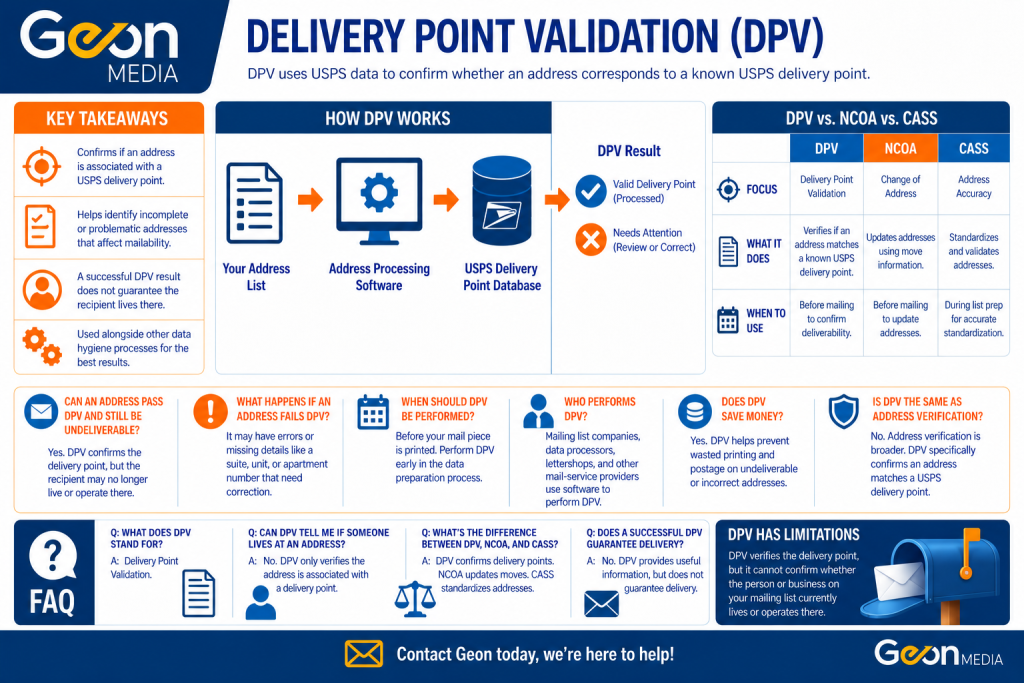
Key Takeaways
- Delivery Point Validation in direct mail helps to determine whether an address is associated with a known USPS delivery point.
- DPV can help identify addresses that might be incomplete or otherwise have problems with that could affect mailability.
- While an address might yield a successful DPV result, this does not guarantee that the person or business on your mailing list is currently occupying that address.
- DPV is often utilized alongside other data hygiene processes when preparing or updating mailing data.
Introduction
When looking at a mailing list, how do you know that the addresses listed are actual USPS delivery points? This is where Delivery Point Validation (DPV) becomes useful. DPV can confirm if an active address corresponds to a known USPS delivery point. While DPV can be used to determine if an address is a valid USPS delivery point, it can’t verify if the person on your mailing list currently lives at the address.
What is Delivery Point Validation in Direct Mail?
DPV is a USPS-associated process that uses USPS addressing data to help determine whether a specific address is connected to a known USPS delivery point. A delivery point is a location where the USPS can deliver mail. One limitation of Delivery Point Validation in direct mail is that, while it provides information regarding whether an address corresponds to a delivery point, it cannot be used to determine which specific individual/business is located at an address.
How Does Delivery Point Validation in Direct Mail Work?
DPV works by comparing an address that you have to the USPS database using a piece of address processing software to determine if the address corresponds to a known delivery point. Depending on the result of the comparison, the mailer will either find that the address is corresponds to a known delivery point, or if additional attention is needed.
Why Is Delivery Point Validation in Direct Mail Important for a Mailing List?
Due to the large quantity of addresses that somebody who is running a direct mail campaign will be mailing to, it’s not practical to manually go through a mailing list and individually verify every address. While an address might look valid on the mailing list, it could be incomplete by an having an incorrect or missing street number on the address, or missing the apartment number, for example. It’s cheaper to use DPV to identify the issues with address quality before the mail pieces are produced and mailed out so mail isn’t deemed to be undeliverable.
Does Delivery Point Validation in Direct Mail Verify That Someone Lives at an Address?
If your mailing list has a name and address on it, DPV can only be used to verify that the address is a valid delivery point. So, if on your mailing list, you have an entry for Homer Simpson at 742 Evergreen Terrace, DPV can only be used to verify that 742 Evergreen Terrace corresponds to a known USPS delivery point, but can’t be used to confirm that Homer Simpson is currently living there.
DPV vs. NCOA vs. CASS
| DPV | NCOA | CASS | |
|---|---|---|---|
| Primary purpose | Checks whether an address corresponds to a known USPS delivery point | Uses change of address information to help identify applicable moves | Helps match and standardize addresses using USPS address data |
| Focus | Delivery point | Address changes/moves | Address quality and standardization |
| Confirms person lives there? | No | No | No |
| Typical use | Identify potential delivery-point issues | Help update addresses after moves | Improves address accuracy and formatting |
Can an Address Pass DPV and Still Be Undeliverable?
Yes, it can. DPV is not a guarantee that your mail piece can or will be delivered. While DPV is the recognition that a delivery point is known by the USPS, the person that you’re trying to mail to might not be living at that address anymore, for example.
What Happens if An Address Fails DPV?
If an address fails DPV, it might need additional review or require a correction. Possible issues that could make DPV fail include having incorrect address information or missing secondary information, such as a suite, unit number, or apartment number, when one is needed to pass DPV testing.
When Should Delivery Point Validation in Direct Mail Be Performed?
DPV should be generally be performed before your mail piece is printed. If an address is incorrect but you’ve already printed out your mail, then there isn’t much you can do to correct it. Making sure that proper data hygiene is being practiced can help to reduce the number of incorrect addresses that you have to correct on your mailing list.
Who Performs DPV Processing?
A mailing list company, data processing provider, lettershop, or other mail-service provider could use data processing software as a part of preparing a mailing list for mailing.
If you need help with performing data hygiene on your mailing list or data file, contact Geon here, and we would be happy to help.
Does Delivery Point Validation in Direct Mail Save Money?
While DPV isn’t a postage discount by itself, DPV can find address errors before the mail piece is printed, which could save money by preventing incorrectly addressed or otherwise problematic mail pieces from being printed and mailed.
Is Delivery Point Validation in Direct Mail the Same as Address Verification?
While the two are similar, address verification and DPV are not the same thing. Address verification is a broad term for checking the quality of an individual address, while DPV is its own process that can be used to determine whether an address corresponds to a USPS delivery point.
FAQ
- Q: What does DPV stand for?
- A: DPV stands for Delivery Point Validation.
- Q: Can Delivery Point Validation in direct mail tell me whether an address is occupied by someone on my mailing list?
- A: No, DPV only can verify whether an address is associated with a delivery point.
- Q: What is the difference between DPV, NCOA, and CASS?
- A: DPV focuses on the delivery point that is associated with an address, NCOA processes change of address information to identify any applicable address changes, and CASS helps to standardize and match addresses using USPS address data.
- Q: Does getting a successful DPV guarantee that my mail will be delivered?
- A: No. While a successful delivery point validation in direct mail can provide you with useful information regarding an address, it doesn’t guarantee that a specific mail piece will reach its targeted recipient.
Conclusion
Delivery Point Validation in direct mail is a tool that can help to determine the quality of an address that is included in a mailing list before the mail piece is produced. By finding if the addresses within a mailing list correspond to known USPS delivery points, DPV is a useful tool that mailers can use to help identify potential addresses that are problematic before any money is spent producing and mailing pieces of mail to the problematic addresses.
While this is a useful tool that validates delivery point information, this doesn’t confirm or deny whether a specific person or business occupies that address. While DPV can be an important part of the data hygiene process as a whole, it shouldn’t be treated as the only address quality or data hygiene process that is needed when preparing your mailing list for a direct mail campaign.
Return to Mailing List Fundamentals, or browse Geon’s Learning Center.
Recent Comments