
Address Verification in Direct Mail
Key Takeaways
- Address verification for direct mail can help to improve the address quality and accuracy for a mailing list before your direct mail campaign.
- Verifying an address determines whether an address can be matched to postal address information.
- Address verification for direct mail can’t replace other parts of a good data hygiene strategy, such as NCOA and DPV.
- A verified address doesn’t confirm that a specific individual or business occupies that address.
Introduction
As you prepare for your next direct mail campaign, you find the following two addresses in your rented mailing list:
- 123 S Main Street Apartment 4
- 123 SOUTH MAIN ST APT #4
Mailing lists are built from compiling different sources of data, and these sources might keep their data using different methods. While these addresses might look like they point to the same place, you might not be able to manually analyze and verify every address that is on your mailing list. If you’re mailing to thousands of addresses, it isn’t feasible to individually look at every address. Any address that is misspelled, has the incorrect suffix, contains missing information, or is otherwise incorrect could create problems when you mail your mail pieces. Using address verification, you can identify and potentially eliminate these problems by checking your address information against postal data before you produce your mail.
What Is Address Verification for Direct Mail?
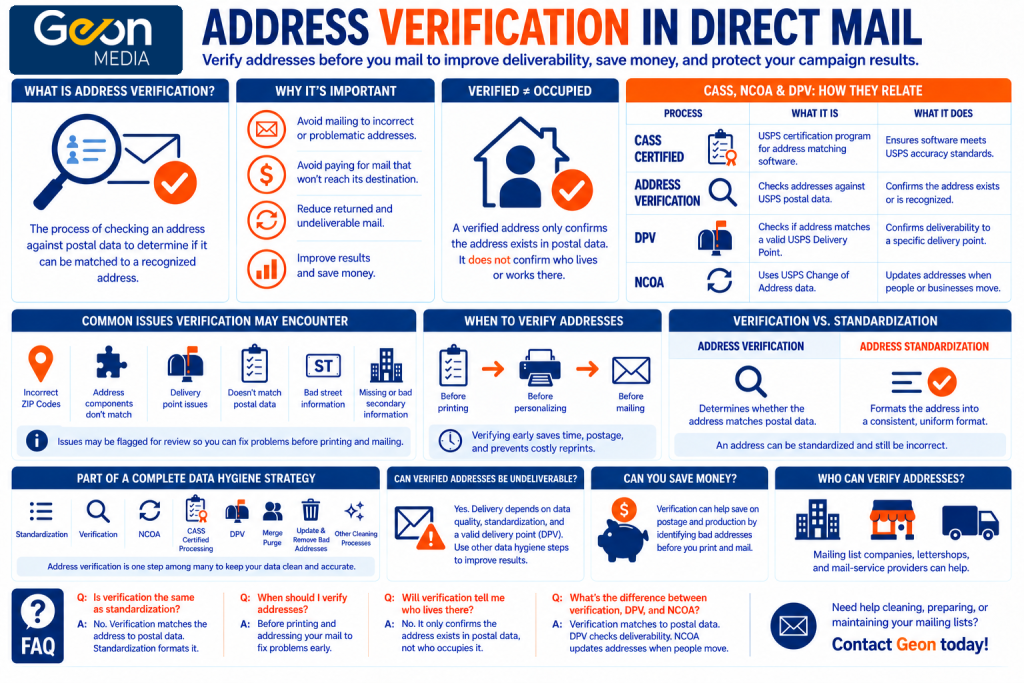
Address verification is the process of checking an address on a mailing list against postal information to determine whether the address on the list can be appropriately matched or recognized.
Is Address Verification for Direct Mail Important?
Every mail piece that you print, address, and mail is going to cost money. If you’re not verifying the addresses that are in mailing list before this is done, you could be:
- Mailing pieces of mail that have problematic or incorrect addresses
- Paying for mail that won’t reach its targeted destination
- Having unnecessary mail that gets returned or is deemed undeliverable
Address verification can help to identify or prevent many of these problems before your mail gets printed and addressed.
Does A Verified Address Mean the Person Lives There?
No, just because an address has been verified doesn’t mean that the occupant is the person on your mailing list. All that address verification focuses on is the address itself and doesn’t check who the occupant is that resides there.
How Are CASS, NCOA, and DPV Related to Address Verification?
| Address Verification & Standardization | CASS | DPV | NCOA | |
|---|---|---|---|---|
| Primary purpose | Improve address consistency and match address information | Certify the quality of address-matching software | Coming if an address corresponds to a known USPS address/delivery point | Identify applicable changes of address |
| Focuses on address quality? | Yes | Yes | Yes | Primarily move/address change information |
| Standardizes addresses? | Yes | CASS certified address matching software can return standardized addresses | No | Not its primary purpose |
| Checks delivery point information? | Can be part of processing | DPV can be incorporated into CASS Certified software | Yes | No |
| Looks for moves? | No | Not its primary purpose | No | Yes |
| Confirms the person currently lives there? | No | No | No | No |
CASS slightly differs from the other items in this table, as it is a USPS certification program that is used to evaluate address matching software, instead of being another address cleaning process.
What Problems Can Address Verification for Direct Mail Encounter?
There are several problems that address verification for direct mail might encounter. Problems such as:
- Incorrect ZIP Codes
- Address components that don’t match
- Delivery point issues
- Addresses that don’t match up with expected postal information
- Misspelled or incorrectly formatted street information
- Missing or problematic secondary address information
While this doesn’t guarantee that every one of these issues will be fixed, sometimes the correct result in the verification process is just the address being flagged for further review.
When Should Your Addresses Be Verified?
Ideally, you should perform address verification for direct mail before your mail has been printed. Once a mail piece has printed and personalized with incorrect information, correcting the issue could require pieces to be reprinted. If you’ve printed out thousands of mail pieces and then discover that the addresses haven’t been verified, there might not be many options that the mailer has other than just reprinting the pieces, which could be an expensive mistake.
Is Address Verification for Direct Mail the Same as Data Hygiene?
No, while verifying addresses is a part of having a good data hygiene strategy, it can’t replace the entire data hygiene process.
Performing data hygiene includes:
- Address standardization
- Address verification
- NCOA
- CASS certified address processing
- DPV
- Merge purge
- Updating and removing any bad addresses or outdated information
- Other database cleaning processes or procedures
Who Verifies Addresses?
There are various groups that can assist in address verification for direct mail. Mailing list companies, lettershops, and other mail-service providers might offer address verification services.
If you need help cleaning, preparing, and/or maintaining your mailing lists or databases before a direct mail campaign, contact Geon today, and we would love to work with you.
Can an Address That Has Been Verified Be Undeliverable?
While address verification for direct mail is an important process, it isn’t a guarantee of delivery. Other factors, such as address quality, standardization, and more can also affect the deliverability of the mail. If an address contains incomplete, incorrect, or poorly formatted information, it could create issues with processing or delivery. In addition to this, if there is not a valid USPS delivery point at an address, it might not be delivered. This issue can be evaluated with DPV. Make sure that you perform other pieces of data hygiene when preparing your mailing list data in addition to address verification.
Can I Save Money Verifying My Addresses?
While not directly saving money through a postage discount on their own, they could help you save on postage costs and wasted production by identifying problematic addresses before your mail pieces have been printed and produced.
Address Verification vs. Address Standardization
| Address Standardization | Address Verification | |
|---|---|---|
| Primary purpose | Puts address data into a consistent format | Checks and matches address information |
| Can correct formatting? | Yes | May be part of the overall process |
| Proves the recipient lives there? | No | No |
| Useful before mailing? | Yes | Yes |
FAQ
- Q: Is address verification for direct mail the same thing as address standardization?
- A: No, they’re not the same thing. Verification determines whether address information can be matched or recognized by postal data, whereas standardization is the process of putting a mailing list into a format that is consistent throughout.
- Q: When should I get the addresses in my mailing list verified?
- A: Address verification should ideally be performed before your mail pieces have been printed and addressed, so any potential problems can be identified and resolved before any printing or postage expenses are incurred.
- Q: Will address verification for direct mail tell me if someone specific currently occupies an address?
- A: No, address verification only focuses on the address itself and doesn’t mean that the address is occupied by a specific business or individual.
- Q: What’s the difference between address verification, DPV, and NCOA?
- A: Address verification focuses on determining that the address matches USPS postal data. DPV determines whether an address corresponds to a USPS delivery point. Finally, NCOA processes data uses USPS change of address information to help identify applicable address changes that are associated with individuals or companies that have filed a change of address.
Conclusion
Address verification for direct mail is an important part of getting a mailing list prepared for a direct mail campaign. Verifying addresses within a mailing list helps to determine whether the list’s address information can be matched to recognized postal data.
Keep in mind that, that while address verification for direct mail is a useful tool, it can’t guarantee that a specific person lives at an address, or that your mail piece will be delivered. Using address verification alongside other data hygiene processes, such as DPV and NCOA, can help improve the overall quality of your mailing list before you spend money printing and mailing your mail pieces.
Return to Mailing List Fundamentals, or browse Geon’s Learning Center.
Recent Comments