
What is Merge/Purge in Direct Mail?
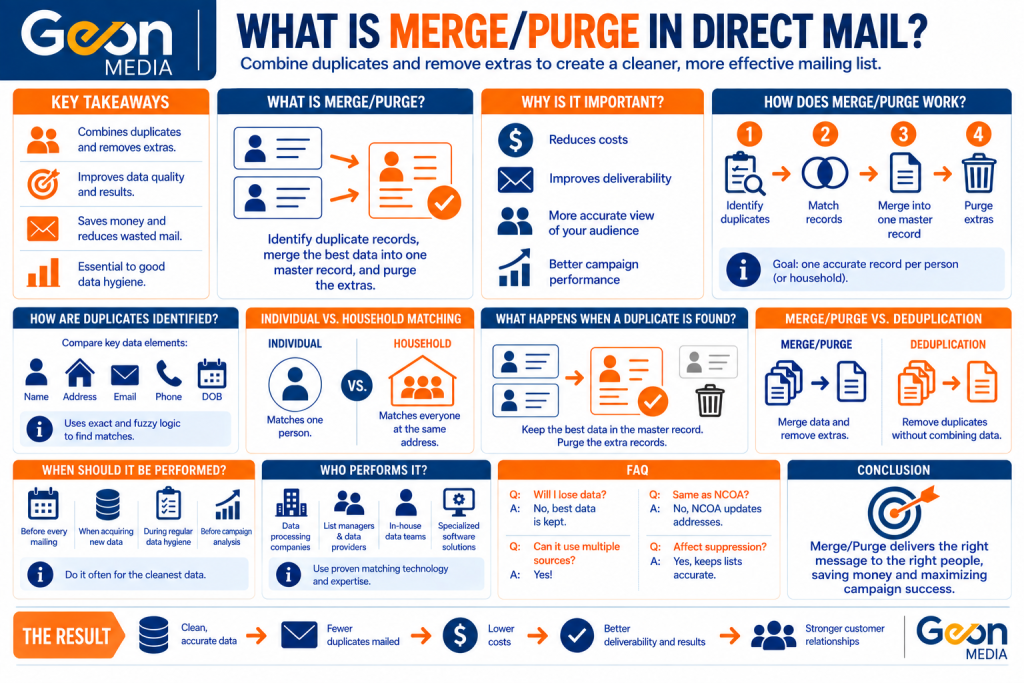
Key Takeaways
- Merge/purge is the process of combining multiple mailing lists or data sources, finding the duplicate or overlapping records, and deciding which records should be retained or removed.
- Depending on whether the records are matched at an individual or household level, multiple people at a single address could either receive individual pieces of mail or be treated as a single household.
- Merge purge in direct mail should ideally be done before your mail has been printed, as any duplicate records can be identified and dealt with before any printing costs have been incurred.
- Merge purge in direct mail isn’t guaranteed to find every duplicate record, as its results depend on the data’s quality and the matching criteria that is being used for the merge/purge.
Introduction
Let’s say you’re getting a mailing list ready for a campaign, and you look at the mailing list and see two records for one person. What do you do? Is there more than one person with the same name at the same address? Performing a merge/purge on a mailing list can help to identify and eliminate the duplicate record before the pieces of mail are printed.
What Is Merge/Purge?
Merge/purge is the process of combining multiple mailing lists or data sources together and finding if there are multiple records that appear to belong to the same person, household, or company, which can then be dealt with according to the mailer’s wishes.
Merge: Combining the mailing lists or data sources.
Purge: Identifying any handling any duplicate records that so the same person isn’t sent multiple mail pieces unnecessarily.
Why Is Merge Purge in Direct Mail Important?
Merge/purge should be a part of a mailer’s larger data hygiene strategy. If a mailer doesn’t merge/purge their mailing list or data source, they could end up having:
- Multiple mail pieces addressed to the same person
- Unnecessary printing and postage expenses
- Negative experiences had by recipients who receive multiple copies of the same piece of mail
- Inflated mailing quantities
If you have three mailing lists that you’re using for a direct mail campaign, the same person could be in all three mailing lists. It’s important to use merge/purge to help identify and potentially remove the duplicate records.
How Does Merge/Purge Work?
There are five main steps to merge/purge.
- The mailing lists or data sources that the mailer is using are combined together.
- The records in the mailing lists or data sources are compared to identify any potential duplicate records.
- The matches that meet the mailer’s criteria for being a duplicate record are identified.
- The mailer decides which records should be retained, and which records should be either removed or otherwise handled.
- The final mailing file that consists of multiple mailing lists or data sources is finished.
How Are Duplicate Records Identified?
Duplicate records don’t have to an exact word for word match, they could be determined to be a match by various pieces of information. What is considered to be a duplicate depends on the matching rules that are used, which might compare information such as the address, first and last name, or other available data. The records in the file should be standardized, which can assist in the process of finding the records once they are uniform. While merge/purge is helpful, duplicate records could still survive the process. The results are going to depend on the initial quality of the data and the matching rules that are being used for the merge/purge.
Individual and Household Matching
One of the most important matching rules of merge/purge is individual vs. household matching. This rule determines if the mailer would like to treat each qualifying individual separately or potentially only send one mail piece to a household.
Individual Matching
Individual matching in a list does not remove individuals at the same address from receiving a mail piece, assuming they fit the other criteria to be mailed to in the first place.
Household Matching
Household matching in a list multiple people from the same address might be treated as a single household for the mailing. So instead of every person receiving a mail piece, the address will receive one mail piece in total.
Example
If you have two people:
Homer Simpson | 742 Evergreen Terrace
Marge Simpson | 742 Evergreen Terrace
If Homer and Marge both qualify to receive a mail piece based on the campaign’s defined target audience, they could each receive a mail piece if you do individual matching. If the campaign manager decides to mail using household matching, only one mail piece would be sent.
Which Is Better?
There isn’t one matching level that is better than the other. It depends on your campaign’s goals, industry that you’re in, offer, and other factors.
What Happens When a Duplicate Is Found?
If two records are found that the mailer deems to be the same person, which record is kept? There isn’t a universal way to deal with duplicate records, and it depends on what the mailer wants to do. If one record is found in a company’s house file and appears again in a prospect mailing list, the mailer might choose not to mail to that person because their offer is targeted towards new prospects. Finding the duplicate record and deciding what to do with it are two different processes.
Merge/Purge vs. Deduplication
Merge/purge and deduplication are closely related terms, although they are somewhat different processes.
Deduplication is a broad term that means identifying and dealing with records that are considered to be duplicates.
Merge/purge refers to the process of combining multiple mailing lists or data sources and then identifying and dealing with records that are overlapping.
If you have one database that is being analyzed to remove any duplicate records, that would probably be described as deduplication. If you have three sources of information that are being combined and have duplicates removed, that would probably be merge/purge.
When Should Merge/Purge Be Performed?
Merge/purge should ideally be done before the mail has been produced. It could be a costly mistake to produce your mail pieces and only then realize that some of your recipients have had multiple pieces of mail created and addressed to them.
Note that merge/purge shouldn’t be the only piece of data hygiene that is performed to get a mailing list ready for production. Other pieces of data hygiene that should be considered include NCOA, CASS certified address processing, and DPV.
Who Performs Merge/Purge?
Depending on how your campaign is being handled, merge/purge could be performed by the mailer, mailing list owners, or lettershops/mail-service providers.
FAQ
- Q: Is performing merge/purge the same as taking duplicate records out of a list?
- A: They’re not entirely the same. While removing any records that are in a list multiple times is a part of merge/purge, another part is combining the multiple mailing lists or data sources and identifying if they have any overlap.
- Q: Is merge/purge perfect at identifying every duplicate record?
- A: No. There are other variables that matter that can help when doing a merge/purge on a list. Data quality and matching criteria both matter as well. If the mailing data has any outdated, missing, incorrect, or inconsistent information, identifying the duplicate records could becomes less reliable.
- Q: Does merge/purge verify mailing addresses?
- A: No, merge/purge can’t verify mailing addresses. If you’re looking for verification and standardization, those are two different topics. Read Geon’s article on address verification and address standardization here.
- Q: If two people live at the same address, is that considered a duplicate?
- A: It depends on whether individual or household matching is being used. In individual matching, they would not be considered to be duplicates, as that counts every person individually. If you’re doing household matching, since that counts one person per address, they would be considered duplicates.
Conclusion
If someone appears more than once in a direct mailing list, it would be a waste of money addressing, printing, and mailing them more than one piece of mail that could have gone to somebody else. To prevent this, mailers should use merge/purge as a part of their greater data hygiene strategy.
If you’re needing assistance with merge/purge, data cleaning, or maintaining a database or mailing list, contact Geon today. We would love to help.
Return to Mailing List Fundamentals, or browse Geon’s Learning Center.
Recent Comments