
How to Define Your Target Customer
Key Takeaways
- Defining your customer starts with analyzing the best customers that you have in your database and focusing on their shared traits.
- Your definition of a perfect customer is going to shift around as time passes, so be sure to keep updating who your ideal customer is.
Introduction
The days of sending the same mail piece to everyone are over. As the cost of printing and postage continue to rise, maximizing the return on investment for your campaign starts with identifying exactly who should receive your mail piece. Since competition for your customers is higher than ever, it’s never been more important to have a good idea who your customer base is.
Trying to define your target customer is the beginning to every successful direct mail campaign. This definition is so important that it can often determine whether your campaign succeeds or fails. For example, a company sending out a notice about a new stock market investment opportunity probably isn’t going to want to send out the mail piece to someone who doesn’t have any investing experience. With that in mind, how do you find out who exactly how to define your target customer, and find who your target audience is?
How to Define Your Target Customer
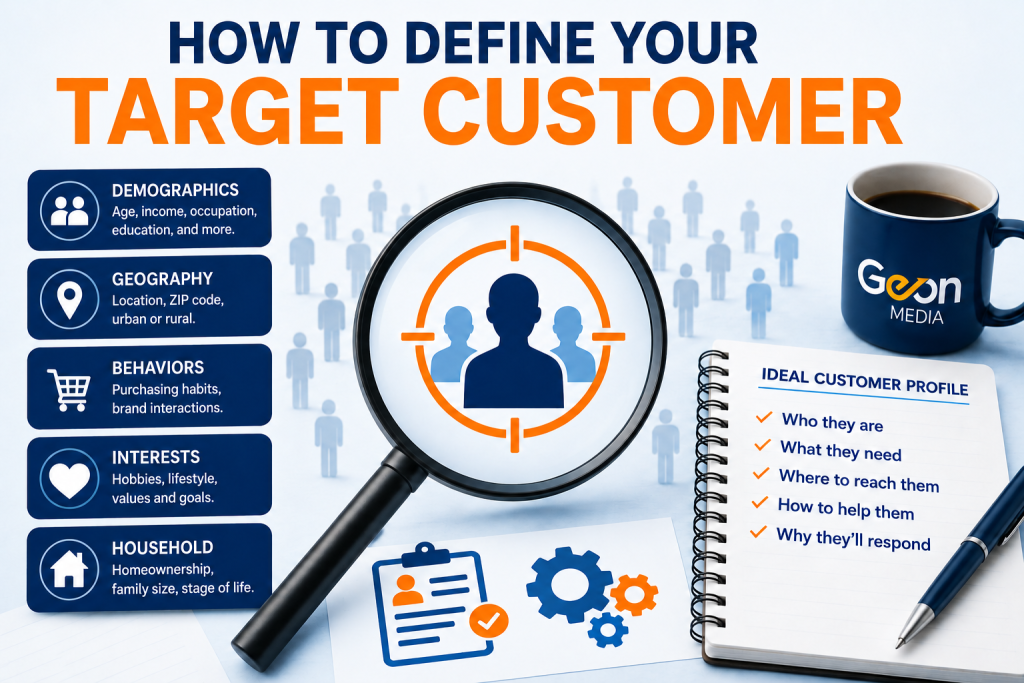
The best place to start when asking how to define your target customer is with analyzing your current customer base. Start with finding their shared characteristics and traits, as well as looking at patterns that they might have, such as having a shared:
- Age
- Income
- Occupation
- Interests
- Purchasing behavior
- Geographic location
- Homeownership
If there is a similarity between your customer base with any of these examples, that is something that should be worth noting. By finding these similarities, you can mold your campaign’s mail piece and offer around these values, which can be a fantastic way to define your target customer. For information regarding how to find lists of these individuals with shared characteristics, Geon’s article regarding mailing lists provides more information.
Think About the Problem, Not About the Product
It is easy to focus your thinking around the product that you are trying to perfect. It’s easy to think that, if you have the perfect product and offer on your mail piece, customers would naturally buy it. However, successful marketers will often think about the problem first. For example, a mail piece that is formed around an offer for debt consolidation would help individuals reduce or eliminate their debt. A webinar offering an investment opportunity gives a solution to consumers that are wanting to invest their finances somewhere. If the mail piece that is being given solves an issue for your target audience base, you’re more likely to get good engagement.
Avoid Being Too Broad, As Well As Too Specific
One of the biggest mistakes that campaign managers make when trying to define your target audience is targeting an audience that is too broad. Let’s use an example of a campaign trying to offer financial aid for schooling to parents that have children. It might make sense to target any and all parents. However, targeting parents that make a lot of money might be a waste of postage, since they might not need the financial aid.
At the same time, being too specific on your trying to define your target customer is also a bad idea. If you’re targeting individuals who enjoy going on vacations where they enjoy skiing, are within 45 to 50 years old, are in a specific income bracket, with four kids, you might find a mailing list count with a big enough total universe to accommodate your request. By finding that perfect combination of not being too vague and not too specific, you can define your target customer, as well as finding the audience that is most likely to engage with your offer.
A common error that mailers have is assuming that your ideal customer is “everybody”. Even products with a more broad appeal tend to perform better when they’re marketed to a specific audience. Defining who your customer base is doesn’t mean you’re excluding any potential customers, it just means that you’re using your campaign’s budget on people who are the most likely to respond.
FAQ
- Q: Is my audience going to always stay the same?
- A: No, your audience is going to evolve over time. Markets are going to change, customers’ needs evolve, and economic conditions are going to shift over time. It’s always a good idea to continually make sure that your audience is who you think they are.
- Q: I’m still unsure about what traits my audience have in common.
- A: No worries. Contact Geon here, and we would be happy to help with defining your ideal customer, and building a targeted audience!
- Q: I don’t have any existing customers. What should I do?
- A: If you don’t have a customer base yet, that could make trying to define your target customer much more difficult. Start by thinking about the type of consumer that would benefit from your product or service the most. Then, identify the characteristics that those people are likely to have in common.
Conclusion
When trying to define your target customer, knowing your customer base and all of their values, wants, needs, and more is the best way to get a prospective campaign to succeed. By solving the problem that that group of people has with your offer, the odds of a smooth campaign goes much higher. The better you are at understanding your customers’ needs, the better you’ll be at creating offers that resonate with them. In fact, you might just identify problems that they haven’t even realized they need to solve.
Return to Define Your Customer & Build Your Audience, or browse Geon’s Learning Center.
Recent Comments