
What Are the Basics of Direct Mail Design?
Key Takeaways
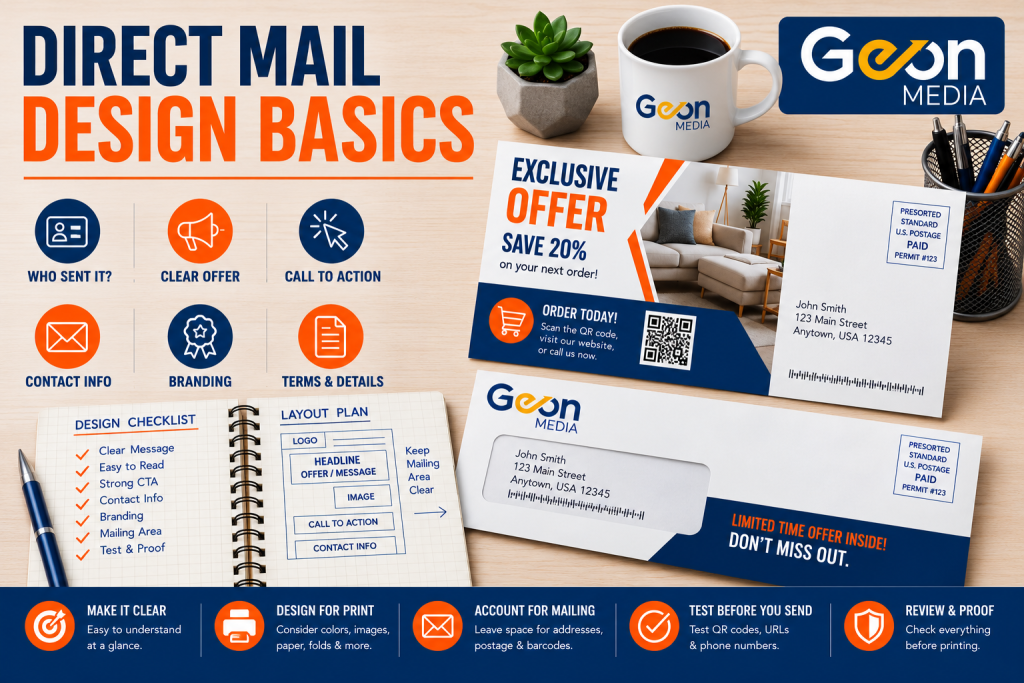
- Your direct mail piece should make it easy for your recipient to understand who sent the mail, what is being offered to them, and what action they should take if they want to claim the offer.
- The decisions that you make with your design need to account for the type and size of the mail piece, what the USPS requirements are, and how the mail piece will look when it’s printed.
Introduction
When designing your mail piece, it might be tempting to make the most contrasting, colorful, interesting design that you can in order to catch the consumer’s attention. But is that the best idea to get someone to engage with your mail piece? After all, your mail piece isn’t just being designed to look good, it’s there to catch the recipient’s attention while also clearly communicating your offer or message. There are several basics of direct mail design that need to be considered, as well as some common mistakes that can create some problems when your design is printed and mailed.
What Should a Direct Mail Piece Include?
There are several pieces of information that your direct mail piece should include, such as:
- Company/organization identification
- A clear offer or message
- Call to action
- Information to contact you or respond
- Branding
- Any needed disclaimers or offer terms
Keep the Main Message and Call to Action Clear and Easy to Find
With your mail piece, the message that you have for the consumer should be clear and to the point, as well as making your call to action (QR code, phone number, website URL, etc.) easy to identify. Everybody has seen either a print or video advertisement that hadn’t made very much sense to them. This could be due to a failure to convey the message that the advertiser wants to get across, or so much going on that the message gets lost.
Make sure that your mail piece and call to action is easy to understand, otherwise the money and time that you’ve spent getting the consumer your message could be wasted. As a test, show someone unrelated to your company your mail piece and ask them:
- Who sent this?
- What’s the offer/call to action?
- Why should I care about this?
- What do I need to do next?
Doing this early on in the design process can help identify any missing or confusing messaging before significant time, effort, or money has been spent producing your mail piece.
Design for the Mail Format
For your mail piece, do you want to use a postcard or an envelope? There are pros and cons to both mediums. Postcards have very limited space but are more visible due to not needing to open an envelope to view the contents. On the other hand, envelopes can hold more information, but the consumer needs to actually open the envelope’s seal to view the contents.
Don’t Forget the Mailing Area
Depending on the type of mailing class and mail piece that is chosen, your design might need to account for areas that are used for the recipient’s address, postage or indica, postal markings or barcodes, and a return address, if applicable. Planning in advance for these elements before the design has been finalized can help to prevent important parts of your creative from being disrupted during postal preparation.
Review Your Design Before Printing
One of the basics of direct mail design is making sure that you review your mail piece before it’s sent to full production. Catching problems such as incorrect dimensions, having insufficient space for postal elements, printing limitations, or running into production issues before thousands of pieces of mail are printed can help to prevent an expensive mistake. If you’re working directly with a lettershop for your direct mail campaign, having them review the planned mail piece before it’s printed can also help to identify any potential production or postal-preparation issues.
Common Mistakes
Consider How the Design Will Look When Printed
What looks fine on a computer might not translate to being a good design when printed out. Some of the common printing errors that could occur for your campaign include:
- Incorrect dimensions
- Colors bleeding
- Low resolution images or graphics
- Chosen paper stock not working with the design
- Important elements of your design falling on or near a fold
- A design that doesn’t accommodate any planned personalization
Test Your Response Mechanism
If you have a response mechanism attached to your mail piece, make sure that the chosen medium is functional before your campaign launches. For example, if you have a QR code, scan it to ensure that your response or visit to the website is registered. If you have a tracked phone number, call it to ensure that your information is documented. While testing the functionality of a response mechanism might seem obvious, it’s an easy step to overlook before your campaign launches.
Other Common Mistakes
There are other basics of direct mail design that can help catch common mistakes if followed, including:
- Having too much information on your mail piece
- Having an unclear offer
- Having a weak or no call to action
- Difficult to locate contact information
- Poor readability
- Sending the mail piece to print without doing a final proof
- Designing without considering postal requirements
FAQ
- Q: Does my mail piece need to have a call to action?
- A: Not every direct mail piece has to ask for an immediate response, especially if your campaign’s goal is to provide information or awareness. However, if you are wanting the recipient to take a specific action, then what this action is and how to complete it should be easy to find.
- Q: Is designing an envelope a different process than designing a postcard?
- A: Yes, for several reasons. For example, with a postcard having its information on one piece of paper that is immediately visible to the consumer, you’re able to do a different design on that when compared to an envelope, which needs to be opened.
- Q: What response mechanism should I use for my campaign?
- A: There isn’t a universal correct answer when it comes to response mechanisms. Which medium is chosen should be decided on a campaign-by-campaign basis.
Conclusion
There are several basics of direct mail design that need to be considered when designing a mail piece. A successful design has to communicate its message clearly while simultaneously accounting for the mail piece’s format, printing process, response mechanism, and postal requirements. Reviewing your design and following these basics of direct mail design before the production and testing functionally of your response mechanism can help to ensure what looks good on a computer can translate successfully to your completed mail piece.
New to Direct Mail?
Are you running your first direct mail campaign?
Read Geon’s beginner’s guide for to direct mail here.
Return to Preparing Your Mail, or browse Geon’s Learning Center.
Recent Comments