
What Is Cost Per Acquisition in Direct Mail?
Key Takeaways
- While your cost per acquisition in direct mail is an important metric, it shouldn’t be used by itself in identifying if your mail campaign was a success.
- Your cost per acquisition is how much it costs to acquire a new customer from your direct mail campaign.
Introduction
One of the metrics that is important to utilize when analyzing your direct mail campaign is your cost per acquisition (CPA). Your CPA is used to determine how much it cost you for every new customer from your direct mail campaign. Just like other metrics that are used when you’re analyzing your campaign, your CPA should be used in conjunction with the rest of them, as a high CPA doesn’t necessarily mean that your campaign was a success by itself.
What Is Cost Per Acquisition in Direct Mail?
Cost per acquisition measures what the average campaign cost is to acquire every new customer that was attributed to your direct mail campaign. If you have done previous campaigns, this number can be used in comparison to those to help get a better idea of how your campaign has performed and can be used to compare against campaigns that you’ll run in the future.
How Do I Calculate Cost Per Acquisition in Direct Mail?
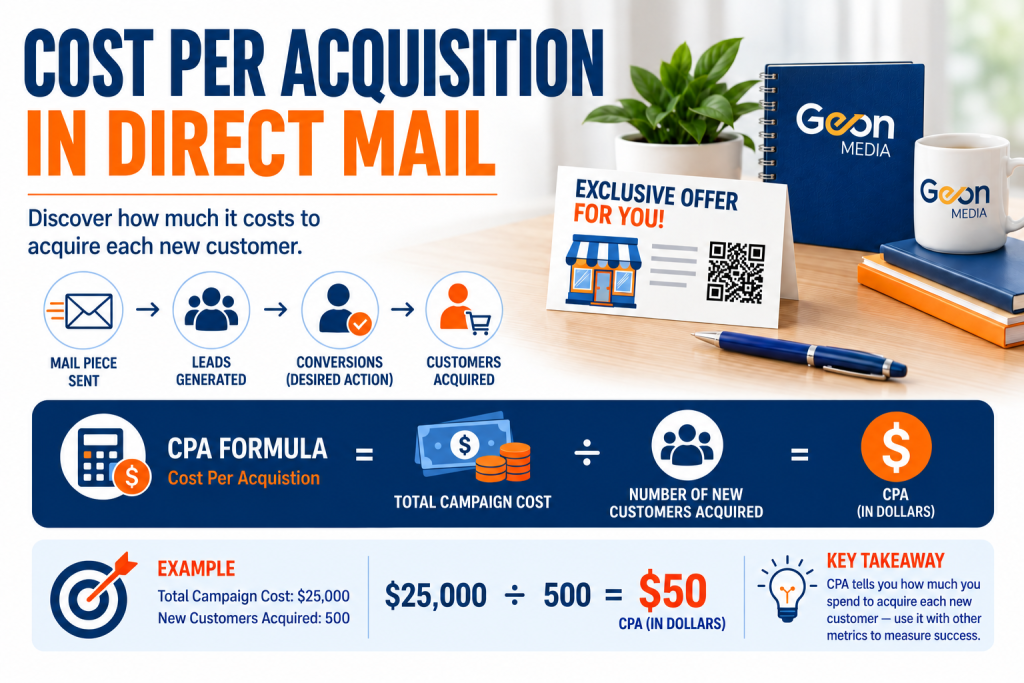
Your CPA is calculated by the following: total campaign cost ÷ total number of new customers = CPA (in dollars). As an example, let’s say I ran a campaign that accrued costs totaling $25,000, and I gained 500 new customers from that campaign. If I’m to follow my formula, that would mean that I would divide my campaign cost, $25,000, by my new customers, 500, which would make my CPA $50. So, that means that I spent $50 on acquiring every new customer that I gained through that campaign.
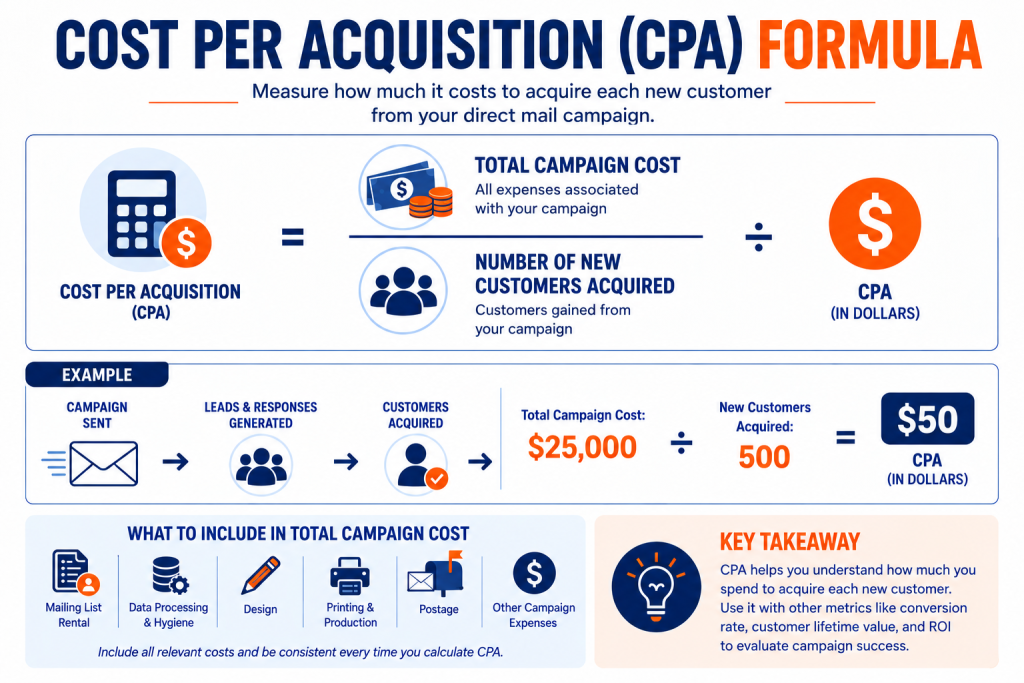
When calculating your cost per acquisition in direct mail, every cost that you had when you did your campaign should be included in your total campaign costs. Your campaign costs might include expenses such as mailing list rental, data processing, design, printing, production, and postage. While some companies might choose to calculate their CPA differently than others, the important thing is that you’re consistent with the costs that are included in your campaign costs. If you include one expense in your campaign costs for one campaign but exclude it from the next, your CPA won’t be comparable.
Is a Lower Cost Per Acquisition in Direct Mail Always Better?
As with other metrics, having a lower CPA doesn’t automatically mean that your campaign was more of a success than a campaign that had a higher CPA. For example, let’s say that Campaign A had a CPA of $1,000, whereas Campaign B had a CPA of $250. However, the customers from Campaign A will bring a lifetime value of $2,500, whereas Campaign B’s customers will only bring in $300. Even though Campaign A in this example had a significantly higher CPA, the high CPA could be justified by the greater value of the customer than their campaign had generated.
What Is a Good Cost Per Acquisition in Direct Mail?
There isn’t a universal “good” CPA. Depending on the industry that you’re in, method of calculating your total campaign expenses, company, and more, what could be considered a successful CPA for one company might be considered a failure for another. A company’s margins, average purchase value, customer lifetime value, and campaign goals can all contribute to how much they can afford to spend to acquire a new customer.
How Can I Lower My Cost Per Acquisition in Direct Mail?
There are several ways to lower your CPA. Using methods such as:
- Having clean data to reduce inaccurate mailings
- A/B testing
- Improving your conversion rate
- Mailing list testing
- Redefining your target customer base
FAQ
- Q: If my cost per acquisition in direct mail was low, does that mean that my campaign was successful?
- A: No. Just because your CPA was low, that doesn’t mean your campaign was successful. Other metrics need to be considered as well, such as your cost per lead, your lifetime customer value, return on investment, and more.
- Q: Why do I need to calculate my cost per acquisition in direct mail the same every time I conduct a campaign?
- A: If you aren’t consistent with the way that you calculate your CPA, then one campaign is going to have less of an overall cost of the total campaign, due to an expense being omitted, while another campaign will have an inflated campaign cost due to that cost being present. If you don’t have consistent methods with the way that your CPA is calculated, it becomes a difficult task to find what your actual CPA is.
Conclusion
Calculating what your cost per acquisition is on a consistent basis can help campaign managers understand how much they’re spending on acquiring every new customer and compare that cost across several different campaigns. While the CPA is an important metric, it shouldn’t be analyzed just by itself. The campaign’s conversion rate, customer lifetime value, revenue, and return on investment are all metrics that can help to provide additional context about whether a campaign was ultimately successful or not.
New to Direct Mail?
Are you running your first direct mail campaign?
Read Geon’s beginner’s guide for to direct mail here.
Return to Analyzing Your Campaign Results, or browse Geon’s Learning Center.
Recent Comments