
How Often Should I Mail?
Key Takeaways
- There isn’t a universal “correct” frequency that a mailer should mail, it all depends on the company, industry, and the purpose of the mailing campaign.
- Analyzing campaign results over time can help to determine whether a mailing frequency is working, or whether it could be worth considering testing a different schedule.
Introduction
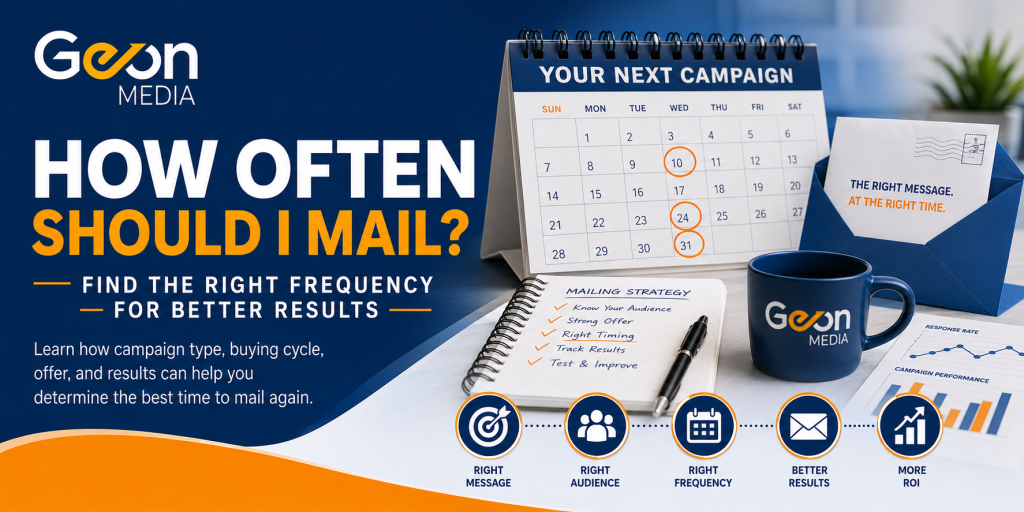
After completing analyzing the results from a direct mail campaign, the next step is to start planning your next campaign. But, ask yourself this: how often should I mail? If you are too quick to launch your next campaign, there’s a chance that your recipients won’t respond due to experiencing burn out from your first campaign. But, if you wait too long, you could miss out on revenue from the campaign. Is there a way to find the sweet spot on how long you should be waiting before sending out another mail piece?
Unfortunately, there isn’t a universal “one-size-fits-all” time period that you should wait until sending out your next campaign. There are several variables that go into deciding when to send out your next campaign and understanding how to test these variables and knowing why they’re important can help wash doubt away of when to mail again.
Variables to Consider When Mailing
There are two main variables that should be considered when asking yourself how often should I mail? The first of these is the type of campaign that is being ran, and the offer that is on the mail piece.
There is a difference between a campaign that is designed to sell a product or service and a campaign that is just designed to get your company’s name out to the public, otherwise known as a prospective vs. retention campaign. A prospecting campaign, customer retention campaign, seasonal promotion, new product announcement, and general brand awareness campaign might call for having different mailing schedules. Ask yourself why you’re contacting the consumer and think whether another mail piece provides enough value to justify contacting them again.
The second variable is the buying cycle of the consumer in the industry that your company is in. For example, a customer is naturally going to purchase from a coffee shop on a more frequent basis than a company that does carpet cleaning. This isn’t a bad thing, and neither frequency is right or wrong; they just reflect a completely different customer buying cycle. Because of this, a coffee shop is going to be able to mail on a more frequent basis than the carpet cleaner.
Watch Your Campaign Results
One of the best ways to determine how often should I mail is to track the results of your mailing campaign over a period of time. Average response rates, conversions, sales, and other campaign metrics can show whether your current mailing schedule is working, or if it needs to be changed. Testing different mailing frequencies can also provide useful information, especially if the other parts of the campaign remain relatively consistent. However, campaign performance can also be impacted by many other factors, so frequency shouldn’t be evaluated in total isolation. Read more about how to use test results to improve your next campaign’s response here.
Frequency Doesn’t Mean Volume
Sending out mail pieces at a different volume should also be avoided if testing how often should I mail. Mailing frequency describes how often how often a mailer contacts an audience, whereas mailing volume describes how many pieces of mail are sent. A company that mails out 100,000 pieces of mail once every quarter is going to have a different frequency strategy than a company that mails 10,000 pieces every month. When trying to evaluate changes in mailing frequency, compare your response rate and other performance metric rather solely relying only on the total number of responses.
Can I Mail the Same Person More Than Once? How Often Should I Mail to the Same Person?
Yes, you can mail to the same person multiple times, but you should be careful with doing this. As mentioned, if you mail on too frequent of a basis, subsequent mailings are going to become less effective. Analyze your average customer and how often they purchase from you and then decide if you should mail to the same person based on that.
When Should I Change My Mailing Frequency?
If you’re noticing that sales and response rates are on a downward slump, it might be time to change what your mailing frequency is. However, just because one or two campaigns produce diminishing results from the campaign before, that doesn’t automatically mean that you should change your strategy. Some campaigns are going to not do as well as you would like. Look at the results of multiple campaigns before coming to a conclusion that mailing frequency is responsible for the drop of performance. A single campaign might underperform for several different reasons that are unrelated to how recently the audience had been previously mailed.
FAQ
- Q: Why can some businesses mail more frequently than others?
- A: The industry that a business is in has a big impact on how frequently they’re able to mail. Some industries have a higher customer purchase rate than others, so they’re able to mail more frequently.
- Q: Are there any external factors that could impact a campaign’s performance?
- A: Yes, how the economy as a whole is doing can impact a campaign’s performance positively or negatively, without there being any fault of the mailer. Another factor can be the mailing list that is being used. If your results have started to decline across several mailing campaigns, the mailer can evaluate the mailing list along with their offer, creative, timing, frequency, and other variables to determine what might have changed. If you’re thinking about changing to another mailing list, read this first. For information on how to select a mailing list if you do decide to change, read Geon’s article on how to choose the correct mailing list, and what makes a good mailing list.
- Q: Is mailing frequently always better?
- A: No. Increasing mailing frequency gives you more opportunities to reach your audience, but it also can increase your campaign cost and doesn’t guarantee that you’ll have additional responses. What the appropriate mailing frequency is depends on factors, including the audience, buying cycle, your campaign’s budget, and previous campaign results.
Conclusion
When asking yourself how often should I mail, there isn’t a universal mailing frequency that is going to work for every direct mail campaign. What the appropriate schedule is depends on your audience, industry, offer, campaign goals, buying cycle, previous campaign results, and more. By tracking your campaign’s performance over several campaigns and testing different schedules, campaign managers can make the most informed decision on when it makes the most sense to mail again.
New to Direct Mail?
Are you running your first direct mail campaign?
Read Geon’s beginner’s guide for to direct mail here.
Return to Improve Your Next Campaign, or browse Geon’s Learning Center.
Recent Comments