
What Is a Direct Mail Response Rate?

Key Takeaways
- A direct mail response rate is the percentage of consumers who responded to the mail piece that was sent to them as part of a direct mailing campaign.
- There isn’t an exact number that makes for a “good” response rate, it depends on the industry, offer, and campaign.
What is a Direct Mail Response Rate?
A response rate is defined as the percentage of consumers who responded to the mail piece that was sent to them as part of a direct mailing campaign. Because every campaign is going to have different goals, there isn’t a single, universal definition of what counts as a response. For example, a mail piece that has a QR code attached to it would have its’ response being the consumer scanning the QR code. A mail piece that has a phone number attached to it to claim an offer would have its’ response being the consumer calling the store.
Because there isn’t one guaranteed way to measure what a response is, the response rate for a campaign is going to vary from one campaign to the next. During the planning phase of getting your mail piece together, it’s important to put a clear definition of what the direct mail response rate is going to be. Is it going to be the number of people that call your phone number, or the number who fill out a reply form? Or the number of website hits you get during your campaign? There isn’t a right or wrong way to measure response rate.
How is a Direct Mail Response Rate Calculated?
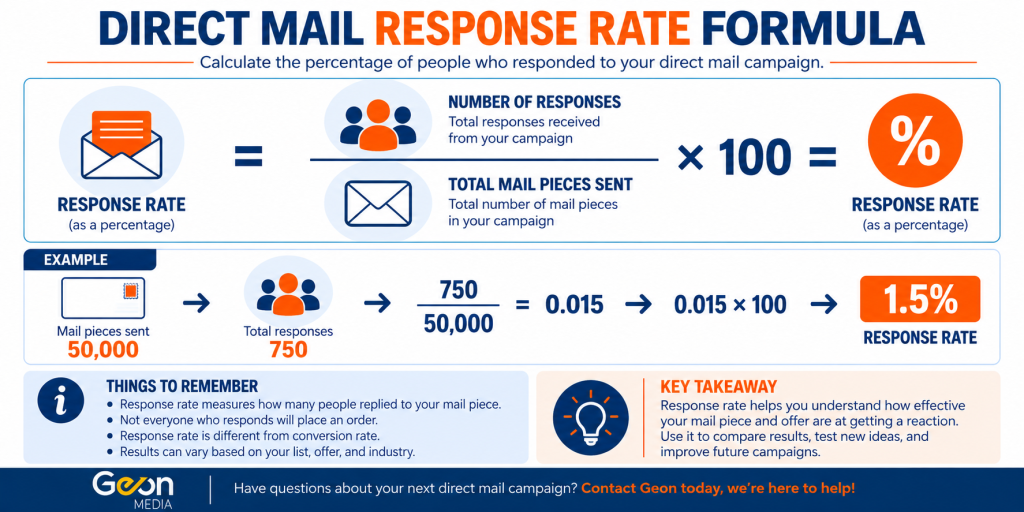
A direct mail response rate is calculated by finding the number of responses you got from your campaign and dividing that number by the total number of mail pieces that you sent out. As an example, let’s say you sent out 50,000 total mail pieces for your campaign. After you’ve collected the responses from your campaign, you have 750 total responses. By taking the responses you got, which is 750, and dividing that by your total pieces of mail that were sent out, 50,000, you see that you have a response rate of 1.5%. This does not mean that those 750 people are all going to order, as that would be the conversion rate.
750 ÷ 50,000 = 0.015
0.015 x 100 = 1.5% response rate
What is a Good Direct Mail Response Rate?
There isn’t a universal “good” response rate when it comes to direct mail. Typically, a successful response rate will provide a positive return on your marketing investment. A mail piece that is sent to existing customers might receive a higher response rate when compared to a cold prospect. The quality of your offer and how well your audience is targeted can have a significant impact on your response rate as well.
What Positively or Negatively Impacts Response Rates?
There are several things that can have an impact on your campaign’s response rate. First, whether or not you are sending an offer to an existing customer of yours could have a positive impact on your response rate. If you already have a positive working relationship with a customer, that could significantly increase the likelihood that they are going to order again. Another big factor is the purpose of the mailing campaign. Is the campaign that you’re running designed to generate leads and get your name in potential customers’ minds, or are you trying to get sales, donations, or subscriptions?
The last big impact that could impact your direct mail response rate is how targeted your audience is. As an example, say you’re trying to sell a new brand of lactose free ice cream to consumers. If you were to find a mailing list that has exclusively individuals who can’t eat traditional ice cream, that mailing list would likely outperform a broader consumer mailing list, due to the audience being aligned much closer with the offer. For more information on how to choose a mailing list that is best for you and your campaign, learn more about that here.
Response Rate vs. Conversion Rate
One of the common mistakes that individuals have about direct mail response rates is getting them confused with conversion rates. While the two are very similar, they measure completely different things.
Your conversion rate is the number of people who have already responded to your campaign who have then completed the target action of the mailing campaign. Taking the example from earlier with having a response rate of 750 people, let’s say that 75 of them then proceeded to sign up for the subscription advertised on the mail piece, or have purchased the advertised product. That would mean that your conversion rate is 10%, after dividing the total number of people who completed the subscription sign up, 75, by the response rate, 750. Knowing when to use a response rate and conversion rate can change the trajectory of a mailing campaign.
75 ÷ 750 = 0.10
0.10 x 100 = 10% conversion rate
| Metric | Measures |
|---|---|
| Response Rate | How many people responded |
| Conversion Rate | How many people completed the desired action |
FAQ
- Q: Do specific industries have a higher or lower direct mail response rate on their mail pieces?
- A: Yes, some industries are going to have a higher or lower response rate depending on the field they’re in. An industry broadly appealing to a wide consumer base is going to have a lower response rate than an industry that is smaller and more niche, without as much competition.
- Q: Does a lower direct mail response rate mean a campaign was a failure?
- A: Not necessarily. Some mailing campaigns might have a higher profit per sale than other campaigns, so it just comes down to whether or not a campaign’s goals hit sales/interaction goals.
- Q: Do different types of mail pieces have different response rates?
- A: They can. Postcards might have a different response rate than envelopes, depending on the size, personalization, or offer that is on the actual mail piece. For more information on postcards and envelopes, and the pros and cons that are attached to each, refer to Geon’s article here.
Conclusion
While it might seem difficult to define what a direct mail response rate is for your campaign, it isn’t a “one-size-fits-all” number. It is going to depend on your audience’s familiarity with your brand, the industry that your company is in, and the specificity of your target audience. Response rates are one of the most simple ways to measure how well a direct mail campaign has performed. While there might not be a universal threshold for success, understanding what impacts a response rate positively or negatively can help improve future campaigns and make better overall marketing decisions. If you have any questions about planning or measuring a direct mail campaign, Geon is here to help.
Return to Analyzing Your Campaign Results, or browse Geon’s Learning Center.
Recent Comments