
Compiled vs. Response Mailing Lists
Key Takeaways
- Whether you choose a compiled or a response list depends on your budget, need for a specialized, niche audience, and the amount of mail pieces that are being sent out.
- The main difference between the two lists is the way that the information was gathered.
Introduction
Once a campaign manager has their mail piece created, the next decision is based on this question: what are the differences between compiled vs. response mailing lists? With tens of thousands of mailing lists online, choosing a list can be easier said than done. There is one big decision that can help with this task – deciding between a compiled mailing list, or a response mailing list. While there are other categories of mailing lists (see Geon’s article on consumer mailing lists and business mailing lists here), asking yourself this question can make finding the correct mailing list easier.
Depending on the type of mailing campaign and mail piece that you might have, one type of list might be a better answer than the other. In order to filter out the incorrect type of mailing list, asking yourself these questions can help with making sure that you’re making the most informed, educated decision on choosing between compiled vs. response mailing lists.
What are the Main Differences When Looking at Compiled vs. Response Mailing Lists?
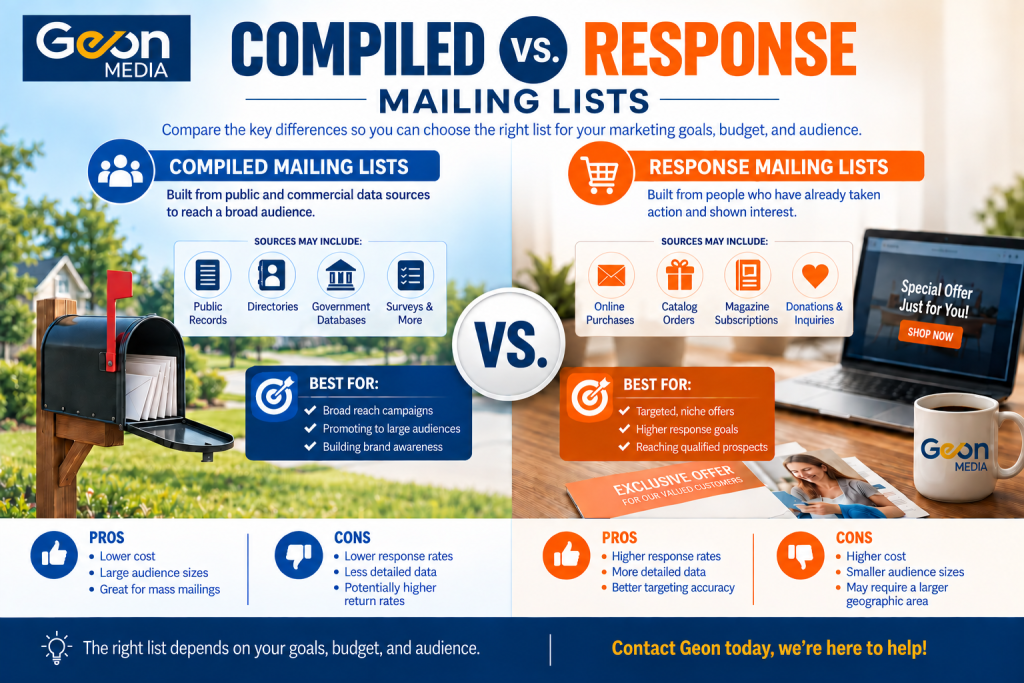
When looking at compiled vs. response mailing lists, the main difference between the two is the way that the lists’ information was gathered. Compiled mailing lists are typically gathered and obtained through easy to access, public databases. Compiled mailing lists get their information from phone books, online government records, directories, Yellow Pages, etc. The information on these consumer mailing lists are typically pretty surface level, typically just containing name, address, phone number, zip code, city, and state.
When it comes to response mailing lists on the other hand, the information is usually a lot more detailed. Response mailing lists usually come from catalogs, online purchases, and any other place that you have given information to. This data is then purchased by companies who compile all of the data together, package it, and sell it to list makers. The list makers will then create mailing lists based on individuals who all have a specific set of traits in common. As mentioned, the information on these lists is usually much more in depth than consumer lists, due to the effort that goes into putting a lot of data points together about every individual person.
What are the Pros and Cons When Looking at Compiled vs. Response Mailing Lists?
Pros to Compiled Mailing Lists:
- Usually cheaper to use.
- Easy to use for getting a mail piece to as many people as possible in a given area.
- Has a much larger overall count.
Cons to Compiled Mailing Lists:
- Has a much lower response rate, due to less targeted mailing.
- Could have a higher return to sender rate, due to the list being less information being sourced.
Pros to Response Mailing Lists:
- Higher response rate, as the individuals receiving the mail piece have engaged with a similar offer previously.
- Better quality names, due to the advanced, concentrated targeting for the names.
Cons to Response Mailing Lists:
- Significantly more expensive than compiled mailing lists.
- A more detailed offer or mail piece is needed.
- A larger area needs to be utilized to find individuals that fit the mail campaign’s target audience.
- Usually has a smaller overall count.
Should I Choose a Compiled or Response Mailing List for My Campaign?
There isn’t a clear-cut way to say whether or not one type is going to be better than the other for any given mailing campaign. One of the best ways to tell which is going to do better is seeing what product/offer is being set on the mail piece. If the product/offer is going to be something that appeals to the general public, that could mean that a compiled mailing list might fit the campaign better. An example of this would be a new coffee shop wanting to send out an offer regarding their grand opening, or a baby clothing company wanting to send an offer to expectant mothers.
If your mailing offer targets a niche, specific audience, it could be smart to seriously consider a responsive mailing list. If done correctly with a clear enough target audience, direct mail remains an effective channel for a company’s marketing front. Due to responsive mailing lists typically being able to closely hone in on individual interests and demographical data, it’s much easier to target the niche without sending the mail piece to the wrong audience. For example, a stockbroker advertising a new investing opportunity would want to exclusively target those who are interested in stocks and bonds and business opportunities, which could be found easier with a responsive mailing list. If you have any questions, your list manager or list broker will be able to assist. If you don’t know what a list manager or list broker is, check out Geon’s article here.
Are There Anything Other Aspects to Consider When Looking at Compiled vs. Response Mailing Lists?
Yes, there are a few other things to consider when making your decision on which type of mailing list to choose. Due to the significant amount of information about individuals on response mailing lists, they typically cost a bit more than regular compiled mailing lists. So, if your campaign’s budget is a bit on the smaller side for your mailing campaign, that could be something that is worth remembering. Most response mailing lists, again, due to their smaller audience that fits all of the data points to be in the more exclusive list, are smaller than compiled mailing lists. So, if you’re targeting a small, niche population, ensuring that there are enough people that fit in your target audience is important.
| Feature | Compiled | Response |
|---|---|---|
| Cost | Lower | Higher |
| Audience | Broader | More targeted |
| Source | Public & commercial data | Customer Actions |
| Typical Size | Larger | Smaller |
| Best For | Mass marketing | Niche campaigns |
| Accurate? | Yes | Yes |
FAQ
Q: Can I combine both compiled and response mailing lists for my campaign?
A: Sure. The main benefit of this is that you are getting as much information on the target audience as possible. If you combine both types of lists, you can know as much about the consumer as possible, which could impact your mail piece or offer.
Q: Is one type of list better than the other?
A: Not necessarily. Whether a list is considered to be “better” really comes down to answering that question on a campaign-by-campaign basis.
Q: I’m trying to find a mailing list that specifically fits my mail campaign, but I can’t find one. Are there any places to look?
A: Sometimes list managers are able to assist with creating a custom list for a campaign. If you have any questions, Geon can assist with this. Contact us here, and we would love to work with you!
Q: Can a mailing list be both consumer and response?
A: Sometimes, it can be both. As an example, a compiled list might then have response data added later in the process.
Conclusion
When looking at compiled vs. response mailing lists, knowing the differences between the two can make the process of organizing and managing a direct mail campaign much easier. By choosing a list that best fits your main demographic, you can have more peace of mind that your mail piece is going to the audience that will best respond to it.
Return to Mailing List Fundamentals, or browse Geon’s Learning Center.
Recent Comments