
Key Takeaways
- Privacy regulations and changes to the digital advertising industry have made audience targeting more challenging in some online channels.
- Direct mail has continued to provide strong engagement and can be complemented with digital marketing strategies.
- The shelf life of a physical mail piece is significantly higher than a digital piece.
Introduction
Does direct mail still work? Despite the growth of digital marketing, direct mail still works, and a large number of businesses continue to rely on it, due to the fact it still delivers measurable results and complements online advertising. Since the modern United States Postal Service was founded on July 1, 1971, some might say that the marketing through mail is outdated. When looking at physical mail, it might be easy to think that businesses that still use it are behind the times, without knowing how much direct mail still works.
Why Businesses Still Use Direct Mail
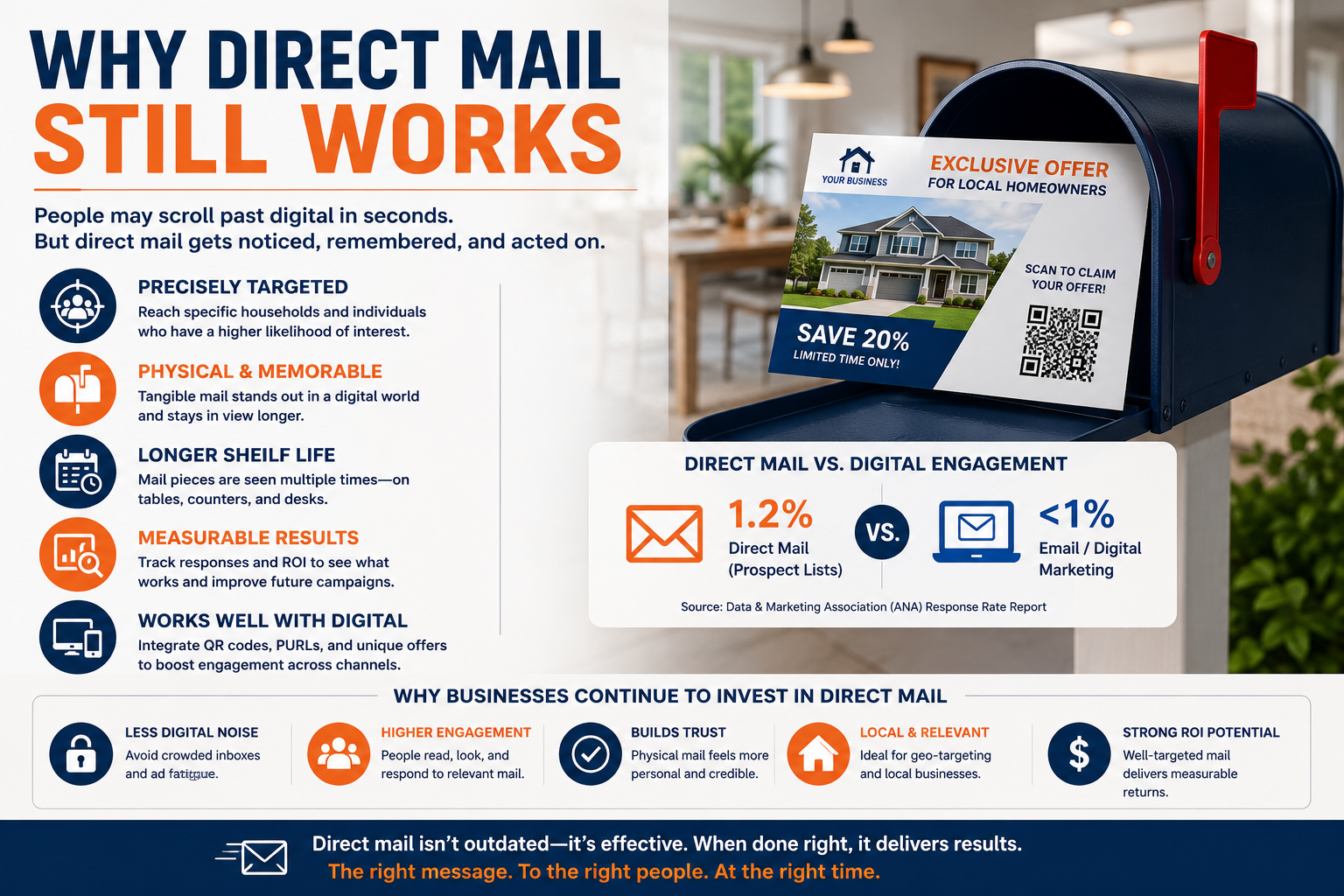
Companies still do direct mail for one main reason: it still works, and it works really well. Rather than replacing digital marketing, direct mail has evolved into one part of a broader marketing strategy for many organizations. According to the ANA’s response rate research, direct mail continues to produce measurable response rates for both prospect and house lists. With a physical product, there is a lot that you can do with it. By making a mail piece memorable, you can ensure that the mail piece remains in the recipient’s head. In contrast, online mail pieces have a much harder time making that impression. Unlike many digital advertisements that are scrolled past in a split second, a physical mail piece will often remain on a table, refrigerator, or kitchen counter, meaning that it has multiple opportunities to be seen.
Another big reason is the shelf life of a mail piece when compared to an online advertisement. Mail pieces are able to remain in a physical location, being able to be seen again and again. If the mail piece eventually ends up discarded, that still gives the recipient a knowledge of your brand, whereas a digital advertisement is only seen for a handful of seconds, if that.
Lastly, when sending out a mail piece, you’re not just sending mail out. You’re targeting individuals – homeowners, families, parents, travelers. You’re sending out something to consumers who have interacted with the industry before. With a digital mail piece, while they offer sophisticated targeting, direct mail still gives marketers greater control over who receives a physical mail piece.
Why Digital Marketing Hasn’t Replaced Direct Mail
According to the Data & Marketing Association’s data, direct mail has an engagement percentage of 1.2% for prospect lists, whereas email or digital marketing has an engagement percentage of less than 1%. As spam filters on emails or other platforms get more and more advanced, that under one percent number could get lower in the near future.
As online entities are being hit with more regulations on what types of data that can be collected, this could have a big impact on the online mail industry. Information is going to be harder to collect, which could make more niche, targeted response data could become more inaccurate (if you don’t know what a response mailing list is, check out Geon’s article on that here). With an uncertain future regarding what the industry might look like, many businesses have continued to invest in direct mail as part of a multichannel marketing strategy.
Is Direct Mail Definitively Better Than Digital Marketing?
No, it isn’t. In fact, instead of putting them against each other, they work best together and complement one another. Postcardmania.com states that, when digital and physical mail pieces are combined, mailers see a 447.8% increase in mail piece engagement than just a regular online mailing list. Mail pieces with a digital element, such as a QR code, personalized link, or an interactive offer online have reported higher engagement when compared to those without the multi-platformed approach. According to rocketprint.com, 97% of mailers who use a personalized element to their mail campaign saw a higher engagement rate when compared to a uniform, standard mail piece mass produced. By working in tandem, physical mail is able to get a boost to its’ success.
When Should Companies Consider Using Direct Mail?
When advertising more to a more niche, specified audience with a response mailing list, companies should consider using a physical mail piece. For a grand opening for a local business, by sending a tangible piece of mail, you can generate hype among the target demographic. As another example, home services such as home cleaners, painters, or roofers are able to know that those who receive the mail piece are individuals who live within a certain area that they service. By doing this, the mailer can be sure that those who need to see the information the most are going to see it.
FAQ
- Q: I’m not sure where to start with organizing a direct mail campaign in the present day.
- A: No worries, Geon has a beginner’s guide to direct mail here. If you still have additional questions, please send us an email, and we’d be happy to assist with whatever questions you have.
- Q: Which industries would benefit from doing direct mail the most?
- A: There isn’t any one industry in particular that would benefit the most from this, as any business is able to do a direct mail campaign. For a list of mailing lists, check out Geon’s data cards.
- Q: Is doing a direct mail campaign expensive?
- A: There isn’t a set way to define “expensive” for a campaign. Due to factors that vary from industry to industry and from campaign to campaign, what might cost one campaign a certain amount wouldn’t mean the next campaign would cost anywhere near the same amount. Check out Geon’s article on how much a mailing list campaign would cost here.
Conclusion
While technology has changed the mailing industry, that doesn’t mean that it has made older methods obsolete. Direct mail has continued to evolve alongside the rest of the industry, rather than being outright replaced by it. When utilized alongside accurate mailing lists, specific audience targeting, and a strong, compelling offer, direct mail remain an effective marketing channel for many businesses. Understanding when and how to use direct mail is the key to getting the best results.
Ready to launch your own direct mail campaign? Explore Geon’s mailing lists, learn how mailing list rental works, or contact us to find the right audience for your next campaign.