
Key Takeaways
- Mailing lists are created by grouping individuals who all have shared interests or demographic traits in common.
- In order to make mailing lists as accurate as possible, mailing list creators need to make sure they clean their data.
Introduction
With tens of thousands of mailing lists available on the market, one might think to themselves: How are these mailing lists built? With all of the information on the lists, it takes a lot of time and care to make sure that the information on the cards are both detailed and accurate. However, where the data comes from and how it’s compiled is quite interesting.
While going through any given day, businesses, public entities, and organizations are creating a large amount of information. When that data is collected, organized, and maintained, it can be used to create mailing lists that help mailers reach the audiences that would be interested in their products or services.
How Exactly are Mailing Lists Created?
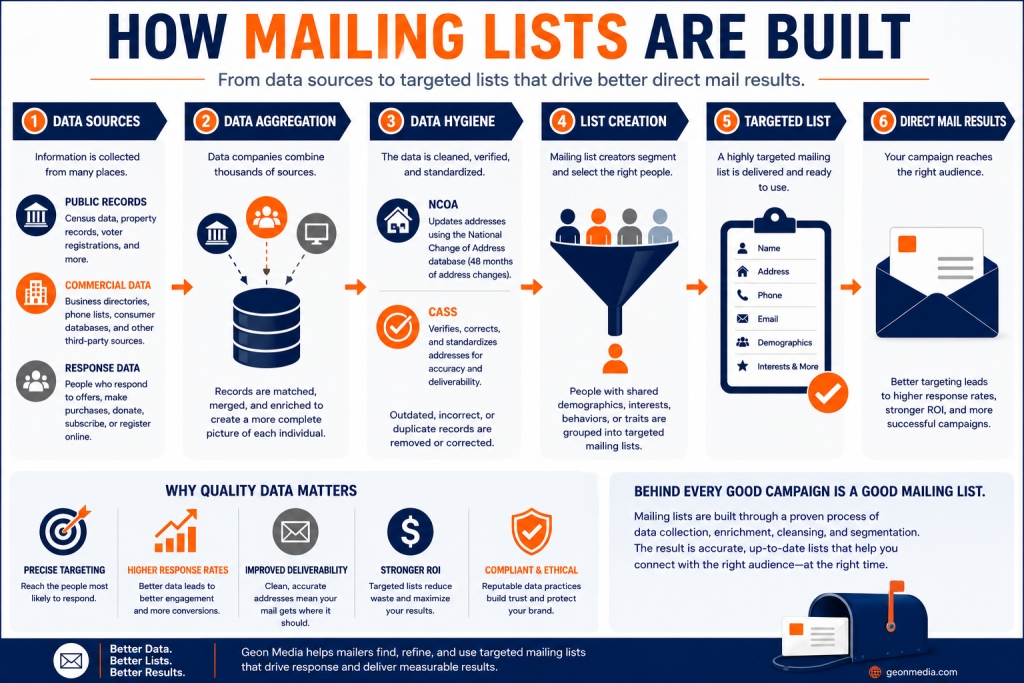
As mentioned, data is becoming more detailed and specified regarding the individuals on the mailing list. And as such, data is sourced from several different sources. There are two main types of data – compiled data, and response data. Compiled data comes from public sources that anybody is able to access – phone books, census data, and directories, to name a few. Response data comes from databases of individuals who have purchased a product or service. A few examples of this include consumers who have made online purchases, donations to charitable organizations, and magazine subscriptions. For more information on compiled and response data, check out Geon’s article on the differences between the two types of mailing lists.
Companies who specialize in data collection will then collect this data through acquiring the publicly available data and through purchasing the data from the various companies that have collected it. Data companies will then combine the small pieces of data from everywhere until they have a very composite description of who all of the demographic information about someone (name, where they live, contact information, etc.), their interests, beliefs, and much more. This data is then verified, standardized, and sold off. Mailing list creators then will take and use this data to build mailing lists around specific interests, demographics, purchasing behavior, or other characteristics.
Is the Data in the Lists Accurate?
Reputable mailing lists are generally very accurate, especially when the mailing list’s owner practices data hygiene on a regular basis. Data hygiene is defined as the process of running data through various programs to ensure that the data in the mailing list is accurate, up to date, and valid. By doing this process, the pieces of data that are outdated are either updated or removed.
There are two main ways to “clean” the data. The first is by running the data through a program that the USPS offers called the National Change of Address (NCOA). The NCOA is a database that houses address updates for individuals that have filed a Change of Address request within the past 48 months. The Coding Accuracy Support System (CASS) has a similar, but different function. The CASS verifies and standardizes the addresses, allowing the mailer to have an easy time sending the mail pieces out down the road. By running data through these two services, it becomes significantly easier to find the “bad” data. Mailers can ensure that their database and mailing lists are as up to date and accurate as possible. To learn more about NCOA and CASS, Geon has articles on NCOA here and CASS here.
How Does the Information Get Formed Into a Mailing List?
Mailing lists are formed by finding people with similar interests, demographic traits, or a combination of the two, and grouping them together. For example, if a mailing list creator sees enough people have interests in traveling and golfing, they might create a mailing list that is based on “luxury golf travelers”. There isn’t a “right” or a “wrong” data card, it just depends on demand, market needs, and the data that the mailing list creator has at their disposal.
Another thing to keep in mind when creating mailing lists is the number of people that have the shared traits and interests that are in the mailing list. Once more and more demographical requirements are added into a mailing list, the number of individuals that have the shared traits exponentially drops, to the point where there are so few people in a list that it doesn’t make sense to create a list. For examples of different mailing lists, check out Geon’s datacards here.
FAQ
- Q: Are addresses in mailing lists guaranteed to be 100% accurate?
- A: No, there can’t be any mailing list that is 100% accurate, no matter how hard the mailing list owner tries to scrub their data. Due to individuals potentially not going through the proper channels when moving or people passing away, for example, there is not going to be a completely foolproof way to get a 100% accurate mailing list.
- Q: On a mailing list, what do terms like “reuse”, “/M”, and “Hotline” mean?
- A: While it takes too long to define every piece of terminology here, check out Geon’s article on how mailing lists work to get a better understanding of how the whole process works.
- Q: How often are mailing lists updated?
- A: There isn’t a set time period that mailing lists “have” to be updated, but most list managers will make sure that lists are updated either quarterly or monthly. To make sure that you’re getting as accurate information as possible, ask your list manager or broker how often the data is updated, and they can help answer that question.
Conclusion
Every mailing list starts with data. However, the value of the data depends on factors like the origin and hygiene. Understanding how these mailing lists are created helps mailers choose mailing lists with increased confidence and gives a better understanding on why one list might perform better than another list.