
How Accurate Are Mailing Lists?
Key Takeaways
- Mailing lists are highly accurate when they have been maintained and updated on a regular basis.
- Natural data decay occurs as people move, businesses relocate and contact information changes. Because of this, list owners need to regularly update their data.
Introduction
As with any business decision, there are several assumptions that need to be made with a direct mailing campaign. One of the biggest concerns that a new mailer conducting their first mailing campaign has is whether or not the names that they’re renting are actually accurate.
The accuracy of any given mailing list depends on how recently it has been updated, and how well it has been maintained. There are several variables that can go into making a mailing list decay, and having a mailing list start to become less accurate doesn’t mean that the mailing list’s owner is negligent or that you shouldn’t work with them. So, just how accurate are mailing lists?
How Accurate Are Mailing Lists?
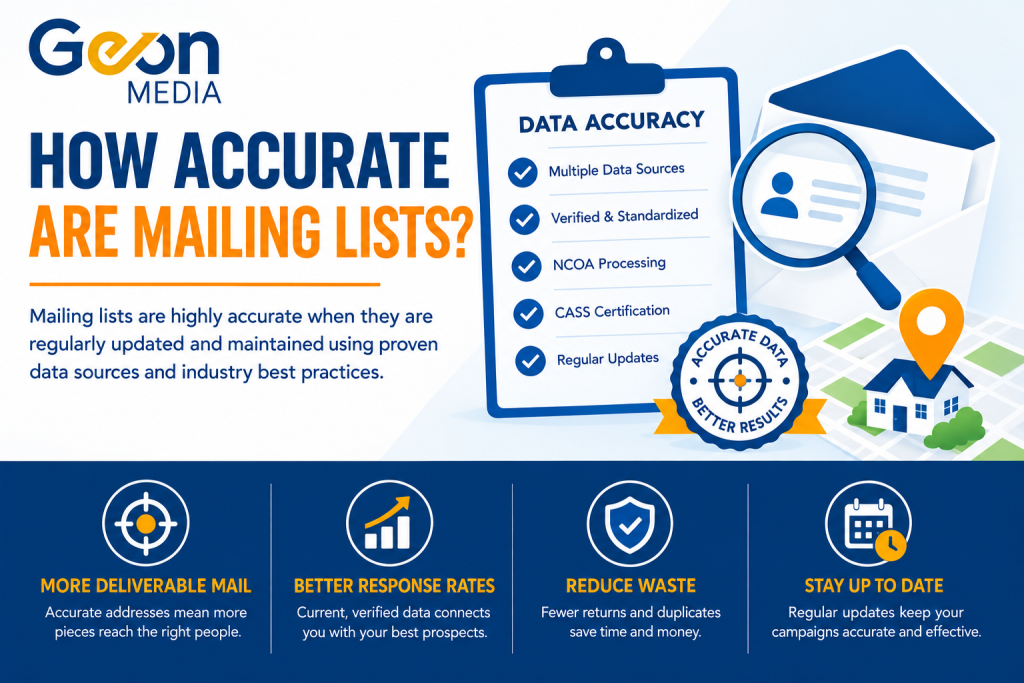
Modern mailing lists are highly accurate when they have been updated and regularly maintained, and the start of creating an accurate mailing list begins with the data that the mailing list is sourced from. When creating a mailing list, the list’s creator will use several data sources. This is to cross-verify the data to make sure that the individuals that are contained within the data are who the data says they are.
There are two types of data: compiled data, and response data. Compiled data comes from sources that are generally accessible to the public, such as phone books or census data. Response data comes from databases that companies keep of individuals who purchased a product or service, which is then sold to data brokers. For more information on how mailing lists are created, learn more about that here. Reputable list managers don’t rely on just a single source for their information. Instead, they compare data from multiple sources, removing conflicting or incorrect information, and continually update their records which could change the overall mailing list count as a new data source becomes available to them.
When the list creator has obtained these pieces of data, they’re able to compile them into a list. With the data coming from several different sources, the mailing list that they create is going to be very accurate. However, over time, mailing lists are going to start to become less accurate.
Why Do Mailing Lists Become Inaccurate?
Mailing lists become less accurate over time. Mailing lists decaying isn’t a bad thing and isn’t necessarily the sign of a bad list manager. As time passes, people are going to move, pass away, and could change hobbies or interests, changing their demographic. Companies could relocate or go out of business. Due to natural reasons like these, mailing lists are going to become more inaccurate, unless the list manager updates their mailing lists.
What is Data Decay?
Data decay is the biggest reason that people ask the question of how accurate are mailing lists. Every mailing list experiences data decay. As people move, change jobs, change their purchasing behavior, pass away, or update their contact information, databases and mailing lists gradually become less accurate as time passes. This is a normal part of owning and maintaining any large mailing list or database and is one of the primary reasons that professional list managers are continually updating their files.
Can Mailing Lists Be Updated?
Yes, mailing lists can be updated. The ongoing process of updating a database to have the most accurate mailing lists possible is commonly referred to as data hygiene. There are multiple options that list owners must practice having good data hygiene. First, they have the option to obtain updated data from data brokers as mentioned above. If the data brokers have updated their data, the list owner is able to obtain updated data from them and use that to update their mailing lists.
Another way that mailing list owners can update their mailing lists is through important tools that the USPS offers to help with data quality – Coding Accuracy Support System (CASS) Certification, National Change of Address (NCOA) processing, Delivery Point Validation (DPV). These systems allow list owners to verify that their addresses are standardized, updated and are valid USPS delivery points, respectively. These programs will ensure that, when a consumer or business relocates, that they can continue to be used in mailing lists. Any reputable mailing list owner knows that, by using these systems, they can ensure that their mailing lists are accurate.
How Do I Know If a Mailing List is Updated?
The easiest way to know that a mailing list has been updated is to ask the list broker or list manager that you’re working with. Any reputable list broker or list manager will be able to tell you when they last updated their mailing lists, how they update them, and the frequency of their update schedule. If your list broker or list manager isn’t able to give you a straight answer, it might be time to look elsewhere for your mailing list. To learn more about what makes a good mailing list, read Geon’s article on what makes a good mailing list.
Ask your list broker or list manager:
- When was this mailing list last updated?
- How often is this mailing list updated?
- Does this mailing list use NCOA processing, and CASS Certification?
- When were the mailing list counts last updated?
FAQ
- Q: How often should a mailing list be updated?
- A: There isn’t a set time frame in which mailing lists should be updated, but it usually is done monthly or quarterly.
- Q: With the data within the mailing list being sourced from different sources, are mailing lists legal to have/use?
- A: Assuming that the data is sourced through legitimate, legal sources, mailing lists are completely legal to have and use. If you have any other questions on the legality of mailing lists Geon has an article on that topic here.
- Q: Are mailing lists 100% accurate?
- A: No, no mailing list is ever going to be 100% accurate, no matter how diligent a mailing list manager is at updating their lists. For an example of why this is the case, when a person relocates to a new address, they are supposed to fill out a change of address form with the USPS. If they don’t, then the USPS has no record of the move, thus the mailer isn’t able to update their mailing lists. This isn’t a blight on a mailing list manager, as this forms a small percentage of names that you will receive if you rent a mailing list.
- Q: What happens if a mailing address is no longer valid?
- A: It depends on the reason that the address is no longer valid. The mail might be forwarded, returned as being undeliverable, or discarded by the USPS. This is one of the reasons that data hygiene is so important.
Conclusion
How accurate are mailing lists? Renting a professionally maintained mailing list is one of the best ways for someone to reach qualified individuals who could use your information the most. However, this is only true if the information that the mailer receives is reputable, current, and legitimate. By ensuring that you’re getting updated names, mailers can eliminate the unknown of knowing if the information that is getting sent out will go to the correct consumers.
Geon reviews your intended audience and mail piece to identify additional criteria that can help refine your mailing list selection. This helps us select names that more closely align with your offer and campaign goals.
Learn why mailers choose Geon Media.
How Ordering Works
1. Tell us about your campaign. Share your intended audience, quantity, and a sample of your mail piece.
2. Review your options. We help you choose a mailing list and any suitable selects or segments.
3. Confirm your order. Review and approve the final pricing and rental terms.
4. Receive your list. We prepare your selection and deliver you with a spreadsheet containing your mailing list.
Learn more about ordering a mailing list.
New to Direct Mail?
Are you running your first direct mail campaign?
Read Geon’s beginner’s guide for to direct mail here.
Return to Mailing List Fundamentals, or browse Geon’s Learning Center.
Recent Comments