
Are Mailing Lists Legal?
Key Takeaways
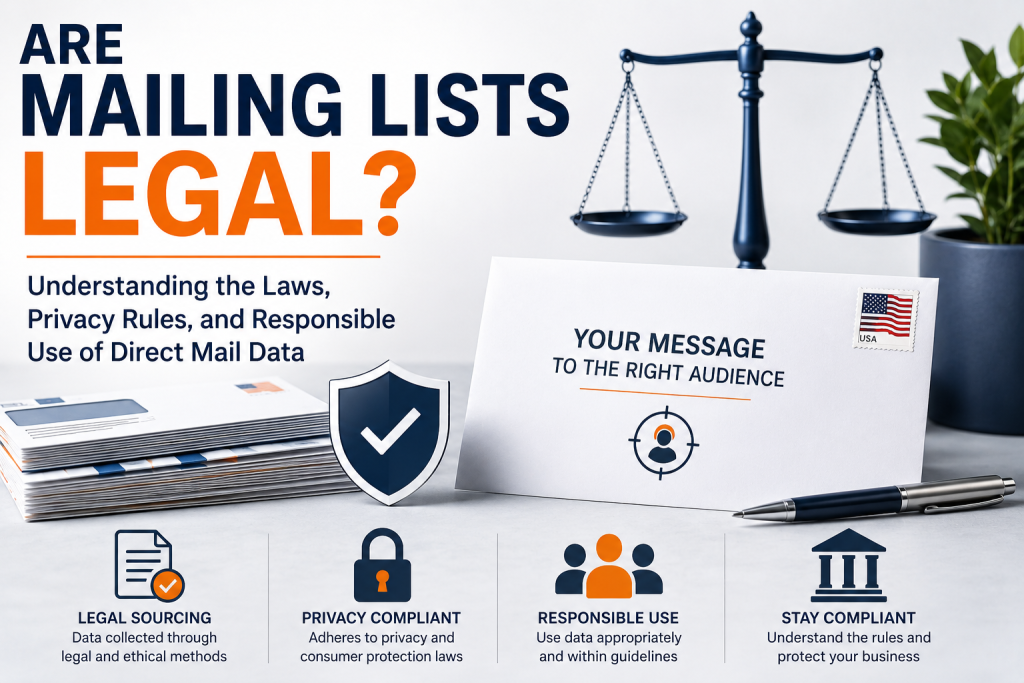
- The answer to the question “are mailing lists legal to use” is yes, assuming the data wasn’t illegally harvested.
- Reputable list owners have usage agreements which protect them and the renter from legal consequences of misuse.
- If you have questions about the source of data, ask your list manager or list broker where the data comes from.
Introduction
Privacy laws are significantly different now when compared to even a few years ago. Businesses are expected to be more open and transparent about how they use, collect, and store information. With all these limitations in mind, are mailing lists legal to create and use? After all, the data that is held in those lists does contain a lot of personal identification information (PII).
Fortunately, the data found in physical mailing lists are subject to a different set of laws than email marketing and other forms of online advertising. However, is the data completely safe in the mailing lists?
Are Mailing Lists Legal to Rent and Use?
Yes, the data that is contained within mailing lists that you see for rent online are generally legal to rent and use for your mailing campaign. There are times where it could be illegal to use, however. If the data was obtained through legal means, such as through customer relationships, magazine subscriptions, catalog purchases, surveys, public records and databases, and from other commercially collected sources (for more information on legal ways that data could be obtained, check out Geon’s article on compiled and response lists), then the data is allowed to be used. If the data is obtained through leaked data or any other illegal methods, then the data should not be used.
Reputable mailing list providers have an interest in maintaining legally sourced and accurate data, as well as their own lists. Mailing lists often will contain seed names, which are addresses that belong to the mailer or people close to the mailer who will receive the mail piece to ensure that the mailer is holding to the mailing list rental agreement. The list manager’s reputation depends on the quality of the data that they rent out and by complying with the various laws and licensing agreements that are applicable to them. This is why the answer to the question “Are mailing lists legal?” depends on where the information that in the mailing list originated, and how the info will be used.
How Do List Owners Protect Themselves Regarding Data Usage?
The number one way that list owners protect themselves is with usage agreements. A usage agreement is a contract between a service provider and an end-user outlining the rules for using their product. This protects the provider’s intellectual property, and limits their liability. By having this in place, the list agreement clearly defines how the data is allowed to be used to protect both the list owner and the renter of the list.
Another way that list owners protect themselves is by knowing privacy laws. When it comes to privacy laws for physical mailing lists, they differ in quite a few ways from digital email lists.
| Physical Mailing Lists | Email/Digital Mailing Lists |
|---|---|
| Less regulation. | More regulation. |
| Less prior consent needed when sending a mail piece. | Prior consent is needed before sending any email. |
| Not considered intrusive, difficult to violate spam laws. | Considered intrusive, easy to violate spam laws. |
| Addresses aren’t considered a personal identifier. | Email is considered a personal identifier. |
Why Working with Reputable List Managers Matter
When it comes to getting your mailing list for your campaign, it can be important to make sure that you work with reputable parties. If the mailing list that you’re using comes from data that was harvested using illicit means, the mailer could be held responsible for using the data. Businesses that have knowingly used data that was obtained through illegal means could expose themselves to legal and financial consequences.
Legal consequences include:
- Civil lawsuits from the impacted organizations and individuals.
- Violations of various privacy laws.
- Contractual liability, if the data violated terms of use or licensing agreements.
Financial consequences include:
- Legal fees from the legal consequences.
- Regulatory fines, if applicable.
- Financial costs that come with informing impacting individuals.
- The cost of replacing the illegally obtained data with another, more legitimate mailing list.
Lastly, there could be reputational damage that could occur if your business is caught using the illegally obtained data.
Data that is illegally obtained is often outdated, inaccurate, incomplete, and/or duplicated, which could mean a poor result from your campaign, even before the legal risks are considered. If you have any questions or concerns regarding the source of data that is in a mailing list that you’re prospecting to use, please ask your list broker or list manager, and they can help answer your question regarding the data’s origin. If you don’t know the difference between a list broker and list manager, Geon has an article on that topic.
FAQ
- Q: Are mailing lists legal if I buy them from anywhere online?
- A: It’s recommended to only get data from reputable sources. By purchasing the mailing lists from reputable, respected sources, you are much more likely to be purchasing a list that comes from a legal source.
- Q: What are red flags when looking at a mailing list?
- A: There are quite a few red flags that should be sounding alarms when looking at a mailing list. Items such as:
- Muddy agreement terms
- Unclear or questionable data sources
- Terms that are much cheaper than lists in similar industries
- Data that hasn’t been updated on a regular basis
- Little to no information about how the data is maintained or updated, otherwise known as practicing good data hygiene (to find out more about data hygiene and the importance of it, check out Geon’s article on that here.)
- A: There are quite a few red flags that should be sounding alarms when looking at a mailing list. Items such as:
Conclusion
So, are mailing lists legal? Yes, when mailing lists are an established, reputable, and legitimate part of direct marketing when the lists are sourced, maintained, and used responsibly. The key is finding and working with reputable list managers and brokers who can confidently explain where data is sourced from, maintained, and what the restrictions are when it comes to its’ use. By taking a few minutes to verify the source of an individual mailing list today, you can protect you and your business from unnecessary legal, financial, and reputational risks tomorrow.
Return to Define Your Customer & Build Your Audience, or browse Geon’s Learning Center.
Recent Comments