
What Are Direct Mail Response Mechanisms?
Key Takeaways
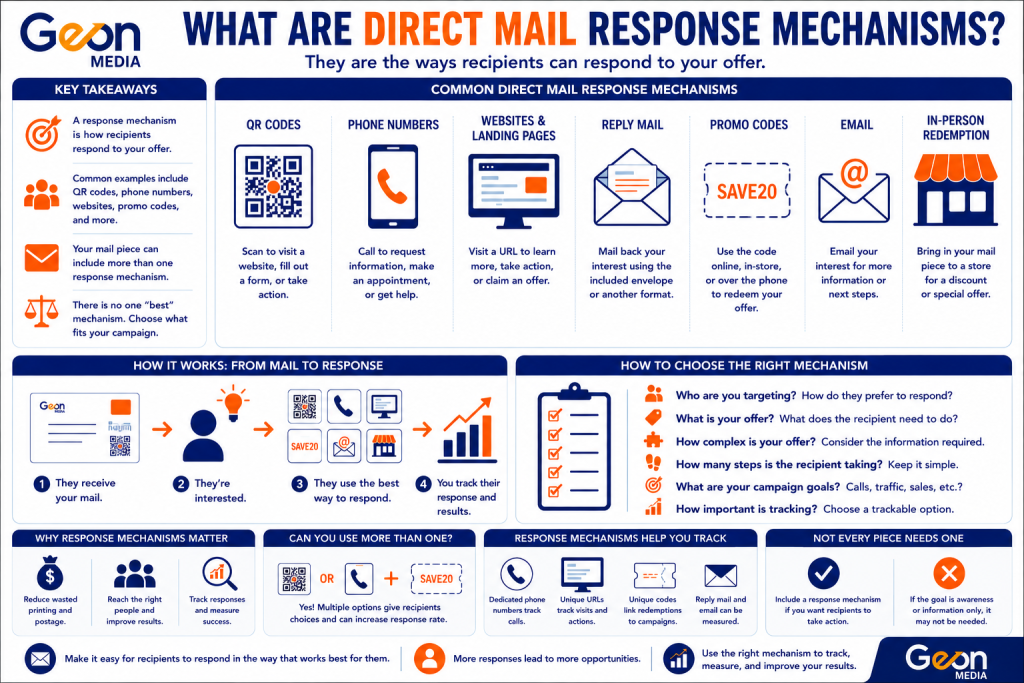
- Direct mail response mechanisms is the method that is used to help recipients respond to your direct mail offer.
- Common direct mail response mechanisms include QR codes, phone numbers, websites, promotional codes, and in-person redemption.
- Your mail piece can contain more than one response mechanism.
- There isn’t one universal “best” direct mail response mechanism. The response mechanism chosen should be determined on a campaign-by-campaign basis.
Introduction
The offer on your mail piece is the reason that you’re mailing. Just as there are many methods to track the results of your offer, there are several mechanisms that can be used to give recipients a way to respond to it. These are known as response mechanisms. Choosing an appropriate response mechanism for your direct mail campaign can help seamlessly guide the recipient from being interested in your offer to responding to it.
What Are Direct Mail Response Mechanisms?
A direct mail response mechanism is a medium that is used to allow the recipient to respond to the mailer’s offer. As an example, if a mail piece said “Call (888) 867-5309 for a free estimate!, the phone number would be the response mechanism.
Response Mechanism vs. Call to Action
While similar, response mechanisms and calls to action are not the same thing. A call to action is the instruction on what to do, and the response mechanism provides the recipient the method to respond. If looking at our example from above, the call to action would be “Call for a free estimate!” and the response mechanism is the phone number.
What Are Common Direct Mail Response Mechanisms?
QR Codes
A QR code is a square-shaped code that a smartphone camera can scan to access a digital destination, such as a website, app, or form. That destination could be a landing page, online shop, digital form, appointment scheduler, etc. QR codes are often used for convenience, as the recipient doesn’t need to manually type a URL to get to a website. While QR codes are useful, they are not tracking mechanisms by default. They can be used to track responses, but only if they’re set up to track responses.
Phone Numbers
A phone number can be used for the recipient to call and request additional information, get a consultation, make an appointment, etc. If the number’s sole purpose is to track responses from a direct mail campaign, calls to that number can assist in measuring the number of responses that the campaign has generated.
Websites and Landing Pages
Your mail piece could have a URL that directly takes the recipient to a website. If the landing page was made specifically for the campaign, then the visits and actions that are taken on the page could be set up to be tracked to help measure results.
Reply Mail
While an old-school method, reply mail still has its uses. Reply mail involves the recipient mailing their interest in your campaign back to you, either using an included reply envelope, or other format.
Promotional/Coupon Codes
Your offer could have a code that can be used to receive a discount or other promotion when used. These codes could be used online, in a physical store, on an order form, or over the phone. Codes have an added benefit by helping the mailer directly associate the customer with the campaign.
If a mail piece has an email address that was included, all that the recipient needs to do is to send their interest to the email for further information or instruction.
In-Person Response
A mailer could instruct the recipient to bring the mail piece into a physical store for a discount.
Could I Use Multiple Direct Mail Response Mechanisms?
Yes, you can use multiple direct mail response mechanisms for your campaign. As an example of this, the same mail piece could include a QR code that takes the recipient to a website when scanned and gives them a coupon that can be redeemed at a physical store. Giving the recipient multiple response mechanisms can give the recipient different ways to respond depending on their personal preference. However, if the process to get someone to respond is too difficult or complicated, otherwise interested recipients of your mail piece could become frustrated and disengage with your campaign.
Which Direct Mail Response Mechanism Should I Use?
There are several things to keep in mind when trying to choose a response mechanism for your direct mail campaign.
Who Are You Targeting?
How would this group of people prefer to respond?
What Is Your Offer?
What does the recipient actually need to do to claim your offer?
How Complex Is Your Offer?
If somebody needs to provide several pieces of information, an online form on a webpage might make more sense than asking them to send you a long email.
How Many Steps Is Your Recipient Taking?
Is your offer convenient for the recipient to claim, or are you asking them to go through several steps?
What Are Your Campaign Goals?
What’s your campaign trying to do? Are you trying to generate calls, appointments, consultations, store traffic, etc.?
How Important Is Campaign Tracking?
Depending on how specifically you need to identify what responses were generated by your campaign and what responses were generated come from other sources, you might want to choose a response mechanism that is able to distinguish between different types of responses.
How Do Direct Mail Response Mechanisms Track Responses?
Certain direct mail response mechanisms can be set up in a way that can help the mailer associate responses to a particular campaign. If someone knows your regular business phone number, using a dedicated phone number for the campaign could allow the mailer to track how many times someone calls that number, for example. If you would like to learn more about how to measure your campaign’s results, read Geon’s guide on Tracking Direct Mail Campaign Results here.
Should Every Piece of Mail Have a Response Mechanism?
If you’re wanting the recipient to take a specific action, then you need to provide them with a way to take that action. If your campaign was designed to build awareness or provide the recipient with information and doesn’t require the recipient to take a specific action, then including a response mechanism on your mail piece might not be necessary. If you’re wanting to learn more about how you can better design your mail piece, learn more about that here.
FAQ
- Q: What’s the best direct mail response mechanism?
- A: There isn’t a “best” direct mail response mechanism. What the appropriate response mechanism is for your campaign depends on your audience, campaign, offer, and desired action for the recipient to take.
- Q: Can direct mail response mechanisms help track the results of my direct mail campaign?
- A: Yes, it can. If set up correctly, certain response mechanisms can help a mailer in identifying which results came from the campaign and which results came from elsewhere.
- Q: Is a call to action the same concept as a response mechanism?
- A: No, they’re not the same. A call to action is a statement which tells the recipient what to do, whereas a response mechanism provides a way for the recipient to follow through on the action.
- Q: Can USPS Informed Visibility be used to track my direct mail campaign’s responses?
- A: No, USPS Informed Visibility can’t be used as a response mechanism. USPS Informed Visibility is used to see where portions of your mail are in the mailing network, and isn’t related to direct mail campaign results.
Conclusion
Now that you’ve gotten the attention of your recipient, they need to respond to your mail piece. When trying to choose the best direct mail response mechanism, it’s important to match the mechanism to the audience and campaign. When choosing a direct mail response mechanism for your campaign, the responding process should be simple enough to allow the recipient to easily transition from being interested in your offer to actually responding to it.
Choosing the appropriate direct mail response mechanism for your campaign can make the process easier for interested recipients to take the next step and respond to your offer.
Return to Analyzing Your Campaign Results, or browse Geon’s Learning Center.
Recent Comments