
How to Track Direct Mail Campaign Results
Key Takeaways
- Tracking your campaign results can help determine if your campaign reached its goals, such as breaking even, or generating a profit.
- There isn’t one universally accepted way to measure campaign success. It depends on your company’s wants, needs, and expectations for the campaign.
- Just because a mailing campaign performs poorly doesn’t mean that it was a failure.
Introduction
Your mail piece has been made, packaged, and shipped out. Now starts the next process of your direct mail campaign: waiting and tracking the results of this campaign that you worked so hard on. Results will give you the quantitative data that you need to see if this campaign met its goal.
Tracking your campaign results is a more complex task than at first glance. How do you track your results? Are you supposed to find an engagement threshold to consider your campaign a success? What about waiting to see how many sales you get? Or maybe comparing your campaign’s engagement to a previous campaign? Defining how you’re planning on tracking the results of your campaign can be an important part of the direct mail process.
Why Do Tracking Campaign Results Matter?
Tracking campaign results matters because it’s the first step in determining if the campaign meets its goals. After all, a mailing campaign costs money to execute, with the process of renting a mailing list, everything that goes into making a mailing piece, printing the mail pieces, and then sending them off. If the campaign results show that the campaign loses money, then it might not be worth it to conduct another campaign in the future.
Tracking the results of your direct mail campaign is easier than most businesses realize, thankfully. There are various tools that can be used to track the results of your campaign. What tool you choose to use is going to depend on your campaign’s goals, budget, and personal preferences.
How to Track Direct Mail Campaign Results
Using technology can really help track your results. As mentioned, there are several ways that campaign results are tracked. USPS Informed Visibility can provide information regarding how your mail is moving through the postal system. To track responses, companies can use different response mechanisms like having dedicated phone numbers, QR codes, coupon codes, and personalized URLs. Utilizing creative ways like these to track your direct mail campaign results can make the process much easier to keep track of your data.
By using methods like these, you can identify the individuals who interacted with your mail piece, and how they responded. For example, if you were mailing out 10,000 pieces of mail, you could generate 10,000 unique QR codes which would all correspond to a specific individual or household that you mailed to. Doing this would make the process of keeping track of your direct mail campaign results, the mail pieces, who responded, and how much they engaged with your mail piece much easier.
What Are Considered to Be a Good Direct Mail Campaign Results?
There isn’t a set definition of what a “good” set of direct mail campaign results are. When asking how to track your campaign results, the results and what the mailer wants to get out of them are going to vary from one campaign to the next. Due to this, it’s important to know what the goal of the campaign is going into it. Without having clearly defined goals going into a campaign, it can become much more difficult to determine whether or not a campaign met your expectations.
The intent of the campaign can also impact what the desired result you’re looking for is. Are you a new company, just looking to get your brand out to consumers to start to develop brand familiarity with them? Or are you selling an actual product, and are looking to make money? The desired results for these two campaigns are not going to be the same, since they had different intentions going into the campaign.
What Do I Do with the Direct Mail Campaign Results?
Once you feel that you’ve gathered enough of the results from your mailing campaign, it’s time to analyze the data. Analyzing the direct mail campaign results can be challenging if you don’t have clear, quantitative goals that you were hoping to achieve with your data. One common goal is to compare the revenue, subscriptions, leads, or other desired metrics generated by your campaign against the total cost of running it.
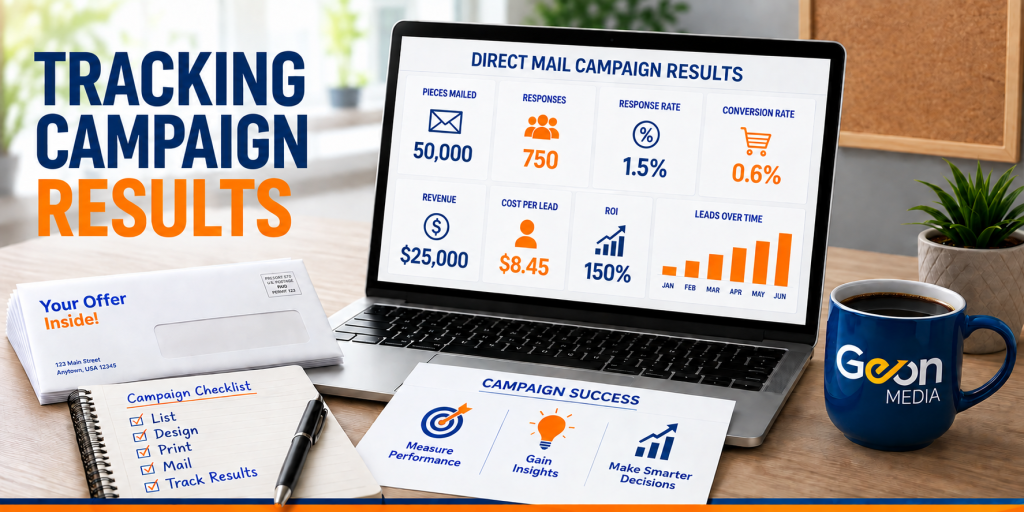
One of the most common metrics tracked is your response rate, which measures the amount of people who engaged with your mail piece in some manner. Second, is the conversion rate. The conversion rate is the percentage of individuals who performed the desire action for the mailing campaign, such as subscribing to a service, purchasing a product, etc.
There are also the sales number, revenue, and the cost per lead (CPL), which measures how much it costs to acquire each qualified lead. Finally, the return on investment (ROI) is the amount of profit that is remaining after all the expense that went into your campaign is subtracted from the campaign’s revenue. Together, these metrics can help provide a more complete picture of how your campaign performed and can help with making better decisions for future mailings.
If this isn’t your first campaign, you can also compare your profit and other metrics to previous your direct mail campaign results. You can look at your earlier choice and see if you made the correct decision in choices, such as seeing if you selected the correct mailing list, if you targeted the correct audience, etc. The benefits are that the campaign manager can see what worked, what didn’t, and why. Especially if the two campaigns were of similar scope, had a similar target audience, and a similar offer. This can be a fantastic way to improve what your future direct mail campaign results look like.
FAQ
- Q: Is there one method of tracking direct mail campaign results that is better than the rest?
- A: No, there isn’t. Which method you choose to track your results comes down to what the mail piece is, the desired result, and budget of the campaign, since some tracking methods are more expensive than others.
- Q: My campaign lost money. Does that mean it was a failure?
- A: Not necessarily. Are you a brand-new company doing their first campaign? If so, a new company may not perform as well as a veteran company with an established brand that could be marketing to customers that they’ve had before. As with most things, experience plays a role in the success of your campaign. See what went wrong and improve for next time.
- Q: How long should I track my direct mail campaign results?
- A: It is going to depend on the campaign and offer, but businesses will often track results for several weeks after the offer has gone out. Some campaigns will offer immediate results, while others might trickle in over several weeks.
Conclusion
Understanding your direct mail campaign results and how to interpret them can have a significant impact on future campaigns. Thankfully, there are quite a few methods of tracking your campaign’s results, and there isn’t a right or a wrong way to track your results. By having a clear, defined goal for your campaign and tracking those throughout your campaign, you can know what needs to improve for your future campaigns.
Once you’ve finished analyzing your campaign’s results, you can apply what you’ve learned to improve your future direct mail campaigns.
New to Direct Mail?
Are you running your first direct mail campaign?
Read Geon’s beginner’s guide for to direct mail here.
Return to Analyzing Your Campaign Results, or browse Geon’s Learning Center.
Recent Comments