
What Is Cost Per Lead in Direct Mail?
Key Takeaways
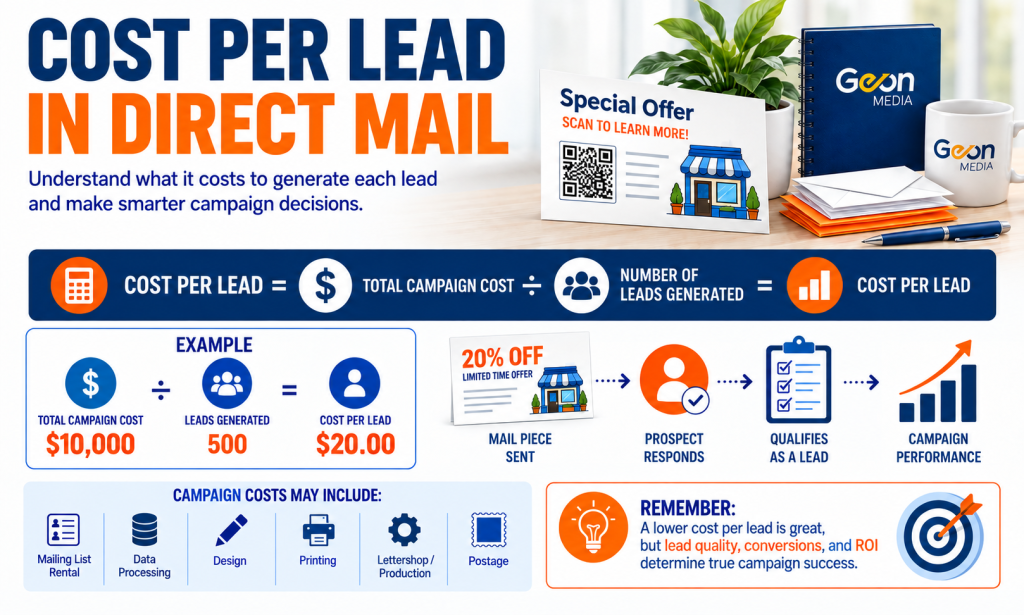
- A cost per lead in direct mail measures how much a direct mail campaign costs for every lead that it generates.
- A lower cost per lead can be desirable, but equally important is the lead quality and eventual conversions.
Introduction
Now that you have your responses from your direct mail campaign, you can start to analyze what those responses actually cost to generate. If you had spent $10,000 on a campaign and generated a few hundred potential customers, how much did you spend for every lead? One metric and help to answer that question, and that’s known as cost per lead.
What Is Cost per Lead in Direct Mail?
In direct mail, a lead is someone who engages, responds, or otherwise expresses an interest in your product or service which was defined before your campaign launched. As an example, a campaign might consider someone a lead after they scan a QR code on the mail piece and complete another action, such as filling a form out, calling a tracked phone number, requesting additional information, or taking another action that has been defined.
How Do I Calculate Cost per Lead in Direct Mail?
Your cost per lead in direct mail can be calculated after collecting your campaign’s results, and is calculated by the following: cost per lead = total campaign cost ÷ number of leads generated. As an example, let’s say my direct mail campaign cost $10,000 to run, and generated 500 leads. Using our equation above, we would have $10,000 ÷ 500 = $20 cost per lead for my campaign.
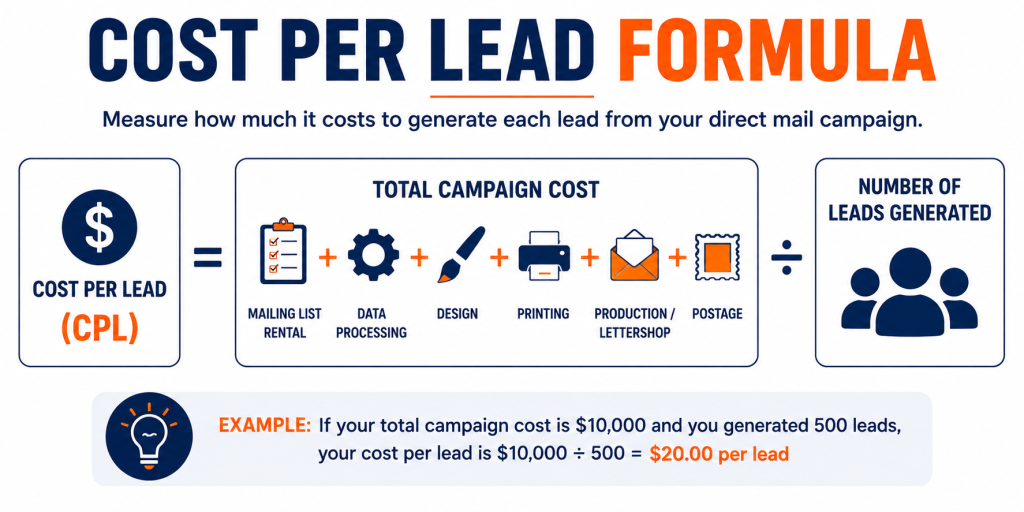
The term “campaign cost” is the total cost of all the expenses that you have from your campaign. Your campaign costs could include the following:
- Mailing list rental price
- Data processing fees
- Design
- Printing
- Lettershop/production
- Postage
Your campaign costs are not going to be the same from one campaign to the next, so it’s important to calculate what your campaign cost is after every campaign that you conduct.
There isn’t a universal “good” cost per lead in direct mail, as your cost per lead has several factors attached to it. What might be a good cost per lead for one campaign would be considered a failure for another. Comparing your projected cost per lead with your actual cost per lead as well as previous campaign’s cost per lead is the best way to know what a “good” cost per lead is.
Is a Lower Cost per Lead Always Better?
No, a cost per lead being lower isn’t always going to mean that it is better. Other metrics matter when looking at your cost per lead, such as the conversion rate, cost per acquisition, return on investment, and lifetime value.
For example, let’s say there are two different campaigns, with the following cost per lead for each campaign:
Campaign A – $15 CPL, but very few leads convert into customers.
Campaign B – $25 CPL, but the leads are much more likely to purchase.
Even though Campaign A had the lower cost per lead, Campaign B could be more profitable if its leads that are of a higher quality produce enough additional customers and revenue to offset having a higher cost per lead.
How Can I Lower My Cost per Lead in Direct Mail?
There are several ways that you can improve your cost per lead.
- Test mailing lists and audiences
- Improve your offer
- A/B test the mail piece
- Improve your targeting
- Remove bad and inaccurate data
- Improve your response mechanism
- Analyze your campaign’s results to improve your metrics
FAQ
- Q: Is cost per lead the same as cost per acquisition?
- A: No, the two metrics are different. CPL is measuring the cost to generate a lead, whereas the CPA measures the cost to acquire a customer. Somebody can become a lead without directly becoming a customer.
- Q: Does a lower cost per lead in direct mail mean my campaign was successful?
- A: No. While having a low cost per lead can be positive, it’s not the only metric that matters. Other metrics, such as the conversions, revenue, ROI, and others matter as well. Just because you have a low cost per lead, that doesn’t automatically mean that those other metrics are at a good level.
- Q: Should my postage and other mailing costs be included when I generate what my cost per lead in direct mail is?
- A: If you’re doing a general total cost of generating leads from your campaign, then yes, you should. The important thing is to define what your costs are before calculating your cost per lead and then calculating them consistently across multiple different mailing campaigns.
Conclusion
Knowing what your cost per lead in direct mail is can help understand how efficiently your direct mail campaign is able to generate potential customers and provides a benchmark for evaluating your future mailing campaigns. However, just because your cost per lead is at an appropriate level doesn’t mean that that is the only metric that matters. Your lead quality, conversion rate, cost per acquisition, revenue, and return on investment all can provide additional context about whether a campaign was ultimately successful.
New to Direct Mail?
Are you running your first direct mail campaign?
Read Geon’s beginner’s guide for to direct mail here.
Return to Analyzing Your Campaign Results, or browse Geon’s Learning Center.
Recent Comments