
What Is a Conversion Rate in Direct Mail?
Key Takeaways
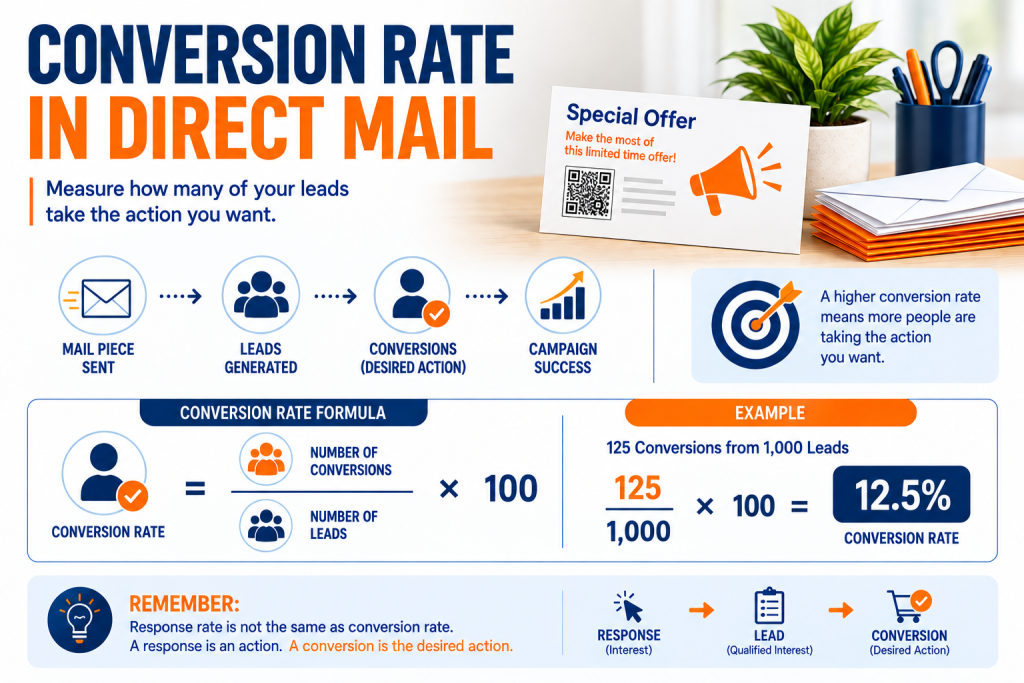
- Your conversion rate in direct mail measures the percentage of leads or respondents who complete the action that your campaign considers a conversion.
- Having a high response rate doesn’t necessarily mean that you’re going to have a high conversion rate, as both metrics can be useful when you’re evaluating your campaign.
Introduction
Now that your campaign has concluded and you know how many leads that you’ve generated, the next question is this: how many of your leads performed the action that you wanted them to do? This metric is known as the conversion rate. The conversion rate can help determine how effectively your campaign has turned interested prospects or leads into people who have completed your campaign’s desired action. While having a good conversion rate in direct mail, this metric shouldn’t be looked at in isolation, as other metrics such as your cost per lead, return on investment, cost per acquisition, and lifetime customer value should also be considered when analyzing your direct mail campaign results.
What Is a Conversion in Direct Mail?
A conversion occurs when one of your mail piece’s recipients completes the specific action that the campaign was designed to generate. What fits your definition of a conversion should be determined before your campaign starts and can vary depending on what your campaign’s goal is. What this “goal” is can vary from campaign to campaign, such as making a purchase, scheduling an appointment, subscribing to a service, making a donation to a cause, etc.
How Do I Calculate Conversion Rate in Direct Mal?
Your conversion rate in direct mail is going to be calculated by the following: conversion rate = (number of conversions ÷ number of leads) x 100. As an example, let’s say that I generated 125 conversions from my last direct mail campaign, but I had 1,000 leads. 125 ÷ 1000 = .125. To get a percentage, we then multiply .125 by 100 to get my final conversion rate of 12.5%.
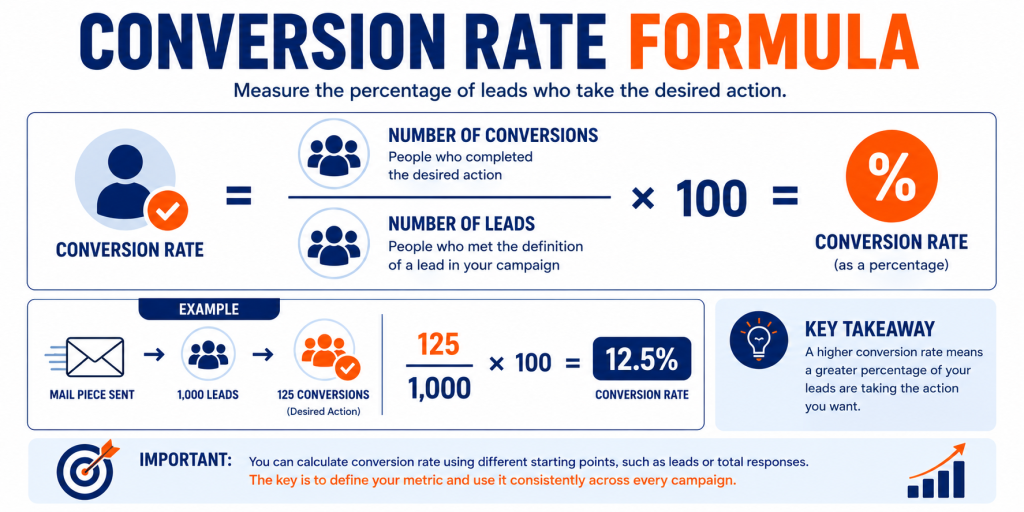
Conversion rates in direct mail can be calculated using different starting populations depending on what the business is measuring during the campaign. As an example, one business might define their conversion rate as the percentage of leads that convert to becoming a customer, whereas another business might define their conversion rate as the percentage of total responses. While using either method to calculate your conversion rate is fine, the key is to just be consistent with your method of measurement.
Is Response Rate the Same as Conversion Rate?
No, your response rate is not the same as your conversion rate. Just because somebody will respond to your mailing campaign doesn’t necessarily mean that they will end up becoming your customer. For example, one of the ways that someone can respond to a mail campaign is through scanning a QR code, but scanning the QR code could be the end of that potential customer’s journey to becoming a customer of yours. So, that person should be counted in your response rate, but not your conversion rate.
What Is a Good Conversion Rate in Direct Mail?
Just as there is no universal response rate that is considered to be “good”, there isn’t a “good” conversion rate in direct mail that is accepted universally. What a good conversion rate is should be established before you start your campaign, as that predetermined number can then be compared to your actual conversion rate. The reason that a good conversion rate is going to vary is due to several factors, including what industry you’re in, offer on your mail piece, price, audience, what your definition of a conversion is, and many other factors. That is why trying to compare your conversion rate to a conversion rate of a company in an entirely different industry shouldn’t be done.
How Can I Improve My Conversion Rate in Direct Mail?
There are many ways to improve your conversion rate in direct mail, including:
- Improve your offer
- Improve your targeting
- Test multiple mailing lists
- A/B test your creative
- Make your response process easier
- Improve your follow-up process with your leads
FAQ
- Q: Are my response rate and my conversion rate in direct mail the same thing?
- A: No, somebody can contribute to your response rate without contributing to your conversion rate.
- Q: Should I measure my conversion rate after every mailing campaign that I conduct?
- A: Yes, it should. Measuring your conversion rate after each campaign can help you to compare your campaign’s performance over time. The key rule to follow is to ensure that you’re consistent with the method that you calculate it. If your definition of what a conversion is changes between one campaign to the next, the results will stop being comparable.
Conclusion
Your conversion rate in direct mail can help show you effectively your direct mail campaign has turned leads or respondents into people who have completed your campaign’s desired action. While your conversion rate is an important metric to use, it shouldn’t be used by itself to determine whether a campaign has succeeded. Looking at your conversion rate alongside other metrics such as your cost per lead, cost per acquisition, revenue, and return on investment can help to provide a much more complete picture of how your campaign has performed.
New to Direct Mail?
Are you running your first direct mail campaign?
Read Geon’s beginner’s guide for to direct mail here.
Return to Analyzing Your Campaign Results, or browse Geon’s Learning Center.
Recent Comments