
Targeting Definitions for Direct Mail
Key Takeaways
- There are different definitions of targeting, depending on characteristic or trait you’re focusing on.
- Targeting a certain type of customer brings diminishing returns if the campaign manager is too specific and rigid about who their target customer is.
Introduction
When organizing a direct mail campaign, it’s natural to have an ideal customer in mind. This ideal customer should be a combination of all the traits that your most frequent customers have in common. By identifying this archetypal customer, this is what is known as targeting that customer. Utilizing targeting in an effective and strategic manner can lead to strong results. However, targeting can also lead to diminishing results if used too much.
What is Direct Mail Targeting?
Direct mail targeting is the process of identifying the consumers or businesses that a marketing campaign is intended to reach. A target audience can be defined using a combination of different characteristics, such as demographics, interests, purchasing behavior, geography, or business characteristics. Once an audience has been defined and identified, the mailing campaign’s offer and creative can be developed to appeal to that audience specifically. There are different types of targeting, defined by their different traits that are used to target the consumer. Using different types of direct mail targeting can be used to reach different types of consumers. Combining different types of direct mail targeting can especially be powerful if used correctly.
What Types of Direct Mail Targeting Exist?
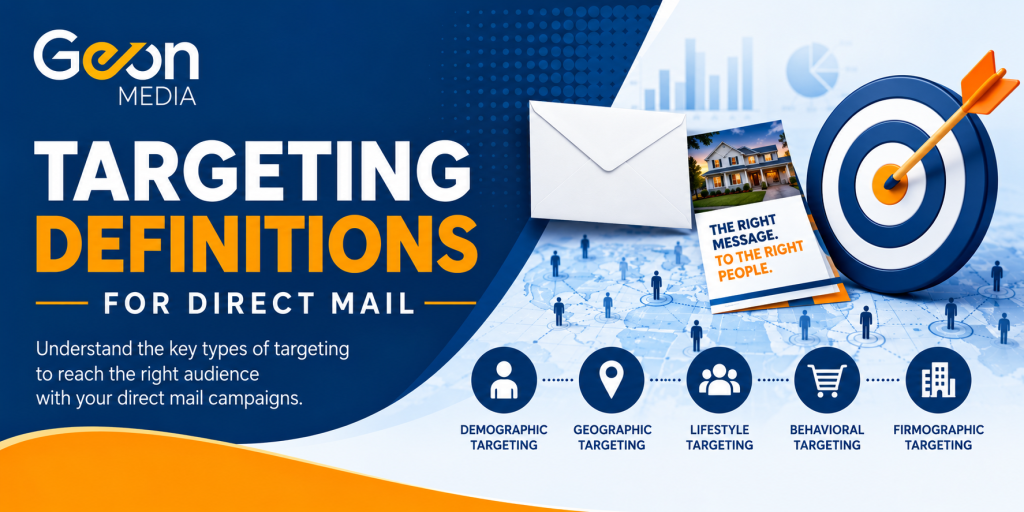
Demographic Targeting – Demographic targeting is utilizing a consumer’s different demographical traits and values to advertise to. These traits include the consumer’s age, gender, income, net worth, relationship status, homeownership, and more. Appealing to these shared traits can be used to advertise a product or service that a certain group of people would be more likely to respond to.
Geographic Targeting – Geographic targeting is appealing to a group of people based on where they live. Almost every mail piece and offer is going to do this to some degree, especially if the offer has to do with a physical service that is in a fixed location, such as a local restaurant, service provider, or other physical storefront.
Interest/Lifestyle Targeting – This is when someone’s interests, hobbies, or lifestyle is used to target a consumer. Interest or lifestyle targeting is especially useful when running an advertising campaign that is for a product or service that has to do with a hobby or interest, such as a campaign for a new video game or for furniture.
Behavioral Targeting – Behavioral targeting identifies an audience that is based on an action that they have taken. This action could be identified based on past purchases, subscriptions, inquiries, responses to previous offers, or how recently they have made a purchase. For example, a company might want to target customers that have previously purchased from them within the previous six months with an offer or related product.
Firmographic (Business) Targeting – Firmographic targeting is targeting a business or company based on the number of employees they have, revenue, or industry. However, this could also mean targeting employees who have a specific job role or title, such as a company executive.
How Can Mailing Lists Be Targeted?
Mailing lists are often sorted by one or more targeting methods. For example, Geon has a mailing list that is based on working mothers that also have families. This audience combines several consumer characteristics, such as the consumer’s gender, parental/family status, and employment status, to create a more specific, defined audience. Additional ways to target a specific type of consumer, known as segments and selects, can be added on to the order.
A segment is a division of a mailing list into a predefined group. These divisions can be used as behavioral targeting, as one of the types of segments that you’ll find is purchasing date, which can help target consumers who recently purchased a similar product or service. Selects allow a mailer to narrow the available audience further by using additional characters that can include age, net worth, hobbies, interests, gender, ZIP code, homeownership, and more. These include filtering individuals based on their age, net worth, hobbies, interests, gender, zip code, and more. Adding segments and selects to your order can help to narrow down your target audience even more.
How Much Direct Mail Targeting Is Too Much?
Once you reach a threshold of adding criteria to who you want to target your offer to, direct mail targeting starts to become counterproductive. As every additional piece of criteria is added on to a filter to find who you’re going to target with an order, the number of people who check every box that you’re looking for gets lower.
As an example, if I’m trying to target a group of people who are male, 18 – 35 years old, make $75,000 a year or more, enjoy hiking, are married with three kids, and own a boat, that number is going to be extremely low, to the point where it isn’t worth it to try to run an expensive mailing campaign.
It’s a campaign manager’s job to find a compromise of being specific enough to where the target audience is present, but wide enough to where the overall count of the mailing list is still high enough to conduct a mailing campaign. For more information on how to choose the correct mailing list for your mailing campaign, check out Geon’s article on how to choose the correct mailing list.
FAQ
- Q: Does a high count on a mailing list mean that the list is a certain quality?
- A: No, there is no correlation between a high count on a mailing list and the quality of the mailing list. There are ways to ensure that the mailing list hits a quality threshold that you’re looking for. For information on that, read Geon’s article on what goes into selecting a good mailing list.
- Q: Do mailing lists have a high variance in how much they charge to rent?
- A: There is a variance in how much it costs to rent mailing lists. If a mailing list has those segments and selects included, that were mentioned earlier, those could add to the cost of a mailing list. As mailing lists get more specific with the criteria that it takes to be on the list, the price might go up as well. Learn more about how much it will cost to rent a mailing list here.
- Q: Is more direct mail targeting always going to be better?
- A: No. Adding more targeting criteria can make an audience more specific, but it can also heavily reduce the number of available prospects. The goal with direct mail targeting to identify the characteristics that are the most relevant to your mailing campaign, while also not eliminating people unnecessarily who could still be a good potential customer.
Conclusion
Direct mail targeting allows a campaign manager to define which types of consumers and/or businesses are the most appropriate recipients for a direct mail campaign. Demographic, geographic, lifestyle, behavioral, and firmographic characteristics can all assist with the process of narrowing down an audience, and multiple types of targeting can be used in tandem with one another. However, it’s important to remember that more direct mail targeting criteria doesn’t always mean better. By focusing on the most important characteristics while keeping a large enough pool of qualified prospects, a mailer can use direct mail targeting to build a prospective audience that closely matches the overall goals of the campaign.
If you’re still questioning which type of direct mail targeting to use in your mailing campaign, contact Geon today, and we will assist with whatever you need.
Geon reviews your intended audience and mail piece to identify additional criteria that can help refine your mailing list selection. This helps us select names that more closely align with your offer and campaign goals.
Learn why mailers choose Geon Media.
New to Direct Mail?
Are you running your first direct mail campaign?
Read Geon’s beginner’s guide for to direct mail here.
Return to Define Your Customer & Build Your Audience, or browse Geon’s Learning Center.
Recent Comments