
Using Test Results to Improve Response
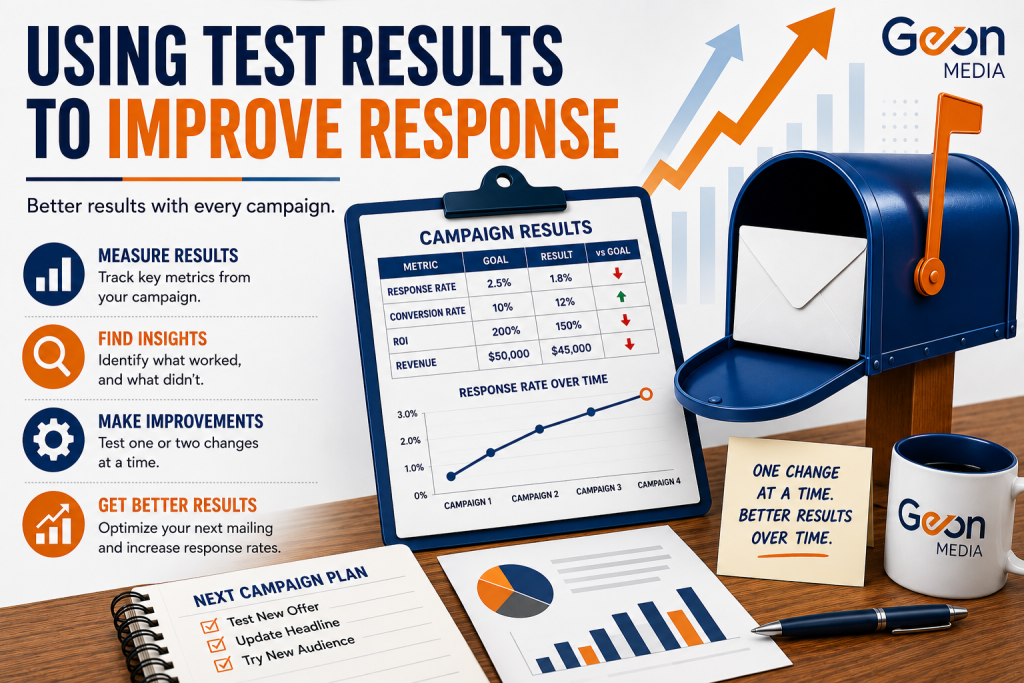
Key Takeaways
- The best way to improve your next campaign is to compare your actual metrics to your planned metrics, to see what worked and what didn’t.
- When changing future campaigns, don’t change more than one or two things, otherwise you won’t know what worked and what didn’t.
Introduction
Once your mailing campaign has come to a conclusion, the next step should be determining how to improve your next one. While a great deal of planning goes into every campaign, no mailing is ever perfect. Every campaign that you execute is going to provide you with valuable information that can be used to help you achieve better results going forward. When thinking about your next campaign, what metrics should be prioritized in order to make more of an impression on your audience?
While looking at different metrics, it might be intimidating to think about where to begin. It is probably worth starting by analyzing your pre-campaign goals. Did you achieve the response rate that you were hoping for? Did your campaign generate enough sales for the campaign as a whole to be profitable? Starting to ask yourself questions like these can help you determine which areas need the most attention as you begin planning your next mailing campaign.
Which Metrics Should I Use to Improve?
As mentioned, the metrics that need to improve are the metrics that your campaign fell short of achieving. Looking at the data that you’ve obtained from your campaign, look at key numbers, such as your return on investment (ROI), response rate, conversion rate, and overall revenue generated. Is there one metric that fell noticeably short of your expectations for it?
Not every improvement needs to come just from increasing response rates or engagement. You can also find opportunities to reduce costs such as printing, production, or list acquisition costs without impacting results. You could also change USPS mail classes, which you can read about here. Finding lower campaign costs can help improve overall profitability just as much as increasing responses and engagement.
How Much Should I Change for My Next Campaign?
One of the most important principles of testing what works and what doesn’t is changing only one or two variables at a time. During science experiments, there is a concept called an independent variable. An independent variable is one or two things during an experiment that are being changed to see if they have an impact on the result of the experiment. In a direct mail campaign, making sure you have an independent variable during your campaign can help you identify what works and what doesn’t.
If you were to change several things at once, and your next campaign is more successful, it could be difficult, if not impossible, to say for sure what part of the mail piece is now working, when it didn’t before. Once a mail piece has been tested enough and the mailer is confident on what works, then the cycle starts back over again. There is never going to be a “perfect” mail piece.
Don’t Ignore Successes
When reviewing your campaign results, don’t focus on what went wrong exclusively. It’s just as important to find and analyze what your campaign worked as well. If a particular offer, mailing list, or design has brought strong results, consider keeping it for the next campaign, while testing improvements elsewhere.
FAQ
- Q: What is the most important metric to use?
- A: There isn’t one singular metric that is considered the “most important”, as they are going to vary from campaign to campaign.
- Q: How do I know which metrics to change or keep the same for my next mailing campaign?
- A: There isn’t a single benchmark that determines when something should or shouldn’t change. Instead, try comparing each campaign against your original goals and previous campaigns. If one metric is consistently falling short of your expectations, it might be time to try a different approach.
- Q: Does every mailing campaign need to have the same metrics?
- A: No, not every mailing campaign is going to be looking to improve upon the one before. Not every campaign is going to have the same end goal. One campaign might focus on generating immediate sales, whereas another campaign might aim to increase brand awareness, collecting leads, or encourage repeat purchases from your house file.
- Q: How many things should I change between one direct mail campaign and the next?
- A: As a general rule, you should only change one or two variables at a time. If you change too many aspects of your campaign, it can be difficult to determine what changes worked well and what changes didn’t work at all.
Conclusion
When doing a retrospective on your concluded mailing campaign, it’s smart to remember that improvement is never completed, and that there is always something to improve upon. By finding and tweaking one or two things for your next campaign, you can see exactly what worked and what didn’t. Over time, these small improvements can lead to stronger response rates, having a higher profitability, and more successful direct mail campaigns.