
How Far in Advance Should I Plan My Direct Mail Campaign?
Key Takeaways
- A direct mail campaign timeline should be planned backward from the desired in-home date.
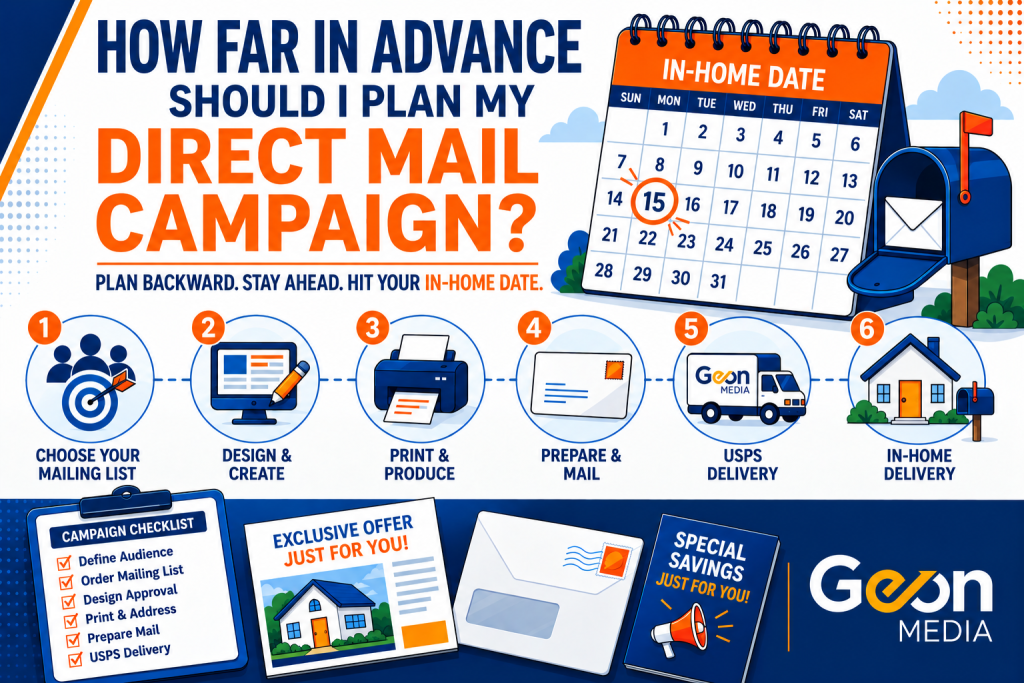
- Plan some time for choosing and ordering from a mailing list, designing the mail piece, printing and addressing your mail pieces, preparing the mail, and for USPS to deliver the mail pieces.
- Starting every step of your direct mail campaign early can give extra time to handle delays or make changes if needed without missing any deadline or arrival window.
Introduction
Direct mail campaigns come in all shapes and sizes. What works for one campaign might not work for another. The amount of time that is needed to prepare a direct mail campaign depends on the size and complexity of the campaign that you’re planning on launching. Planning several weeks ahead of schedule gives the mailer time to prepare each part of the direct mail campaign timeline, including defining your audience, designing your mail piece, figuring out production, and choosing the best delivery option without delaying your campaign or rushing the process.
Start With Your Desired In-Home Date
For a direct mail campaign, the very first decision that should be made is deciding what the in-home date should be for your mail piece. The in-home date is the date, or window of dates, when your recipient will ideally receive the mail piece in their mailbox. Once this date has been identified, the mailer should work backwards from that. There can be a variance in how long it takes mail to arrive, so knowing when the best time to send your mail piece for your campaign can be important.
As an example, let’s say that a company wanted to run a Labor Day sale. Instead of deciding when to send out the mail piece first, the campaign manager should first identify what the desired arrival window is and then make decisions after that decision has been made.
Allow Time to Choose Your Mailing List
Before production has started, the mailer needs to choose their desired mailing list. Some of the decisions that need to be made that could impact on the mailing list that you decide to use include:
- Defining your target audience
- Finding the appropriate mailing lists
- Requesting counts
- Deciding whether any selects or segments should be added to your order
- Placing the list order
- Performing any data processing or data hygiene on your database
All these decisions can impact who gets your mail piece, and how likely they are to respond to it.
Build Time for Creative and Production
The first stage of the direct mail campaign timeline is designing your mail piece. When deciding your mail piece’s design, know that there isn’t a right or wrong answer with what your mail piece should look like. Depending on the industry, offer, budget, and quantity of mail pieces being sent, there could be a wide array of designs that might work or not work. There are pros and cons to sending the mail piece on an envelope or postcard, which you can read about here.
Some time should be set aside after the postcard is designed to get approval and proofing. After this, it’s time to print. When printing, compare printing options between different printing houses, so you can get the most competitive price. Some time should also be set aside for delays with printing, as a multitude of things could go wrong, such as running into supply issues.
After printing, the mail pieces now need to be addressed and prepared to be handed off to the USPS. Depending on the type and size of your campaign, this process could include personalization, addressing, sorting, barcoding, and other preparation for the post office. Once you’ve produced and prepared your mail, the mail pieces can now be handed off to the USPS network for delivery.
Allow Time for USPS Delivery
There isn’t a set timeline for the USPS to deliver your mail. It depends on several factors, such as time of the year your campaign is being launched, what the weather is like in different parts of the country, staffing issues at the post office, how far the mail is traveling, and more. As an example, the USPS reported that, for quarter two in 2026, 84.7% of end-to-end Marketing Mail arrived on time, and 96% arrived at a maximum of three days of its applicable service standard. So, while your mail is more likely than not to arrive on time, having knowledge that an unexpected error could happen could help with having realistic expectations about your direct mail campaign timeline.
Expect the Unexpected
As explained above, knowing that an unexpected bump in the road could show up can help with not completely derailing your direct mail campaign timeline. A multitude of issues could come up, such as:
- The creative needing revisions.
- The mailing list count wasn’t what was expected.
- A proof needs to be corrected.
- Printing takes longer than anticipated.
- A mail-heavy holiday impacting the delivery schedule of your mail piece.
- USPS delivery takes longer than the standard.
- Weather causing delays.
- The client changing something at the very last minute.
At the end of the day, don’t schedule every stage with such rigidity on date deadlines that one single delay could derail your entire direct mail campaign timeline. Make sure that your expectations for your campaign that are realistic for every step of the process.
Sample Direct Mail Campaign Timeline
As an example, a direct mail campaign timeline could look something like this. The dates are overlapping because every step in the campaign process doesn’t need to happen in sequential order. As an example, you could be designing your postcard or envelope while you’re in talks with a mailing list manager about renting a mailing list.
| Time Before Desired Arrival Date | Example Task |
|---|---|
| 4 – 6 weeks | Establish audience, offer, budget, and campaign goals |
| 3 – 5 weeks | Select mailing list and request counts |
| 2 – 4 weeks | Design, proof, and approve mail piece |
| 1 – 3 weeks | Printing, addressing, and postal preparation |
| Mailing period | Enter mail with the USPS |
| Desired window | Mail begins reaching recipients |
Again, this is an example of a direct mail campaign timeline rather than a guaranteed production schedule for your mail campaign. Your direct mail campaign timeline will vary based on your campaign’s mailing size, complexity, vendors, mail class, destination, and other factors.
FAQ
- Q: How early should I plan out my direct mail campaign timeline?
- A: There isn’t one planning timeline that is going to work for every direct mail campaign. Starting at least several weeks ahead of schedule can help negate time delays that you might find in the pipeline. Larger or more complicated campaigns might need additional lead time. When mailed, the USPS offers services like USPS Informed Visibility to help see where portions of your mail is in the mailing system, but can’t be used to see where individual pieces of mail are.
- Q: What if I already have my mailing list and mail piece designed?
- A: If you already have both of those steps completed, then the your direct mail campaign timeline can be shortened by a considerable margin.
- Q: What is an in-home date?
- A: An in-home date is the date that the recipient of your mail piece receives the mail piece in the mail.
- Q: Can I rush my direct mail campaign timeline?
- A: Yes, you’re able to expedite parts of your direct mail campaign timeline. However, rushing production schedules could increase costs. Mailers should also remember that the USPS service standards are expected delivery timelines, rather than guaranteed arrival dates.
- Q: How often should I mail to my audience?
- A: There isn’t a definitive answer regarding the frequency that you should be mailing.
Conclusion
Planning your direct mail campaign timeline doesn’t start with deciding when to turn your mail pieces over to the USPS. It starts with deciding when you want your mail to reach the consumer and work backward from there. By reverse engineering your campaign, starting with the consumer receiving the mail, you can plan your campaign while accounting for the very real possibility of encountering an unexpected delay that needs to be dealt with while not running into a time crunch.
If you’re planning a direct mail campaign and aren’t sure how your direct mail timeline should look or how far in advance you should order your mailing list, contact Geon today. We assist with identifying your audience, obtain counts from a mailing list, and make sure your mailing data is all ready to go when you’re ready for it.
New to Direct Mail?
Are you running your first direct mail campaign?
Read Geon’s beginner’s guide for to direct mail here.
Return to Preparing Your Mail, or browse Geon’s Learning Center.
Recent Comments