
What Is Return on Investment in Direct Mail?
Key Takeaways
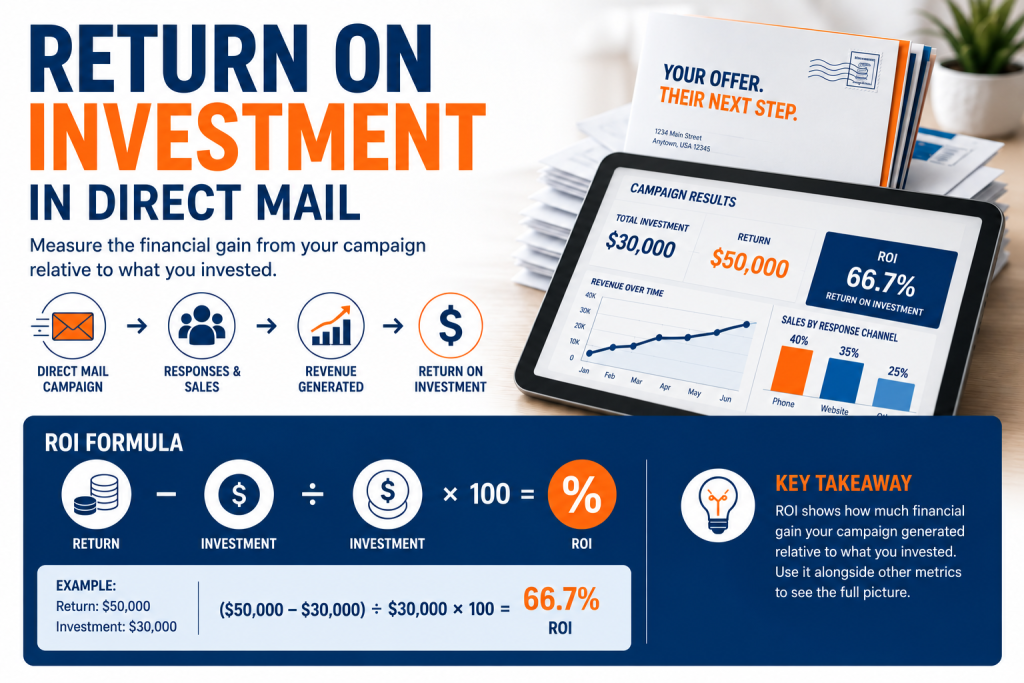
- Return on investment in direct mail measures the financial gain from a direct mail campaign when measured against the amount that was invested in the campaign.
- While your return on investment is an important metric, it shouldn’t be the only metric that is analyzed when determining if your campaign was a success.
Introduction
A lot of people consider the return on investment (ROI) to be the most important metric when analyzing the result of an investment. The ROI is what percentage of your investment you received from the investment at time of analysis. While the ROI is important, it should not be analyzed by itself, as a positive ROI does not mean by itself that a direct mail campaign was a success.
What Is Return on Investment in Direct Mail?
Your return on investment in direct mail can be calculated after you’ve collected your campaign results, and compares your financial return that was generated by a direct mail campaign with the total amount invested in conducting it. Your ROI is expressed as a percentage, with a ROI of 0% representing your break-even point under your defined calculation. If you’ve done several mailing campaigns, this ROI can be compared to those to see how much better or worse your current campaign has done when going against them.
How Do I Calculate Return on Investment in Direct Mail?
You can calculate your return on investment in direct mail by using the following equation: ROI = (return – investment) ÷ investment x 100. As an example, let’s say that I have a campaign that I had conducted that gave me a $50,000 return on my campaign, and my campaign in total cost me $30,000 to conduct.
So, using our ROI formula, we would have our return of $50,000 subtracted from our initial investment, $30,000. The result ($20,000) of that would then be divided by the initial investment of $30,000 to get .667. As our ROI is a percentage, we would then multiply that .667 by 100 to get our return on investment being 66.7%. In other words, under this calculation of ROI, this campaign has generated an additional approximately 67 cents for every dollar that was initially invested into it.
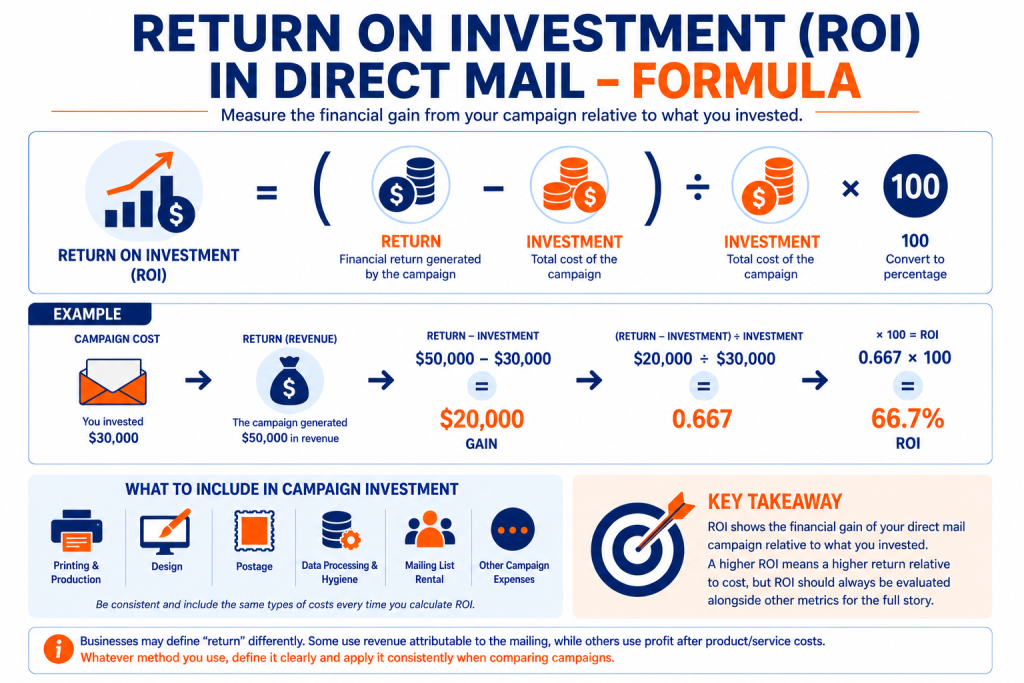
Businesses may define the “return” used in their return on investment in direct mail calculation differently. For example, a simple campaign analysis might use the revenue that was attributable to their mailing, whereas a more complex campaign analysis could account for the costs that were associated with the products or services sold. Whatever method that you use to calculate your ROI, it should be clearly defined and applied every time that you are comparing multiple campaigns.
When calculating how much you spent on your campaign, it’s important to include the same expenses every time that you conduct a mail campaign. Some of these expenses that you can include your campaign’s printing, design, postage, data processing, and mailing list rental costs. While businesses might differ in which expenses they choose to include when they are analyzing a campaign, they should clearly define and calculate their costs consistently from one campaign to the next. If you don’t keep your costs consistent, then you are measuring your ROI and other metrics using inaccurate costs from one campaign to the next.
Why Does Return on Investment in Direct Mail Matter?
Your return on investment in direct mail matters because it is a very simple way to get a bird’s eye view of a campaign’s financial performance. It compares everything that was invested in the campaign with the financial return that was generated. While it is not that simple, campaign managers can get a pretty good idea of how a campaign performed by this metric.
Does a Higher Return on Investment in Direct Mail Always Mean My Campaign Was Successful?
No, just because a campaign had a high ROI does not mean that the campaign was overtly successful. One of the problems with exclusively using ROI comes from the fact that the actual ROI percentage does not include actual monetary values.
Let’s say we have two campaigns that have just concluded a direct mail campaign. Campaign A had a ROI of 80%, whereas Campaign B only had a ROI of 30%. However, Campaign A had expenses totaling $1,000 and had $1,800 in revenue, whereas Campaign B had expenses totaling $30,000, and made $39,000 in revenue. Just because Campaign A had a higher ROI, Campaign B produced a larger dollar return above the initial campaign investment. While there are other metrics that need to be looked at to determine which campaign was more of a success, ROI should not be looked as a deciding factor to see if a campaign was a success.
What Impacts Return on Investment in Direct Mail?
There are several factors that can impact what your ROI is. Some of these factors include:
- Campaign cost
- Offer and pricing
- Conversion rate
- Targeting
- Cost per acquisition
- Response rate
- Cost per lead
FAQ
- Q: If I had a good ROI, does that mean that my campaign was successful?
- A: No, just because you had a good ROI doesn’t mean that your campaign was successful. There are other metrics that need to be looked at before determining whether your campaign as a whole was a success.
- Q: Should I measure my ROI after every campaign that I conduct?
- A: Yes, calculating ROI after a campaign can help you compare its financial performance with your previous mailings, and can help to identify changes over time. For those changes to be meaningful, the method that is used to calculate your ROI should remain as consistent as possible.
Conclusion
Knowing what your ROI is can help you evaluate your direct mail campaign using its actual financial results, rather than going off assumptions. While your ROI is an important metric that should be taken into account as you conduct more direct mail campaigns, it is not the only metric that should be looked into. Using ROI in conjunction with other metrics, such as your cost per acquisition, lifetime customer value, lead quality, cost per lead, and more should also be analyzed so you can make the most educated decisions going forward.
New to Direct Mail?
Are you running your first direct mail campaign?
Read Geon’s beginner’s guide for to direct mail here.
Return to Analyzing Your Campaign Results, or browse Geon’s Learning Center.
Recent Comments