
Direct Mail for Beginners
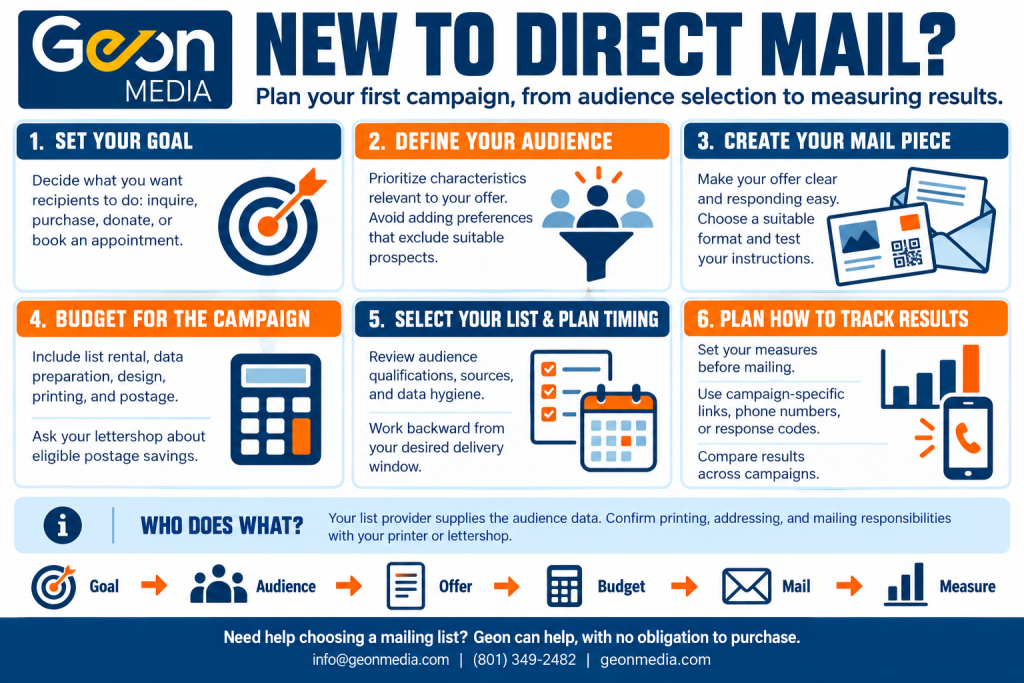
Table of Contents
- Key Takeaways
- Introduction
- What Is Direct Mail Marketing?
- Decide What You Want Your Campaign to Accomplish
- Identify Your Target Audience
- Develop Your Mail Piece and Offer
- Understand Your Campaign Costs
- Choose the Right Mailing List
- Coordinate Your Campaign’s Schedule
- Plan How You Will Track Results
- Ready to Get Started?
- FAQ
- Conclusion
Key Takeaways
- Clearly define who your target audience is and what you’re trying to accomplish with your direct mail campaign early in the planning process.
- Plan out your budget for every step of your direct mail campaign to ensure that no part of production goes over what you have to spend.
- Make sure that your chosen mailing list has data hygiene performed on it to ensure that it is as up to date and accurate as possible.
- Plan how you’re going to track your results when you’re planning your campaign.
Introduction
If you’re new to the direct mail industry, looking at the many steps of conducting a direct mail campaign can be daunting. There are so many things to keep in mind. You need to make sure that the correct mailing list and target audience are identified, have a compelling mail piece and offer, and have and stick to a mailing schedule, all while staying within a budget, which can be a lot to juggle.
For these reasons, that is why we here at Geon Media decided to create a comprehensive direct mail for beginners guide to work along with our Direct Mail Resource learning center to help new, inexperienced mailers to break down the direct mail process to make the process look a bit less frightening.
What Is Direct Mail Marketing?
Direct mail marketing is the process of sending a physical piece of mail to consumers who share one or more identified characteristics, such as an income bracket, age, gender, location, interests, etc. This mail piece has information on it that contains either an offer, contact information, or other message that the mailer wants to get to these individuals. Once the mail has been distributed, the mailer can then view the results of the campaign using a predetermined method to view the campaign’s performance.
Decide What You Want Your Campaign to Accomplish
When people think of a direct mail campaign, their mind will typically go to an advertisement for a product or service. That doesn’t necessarily need to be the case. Mail pieces for direct mail campaigns can serve a variety of purposes. While they can be for selling a product or subscription service, they can also be used to distribute information, donation requests, consultation offers, and more. Knowing why you’re conducting the campaign in the first place can be an important step that might get stepped over. Knowing the end goal for what your campaign is attempting to accomplish should guide what your offer and mail piece end up looking like.
Identify Your Target Audience
Before finding your ideal customer, what sort of problem does your product/service help solve for the consumer? For example, a webinar or seminar regarding information for debt consolidation can help resolve debt issues. Identifying what problem your product/service solves can help identify who you are able to market to.
Ask yourself: if you could create your target customer, what would they look like? What would they do, what interests would they have, etc.? To begin, look through your records to find your best customers. What do they all have in common? What shared characteristics do they have?
Combining the answers of what problem your product helps solve and what your target customer looks like can help identify who your target audience is. However, having a target audience that is too narrow could eliminate who could otherwise be great prospects.
For example, if I am marketing a debt relief webinar, I might find that my ideal picture-perfect customer is:
- In their mid-30s
- Married
- Make < $50,000 annually
- Have 3 kids
- Take 2 vacations a year
- Live in rural areas
- Have a pet
- Are interested in business opportunities
For my webinar, I would start by identifying the characteristics that are directly relevant to my offer. Finding prior interest in debt relief or debt consolidation products or services could be more relevant to my offer than pet ownership, vacation habits, or marital status. Keep any qualifications that are required for your offer, but question if the remaining requirements that you’ve identified are actually requirements, or if they’re just preferences. Your mailing list provider can assist with identifying which of your relevant characteristics that you’ve identified are available for selection.
Develop Your Mail Piece and Offer
When developing your offer, it’s difficult to walk the line between being something that your company can afford to do, and an offer that causes the recipient to act. When trying to get your recipient to respond to your mail piece, you need to encourage them to act, without creating urgency or scarcity in an artificial manner, or falsely advertising or misleading them. As an example, if your offer has a legitimate end date or cutoff point, make that information easy to find and explain it in a clear manner.
Your audience shouldn’t have to metaphorically jump through hoops to respond to your offer. There are various response mechanisms that can be used to give more information to your mail piece’s recipient, such as a QR code, phone number, and more. Whichever mechanism you choose to use, make the information easy for the recipient to find. If the additional information or offer requires a large amount of effort to find, or if the instructions on how to claim the offer are confusing or misleading, the likelihood that somebody who is genuinely interested in your offer claiming the offer is small.
When choosing how to design your mail piece, consider whether you want to use a letter mailed in an envelope, or if you want to use a postcard. There are pros and cons for both mediums. Postcards can use fun designs and are usually cheaper to produce but usually can’t hold as much information as envelopes. Envelopes can hold more information, but you’re rather limited regarding what you can put on the envelope due to the USPS having requirements for envelopes. Consider which you want to use for your mail piece before getting too far in the design process.
Your mail piece should communicate what your offer is in a clear manner while also having a design that catches somebody’s eye who is browsing their mail. As a test for your mail piece, asking somebody who is unrelated to your company to test your mail piece can be beneficial. See if they can answer the following questions when looking at your mail piece:
- Who sent this?
- What is the offer or call to action on the mail piece?
- Why should I care about this piece of mail?
- What step(s) do I need to take next to claim the offer?
At Geon, we require a sample of your mail piece when renting a mailing list. We try to match qualifications to the audience on the mailing list that we give you to rent, and having the mail piece as reference can help us with the name curation process for your mailing list.
Understand Your Campaign Costs
When conducting your direct mail campaign, there are various expenses that go along with your campaign. The first major expense is the cost to rent a mailing list. Most mailing list owners don’t allow you to outright purchase a mailing list, rather they will lease it to you to use a certain number of times. When looking at a mailing list, inquire with the list’s owner or broker if the mailing list allows for a discount once a certain threshold of names have been purchased.
Bulk purchasing can be a major incentive for mailers to continue ordering from the same mailing list. For example, Geon offers 85% of the original price once 100,000 names have been ordered from the same mailing list.
The next big expense is printing and preparing the physical pieces of mail. While the mailer could do this themselves if they have the proper equipment, this is usually done by a company that has equipment for heavy duty printing, or a lettershop. A lettershop is a company that specializes in the mass production of mail for direct mail campaigns, but they could also offer additional services, such as mail presorting, drop shipping, and more. Ask your lettershop if entering your mail into the mail stream closer to its target destination could reduce postage enough to offset the additional transportation and preparation costs.
When it comes to postage, which is another big expense, there are ways to get discounts in several ways. The first is by having your mail presorted. When mail is handed over to the USPS, it needs to be sorted in different manners before it can start to be delivered. If mail is presorted according to USPS requirements, your mail could start to qualify for automation pricing, assuming the other requirements for automation pricing are also met.
Another method to save money on postage is by putting the Intelligent Mail barcode (IMb) on the mail before handing it off to the post office. While not the exact same concept as tracking information, the IMb contains important information that allows the mailer and post office to view what stage the mail is at in the delivery process. Having a lettershop assist with the process of putting an IMb on your mail could qualify you for postage savings if combined with other processes, such as automation pricing or having your mail presorted.
Depending on the class of mail that is chosen, mailing a certain number of pieces of mail could make you qualify for bulk mail savings. Check the USPS website here for more information regarding these discounts. Lastly, USPS offers various seasonal discounts throughout the year. Checking if your mail can qualify for these miscellaneous discounts could save you money on postage. Understanding all of these costs can help you ensure that you stay within the limits of your budget.
Choose the Correct Mailing List
There are tens of thousands of mailing lists online that are owned and managed by various companies. These mailing lists come in all shapes and sizes, varying based on industry, source, prices, and more. Choosing the correct mailing list for your campaign can be a difficult task, and choosing the wrong mailing list for your campaign can hinder your results.
When looking for a high-quality mailing list, ask yourself:
- When was this mailing list last updated?
- Is this mailing list cleaned using data hygiene to remove and update the outdated information?
- What are the data sources for this mailing list?
Analyze the description of the mailing list and see if the list matches the audience that you are targeting. Make sure that your defined target customer is included within the mailing list.
Verify that the source of the mailing list is accurate and legitimate. Mailing lists are created using information from sources such as public records, directories, purchases, subscriptions, and surveys. Some lists draw from a single source, whereas others combine information from multiple sources. There are two main types of sources that make up mailing lists: compiled sources, and response sources. A compiled source is mainly a piece of publicly available information, such as publicly accessible online data or a phonebook. A response source is created through individuals responding to something, such as a catalog, purchase, survey, and more. If possible, try to make sure that the sources for the mailing list you’re wanting to rent are legitimate.
Look at the price to see if the price is comparable to other, similar mailing lists in the same industry. If the price is significantly higher or lower than similar lists, if you have any questions regarding the source(s), or if you have any concerns about anything else about the mailing list, ask the list manager or broker.
The list manager or broker should be able to answer any questions that you might have about the list, such as where it’s sourced from, how often it gets cleaned, etc. If the price, source, or anything about the mailing list is suspiciously different than similar mailing lists, remember the old rule: if it seems too good to be true, it probably is. Make sure that you use a quality mailing list for your direct mail campaign.
Check out Geon’s mailing lists and datacard library here.
Consider adding selects and/or segments to your mailing list order. Selects and segments are additional criteria that can be added on top of the already existing criteria to further enhance a mailing list’s audience. While selects and segments will usually come with an additional cost on top of the mailing list’s base rate, they can turn what could be an otherwise unappealing mailing list into a mailing list that is the best fit for you and your direct mail campaign.
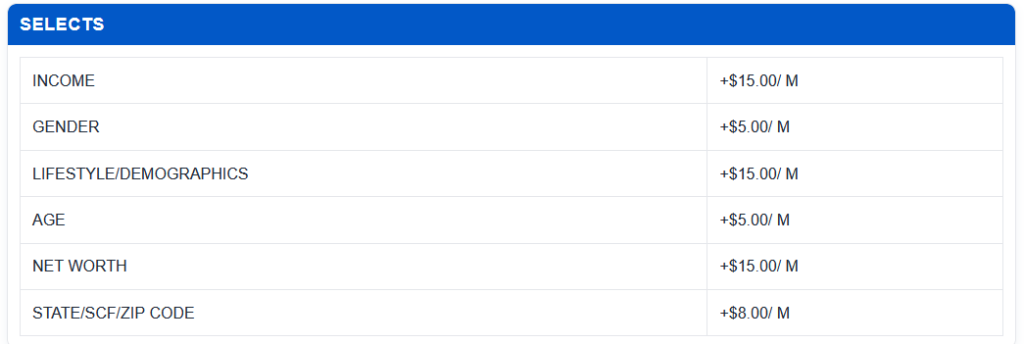
If you’re still unsure of which mailing list to choose, turning to a mailing list broker for assistance could be a smart idea. Brokers can retrieve many mailing lists for a certain campaign, and can assist mailers by giving an unbiased opinion regarding which mailing list is the best for your campaign, and if any selects or segments could help concentrate on who you should mail to. Geon offers mailing list brokerage services, read about that here.

Coordinate Your Campaign’s Schedule
When planning a schedule for your direct mail campaign, start with your desired in-home delivery window, which is the day(s) that your mail arrives in the mailbox of the recipient, and work backwards from there. This is especially important if your offer corresponds with a calendar date, such as a sale for a specific holiday. Doing this will allow you to give your campaign enough time for each step of the process, such as receiving your rented mailing list, having your mail produced, and when you actually launch your campaign.
The USPS does not guarantee that mail will be delivered on a specific day, so rather than planning on your mail all arriving on a specific date, plan a window of time of when your mail will be delivered. There are various reasons that mail could have a delayed arrival, such as mailing around holidays or dates when the USPS receives an influx of mail (think Christmas or Valentine’s Day), or if there is a major weather event in one part of the country, such as a snowstorm or hurricane. Failing to give yourself ample time at each production stage can result in the campaign being delayed, or have your campaign rushed to completion.
Plan How You Will Track Results
Before your campaign, clearly define how you are going to track the results from your direct mail campaign. There are many metrics that you can use to track your results, including the response rate, conversion rate, return on investment, cost per lead, and more. Choosing the metrics before your campaign and deciding what benchmarks you would like to achieve can help prevent you from changing up what results would be considered a “success”.
Not every metric is going to be relevant for every type of campaign. For example, a campaign that is designed to track inquiries for a free consultation might not want to track the same results as a campaign that is designed to sell a new product.
When choosing how you’re going to track responses for your direct mail campaign, consider how you will attribute the response mechanism to your campaign. A QR code that leads to a campaign-specific landing page on a website can be tracked by viewing how many people have visited the page, and a phone number that is dedicated to your campaign that is located on the mail piece can be tracked to quantify the number of calls that it receives.
If possible, try to keep your tracked metrics consistent across campaigns. Doing this allows you to compare results after each campaign, which can help with tracking your long-term direct mail success.
Ready to Get Started?
Are you ready to get started with your direct mail campaign? Follow this checklist to ensure that everything is in place before your campaign. Remember: if you have any questions, contact Geon, and we would be happy to help wherever we can with no obligation to purchase.
- Have you decided what you want your campaign to accomplish?
- Is your target audience clearly defined?
- What is your offer? Is it something that your company can afford to offer?
- Have you decided upon a mail piece? Does it clearly communicate who your company is, and what you’re offering? If your offer has a hard deadline, is the deadline clearly defined and is it easy to understand?
- What is your budget on your campaign? Have you investigated whether you qualify for any discounts when it comes to your mailing list, postage, or mail piece production?
- Have you selected the correct mailing list? Does that mailing list come with any selects or segments that could be used to better hone in on your target audience? Does that mailing list regularly have data hygiene performed on it to remove outdated and inaccurate information?
- Have you planned out your production schedule to give yourself an adequate amount of time for each step, even if an unexpected event happens?
- Do you have a clearly defined plan regarding how you’re going to track the results of your direct mail campaign?
FAQ
- Q: Does direct mail still work when compared to things like digital or email marketing?
- A: Yes, direct mail does still work, even in the age of digital marketing. There are various advantages that physical mail has over email or digital marketing. For more information on this, read Geon’s article on “Why Direct Mail Still Works” here.
- Q: If I am having a hard time choosing a mailing list for my campaign, how do I make the final decision?
- A: Asking a mailing list broker for assistance when choosing between multiple mailing lists can help with making the final decision.
- Q: How do I qualify for discounted postage rates?
- A: There are several requirements to be eligible for discounted postage. Depending on your chosen mail class and mail piece, some of the requirements might include having an Intelligent Mail Barcode (IMb), being presorted, mailing a certain quantity of mail, and more. Check out the official USPS website for more information regarding discounted postage rates, as well as seasonal discounts that are updated from time to time.
Conclusion
Seeing everything that goes into a direct mail campaign can be intimidating. With so many moving parts, keeping track of everything can be a difficult task, especially if you’re working with a deadline. However, one of the best ways to break this down is to dissect each part of the process and tackle the parts one by one. If you are looking for more information regarding a specific part of the direct mail campaign process, check out Geon’s Direct Mail Resources, or contact us below or by emailing info@geonmedia.com with no obligation of a purchase.
Geon reviews your intended audience and mail piece to identify additional criteria that can help refine your mailing list selection. This helps us select names that more closely align with your offer and campaign goals.
Learn why mailers choose Geon Media.
How Ordering Works
1. Tell us about your campaign. Share your intended audience, quantity, and a sample of your mail piece.
2. Review your options. We help you choose a mailing list and any suitable selects or segments.
3. Confirm your order. Review and approve the final pricing and rental terms.
4. Receive your list. We prepare your selection and deliver you with a spreadsheet containing your mailing list.
Learn more about ordering a mailing list.
Recent Comments