
What Is Customer Lifetime Value in Direct Mail?
Key Takeaways
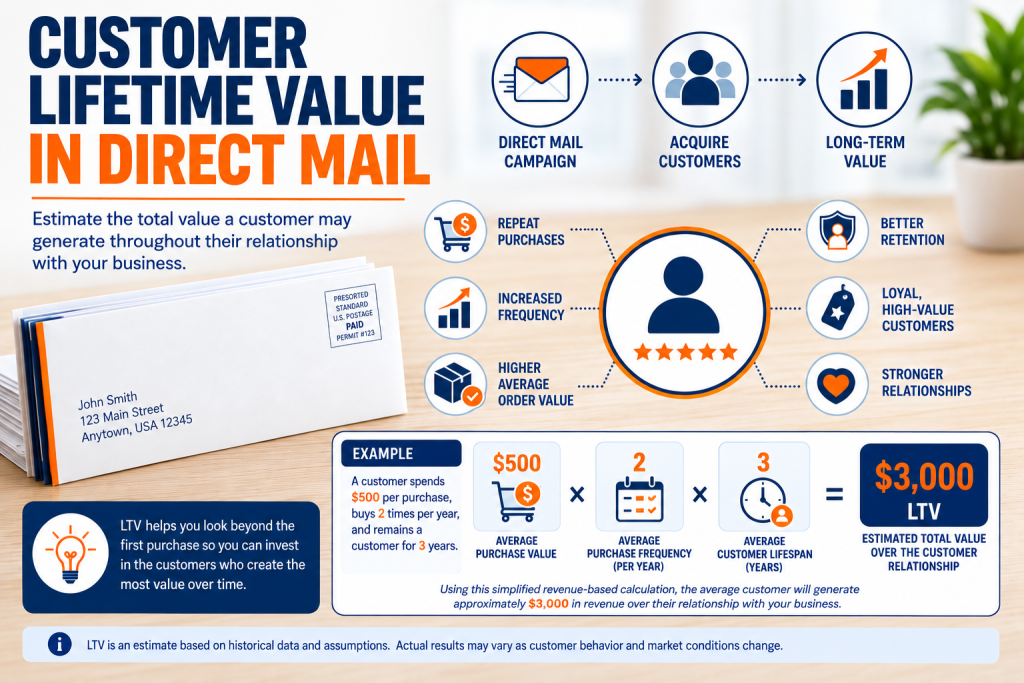
- Customer lifetime value helps to estimate the total value that a customer might generate throughout their relationship with a company.
- Comparing customer lifetime value with your customer acquisition cost can help you to determine if your cost of acquiring customers through a direct mail campaign is sustainable over a period of time.
Introduction
After your direct mail campaign has concluded, you begin to track and analyze your data. You have calculated your cost per lead, return on investment, response rate, conversion rate, and cost per acquisition. While all these metrics are useful and can help you to analyze your campaign’s results, they don’t answer the following question: how much revenue will a customer generate in their lifetime of being a customer of my business? This question can be answered by calculating your customer lifetime value (LTV). As with other metrics, while your lifetime value can be a helpful metric to have, it should not be the only metric that you look at to determine if your campaign was a success.
What Is Customer Lifetime Value in Direct Mail?
When a customer purchases something from your company, they may become a repeat customer of your business. As mentioned, your LTV is the total value that a customer may generate throughout their relationship with your company. As you can compare your LTV directly to your cost per acquisition, you can see if your LTV justifies continuing doing direct mail campaigns.
How Do I Calculate Customer Lifetime Value in Direct Mail?
Unlike other metrics where the formula for them is mostly fixed with only one or two variables on ways that they can be changed, calculating your LTV can be done in a few legitimate ways. However, a simple formula can be the following: LTV = average purchase value x average purchase frequency x average customer lifespan. As an example, let’s say my customer, on average, buys from me twice per year, spends $500 per purchase, and remains a customer of mine for three years. Using this simplified revenue-based calculation, my average customer would generate approximately $3,000 in revenue throughout their relationship with my company.
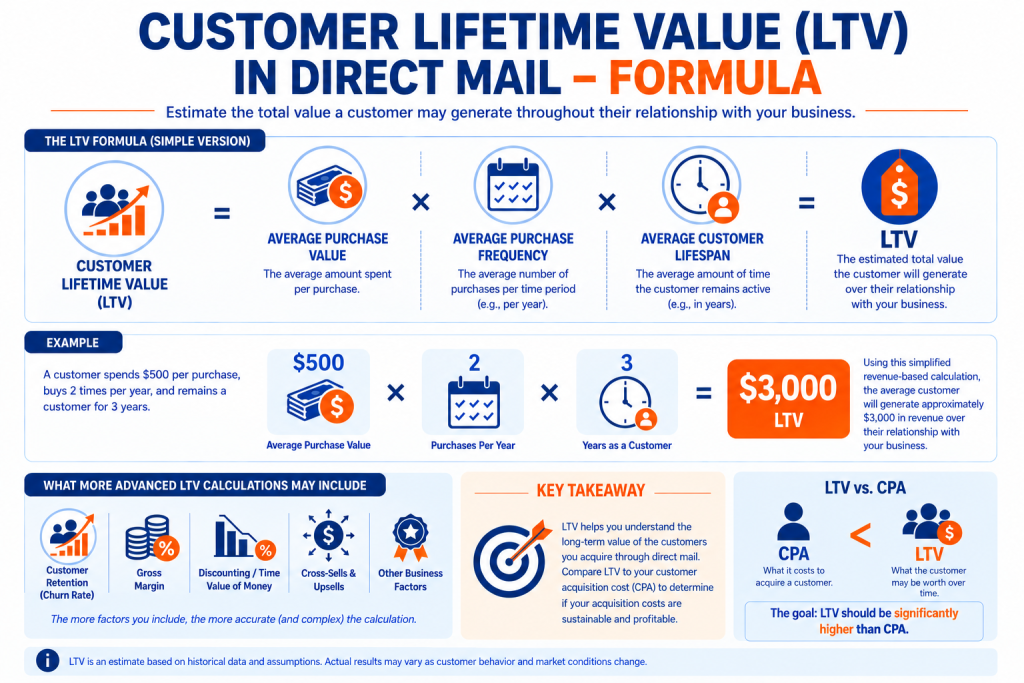
This is an intentionally simplified version of a customer lifetime value in direct mail equation. Many businesses might choose to incorporate other variables such as customer retention rate, the time value of future revenue, gross margin, and more into their LTV.
Why Does Customer Lifetime Value in Direct Mail Matter?
Finding your customer lifetime value in direct mail matters because you can find out if the methods that you’re using to bring in new customers is worth the effort. For example, comparing your customer lifetime value and your cost per acquisition (CPA) can show why individual metrics shouldn’t be used to evaluate a direct mail campaign by themselves. Let’s say we have two campaigns:
Campaign A
CPA = $100
LTV = $200
Campaign B
CPA = $200
LTV = $1,000
Even though Campaign B has a higher cost per acquisition, Campaign B’s customers have a much higher estimated LTV. This could justify the higher acquisition cost. However, LTV by itself doesn’t mean that Campaign B was more profitable. Other variables need to be taken into account, such as the profit margins, the costs associated with serving those customers, and other business expenses also have to be taken in consideration.
Does a Higher Customer Lifetime Value in Direct Mail Always Mean My Campaign Was Successful?
FTV is an estimate that is largely based on historical customer behavior, as well as assumptions about the future. Factors such as changes in customer retention, purchasing frequency, average purchase value, industry competition, or consumer behavior can cause what the actual customer value is to differ from your estimate.
How Can I Improve Customer Lifetime Value in Direct Mail?
There are several ways that customer lifetime value in direct mail can be increased. Actions such as:
- Encourage repeat purchases
- Improve your customer retention
- Increase purchase frequency
- Increase average purchase value
- Ensure you’re targeting the correct audience
- Improve your customer’s overall experience with your company
How Does LTV Relate to Direct Mail?
Direct mail can be used for customer acquisition or prospecting as well as customer retention. LTV can help a campaign manager understand and correlate why acquiring a particular type of customer could potentially justify having a higher mailing and/or acquisition cost. Another reason how LTV relates to direct mail is due to the audience on the mailing lists. As an example, one mailing list could produce less initial customers than another, but those customers could purchase on a more frequent basis or remain customers longer. Looking beyond the initial response and acquisition numbers could provide a more complete picture of an audience’s total value.
FAQ
- Q: Is LTV the same as the amount of a customer’s first purchase with my company?
- A: No. Your customer lifetime value in direct mail is the total amount throughout your company’s relationship with the customer, not just the up-front purchase.
- Q: Is a customer with a high LTV worth a more expensive up-front acquisition cost?
- A: It could be. Depending on how much higher that customer’s LTV is, it could be worth considering. However, other costs, such as campaign costs, margins, and other expenses need to be taken into consideration before saying yes or no.
- Q: Is customer lifetime value an exact number?
- A: No, it’s not an exact number. When trying to estimate future customer value, LTV is only based on historical data, and could change as consumer tastes change, or as your company grows and evolves.
Conclusion
A company’s customer lifetime value in direct mail can be a powerful metric when it’s considered alongside other measurements, such as cost per acquisition and return on investment. LTV can help a company evaluate whether having a higher upfront acquisition cost is justifiable by the long-term value of those customers that were acquired through a campaign. However, because LTV is an estimate, it should be considered alongside actual campaign results, margins, acquisition costs, and other metrics when you’re evaluating performance.
New to Direct Mail?
Are you running your first direct mail campaign?
Read Geon’s beginner’s guide for to direct mail here.
Return to Analyzing Your Campaign Results, or browse Geon’s Learning Center.
Recent Comments