
What Is RFM Analysis in Direct Mail?
Key Takeaways
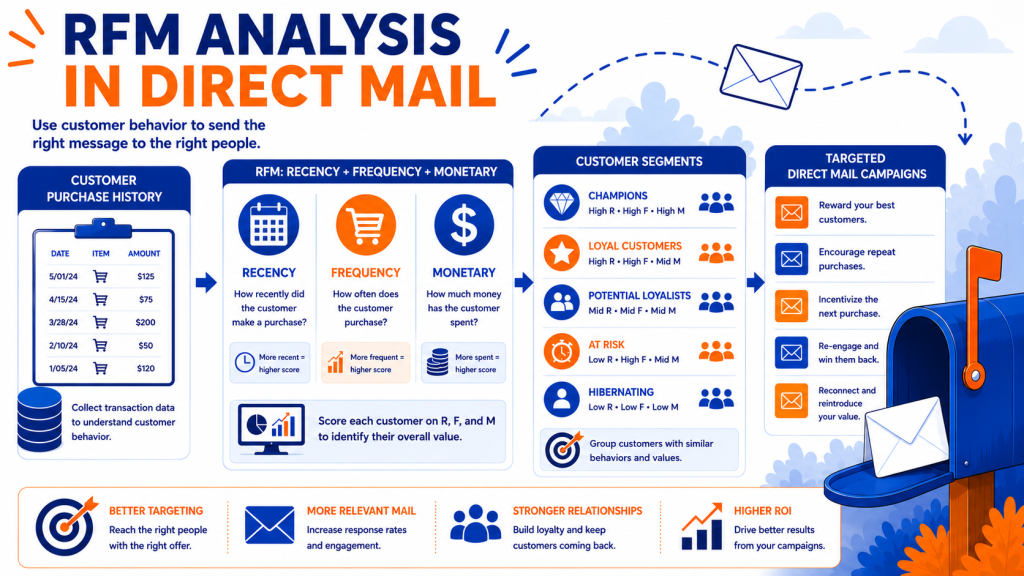
- RFM stands for Recency, Frequency, and Monetary value.
- RFM analysis in direct mail looks at customer purchase history to help segment a customer database.
- Recency takes a look at how recently someone made a purchase, frequency analyzes how often they purchase, and monetary value looks at the amount that they spend.
- RFM analysis in direct mail doesn’t guarantee that a particular customer will respond. Rather, it’s a way to use previous customer behavior to help make decisions regarding targeting.
- RFM in direct mail can help businesses to identify different customer groups that might be appropriate for different direct mail campaigns.
Introduction
If you’re producing a mail piece for a campaign, should every recipient be mailed the same mail piece? You’re running a retention direct mail campaign, and you’re mailing a total of 30,000 pieces of mail. Some of your customers that you’re mailing have purchased from you last week, whereas some haven’t been active in two years. Some purchase on a weekly basis, and some have only purchased a product once or twice in years. Some customers have purchased thousands of dollars of product from you, and some have only spent a total of $50.
Based on this, it might not make sense to treat every target of your direct mail campaign the exact same. Recency, frequency, and monetary value (RFM) analysis can help to determine the way and method to segment your customers. RFM analysis in direct mail can help to find customer segments that you can use to determine who receives which mail piece.
What Does RFM Stand For?
Recency
How recently did your customer purchase a product or service from your company? A customer that purchased something three weeks ago should be marketed to differently than a customer who last purchased three years ago. Recency can provide you with information about how long it has been since a customer has last purchased from your
Frequency
How often does your customer purchase a product or service from your company? Somebody that has purchased something every month for the past two years might be segmented differently than someone that has purchased once or twice in the past two years. Frequency can help to segment these customers.
Monetary
How much has a customer spent with your company? Depending on how your company conducts its RFM analysis in direct mail, what the monetary value is could represent total spending over a certain defined period, average purchase amount, or a different relevant monetary measurement. A customer that is a large spender could be segmented in a different way than a customer that only makes smaller purchases.
How Does RFM Analysis in Direct Mail Work?
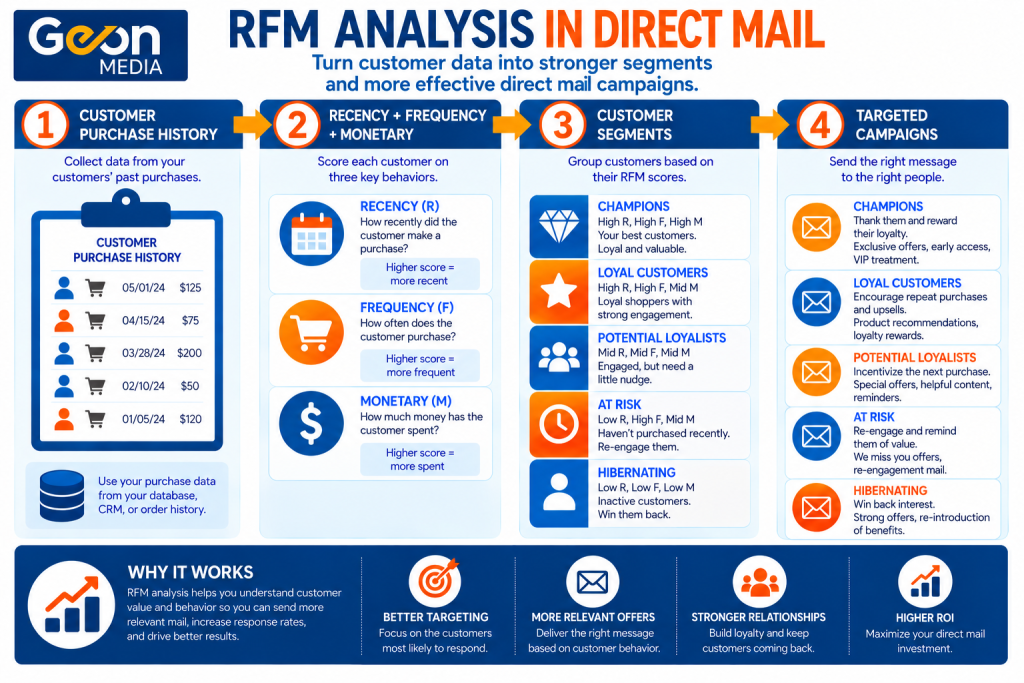
Starting with customer transaction data, companies can evaluate customers based on the three RFM characteristics, recency, frequency, and monetary value. Companies are then able to segment their customer base into different groups, who then will have a targeted direct mail campaign that is tailored to their segment. Some RFM analysis in direct mail might assign a customer scores based on their recency, frequency, and monetary characteristics. What the exact scoring method is and the way that customers are grouped together can vary depending on the business and their objectives.
Example of RFM Analysis in Direct Mail
| Customer | Last Purchase | Purchases | Amount Spent |
|---|---|---|---|
| Customer A | 2 weeks ago | 12 | $2,000 |
| Customer B | 1 month ago | 1 | $175 |
| Customer C | 2 years ago | 8 | $1,500 |
Do these three customers have the same purchasing frequency? Do they purchase the same amount per purchase? How about the amount of purchases with this company? Obviously not. Customer A is recent, frequent, and spends a rather high amount when they do purchase. Customer B is recent, but they’ve only purchased once. Customer C has historically purchased frequently and spends a large amount on average per purchase, but hasn’t purchased in a long time. Due to this, a mailer could consider doing a different mail piece for all three of these customers, especially Customer C, as a reactivation campaign could be considered.
How Can Performing An RFM Analysis in Direct Mail Help Me Segment My Customer Base?
While doing an RFM analysis in direct mail isn’t going to tell you to directly send a certain offer to a certain individual/group, it can help you to identify important customer segments that you can then develop a direct mail campaign around.
Recent Customers
For recent customers, you might want to encourage them to make another purchase or introduce a complementary product for them for the next time they do business with your company.
Frequent Customers
If you have a group of frequent customers, they could be the appropriate targets for a brand loyalty program, a special promotion, or another way to reward established customers.
High-Value Customers
High-value customers could receive different treatment than customers that have spent less or purchased on a less frequent basis.
Previously Valuable, but Inactive Customers
If a customer used to be a higher value client but has stopped purchasing, launching a reactivation campaign could be a good idea.
Can’t I Just Mail My Entire Customer File?
While you can mail everybody that you have on your house file, there are several advantages that segmenting your customer base can bring, if you have enough of a customer base and transaction history to find meaningful differences between different groups. Not every customer that you have is going to respond in the exact same way if you were to only send one mail piece to everybody.
Some of these advantages of segmenting your customer base include:
- Developing targeted offers that are more relevant to one group of customers.
- Tailor specific messaging that is directed at a customer’s relationship with your company.
- Prioritize mailing to a certain customer segment.
- The ability to test different customer segments to see if a group prefers different messaging or offers than another group.
- Avoid treating all the customers that you have as if they have the same purchasing behavior.
Is RFM Only for Direct Mail?
No, RFM is a broader technique that can be used for other marketing and customer analysis purposes, such as digital marketing, email marketing, and other purposes.
What Data Do You Need for RFM Analysis in Direct Mail?
To perform a basic RFM analysis in direct mail, you need enough customer transaction data that allows you to then determine:
- Who exactly your customer is.
- When and how often your customer purchases from your company.
- How much the customer has spent.
Does RFM Replace Defining Your Target Customer?
No, RFM and defining your target customer are two separate topics, but they are similar. Defining your target customer can help to answer, “Who do I want to reach with my campaign?” Whereas performing an RFM analysis in direct mail can help answer “Which customers in my existing customer base would this campaign be appropriate for?” While this is an oversimplification, this is a good framework regarding why the two concepts are different from one another, though similar.
Are RFM and Customer Lifetime Value the Same Thing?
While these are also similar from one another, RFM and customer lifetime value (CLV) are not the same thing. Doing an RFM analysis in direct mail uses recent and historical customer data and behavior to segment customers. CLV, on the other hand, estimates what the economic value of a customer is over their lifespan of having a relationship with your business.
Test Your RFM Segments
If you’ve identified who you think your “best” customer base is after doing an RFM analysis in direct mail, don’t assume that they’re always going to be your number one customers for every campaign that you run. Test one RFM segment against another while keeping as many other campaign variables as consistent as you can, and see how different segments perform when they receive the same offer and mail piece. Then, measure other metrics, such as your response rate, cost per lead, return on investment, conversion rate, cost per acquisition, lifetime customer value, and other metrics. Doing this can help you to continue to develop and grow your direct mail campaigns going forward.
Keep the Underlying Customer Data Accurate
RFM is only going to be as useful as the documented customer and transaction information that is being analyzed. Purchase dates, transaction amounts, and customer identities need to all be recorded in a consistent manner in order to meaningfully segment them. When those segments are used for a direct mail campaign, performing proper data hygiene can also help to keep the mailing information current and reduce the number of mail pieces that are sent to an outdated or incorrect address.
FAQ
- Q: What does RFM stand for?
- A: RFM stands for Recency, Frequency, and Monetary Value.
- Recency helps to measure how recently a customer has made a purchase with your company or otherwise completed whatever transaction your company is tracking.
- Frequency investigates how often a customer has made a purchase with your company or completed whatever the relevant transaction is during the period that is being analyzed.
- Monetary measures the customer’s spending or other economic activity during a defined period, which depends on how the business has structured its analysis.
- A: RFM stands for Recency, Frequency, and Monetary Value.
- Q: Does a high RFM score guarantee that someone will respond to my mail piece?
- A: No. While RFM uses previous customer behavior to help in segmenting an audience, what someone’s previous behavior with your company is doesn’t guarantee how someone will respond to a campaign in the future.
- Q: Can RFM be used for prospect mailing lists?
- A: Traditional RFM analysis isn’t generally used with a standard, rented prospect mailing list, as RFM relies on historical customer transaction data. RFM analysis is more commonly used with a company’s own house file.
- Q: Do I need a special piece of software to perform RFM analysis in direct mail?
- A: No. The complexity of RFM analysis in direct mail can range anywhere from simple customer segmentation to using sophisticated databases and analytics systems, which depend on the size of the customer database and your company’s needs.
Conclusion
When trying to divide your customer base into groups for more targeted direct mail campaigns, doing an RFM analysis in direct mail can help businesses to determine which customers to target, and how those groups differ from one another. By considering how recently a customer has made purchases, how frequently they purchase, and how much they spend per purchase, businesses can help to divide their customer base into meaningful segments, rather than grouping every customer into one archetype.
Return to Define Your Customer & Build Your Audience, or browse Geon’s Learning Center.
Recent Comments