
Building Long-Term Direct Mail Success
Key Takeaways
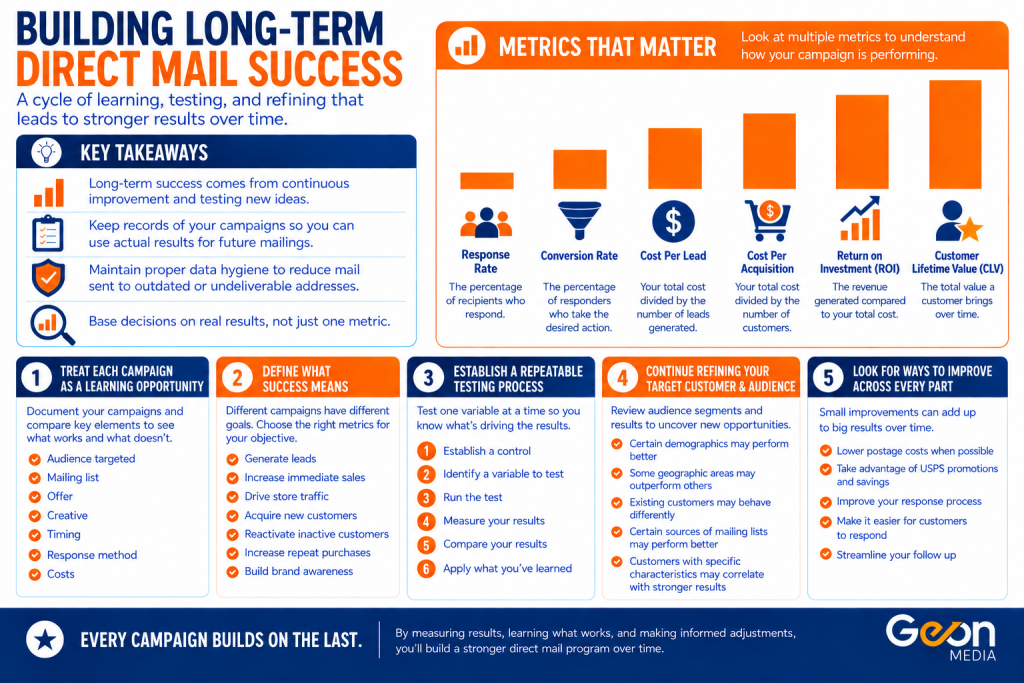
- Long-term direct mail success comes from creating a cycle of continuous improvement and testing new ideas with your direct mail campaigns.
- Keep records of your previous direct mail campaigns so you can use actual results when planning future mailings.
- Maintain proper data hygiene on your mailing lists to reduce the number of mail pieces that are sent to outdated, incorrect, or undeliverable addresses.
- Evaluate your campaign based on results that matter to you, and don’t focus on one poorly performing metric.
Introduction
Having one successful direct mail campaign is great, but can you repeat that performance when it’s time to mail again? Do you know how to maintain your long-term direct mail success? Likewise, having a disappointing direct mail campaign can be frustrating, but does that mean that direct mail won’t work for you and your company? The information that you’ve generated from one campaign can help to make the next better. Over time, if you repeat this cycle, you can generate long-term direct mail success.
Treat Each Campaign as a Learning Opportunity
When you were in school, there’s a high likelihood that you didn’t immediately start doing algebra or reading full-length novels from day one. If you’re looking to build long-term direct mail success, you should treat doing a direct mail campaign the same way. After each campaign, focus on what you can learn from the failures and successes that you have. If something worked, why did it work? And if something failed, why did it fail?
Document the information from your campaign, so you can use it as a benchmark for future campaigns. Every campaign that gave properly measured results can give you information, such as your:
- Audience targeted
- Mailing list
- Offer
- Creative
- Timing
- Response method
- Costs
- Customer behavior
Comparing these elements from campaign to campaign can give you a better idea of what is working and what isn’t. It’s important to note that just because a metric doesn’t beat a previous campaign, you can still learn from it. You might discover that one audience responds less but spends more, or an audience responds more but they don’t stick around as customers, for example. And just because a mailing list or campaign has generated success/failure in the past, as your business and consumer taste evolves, what worked/failed in the past could fail/succeed now.
Define What Success Actually Means
Building long-term direct mail success is difficult if you haven’t defined what “success” is. The campaigns that you run might have different goals when compared to one another. Your campaigns might be trying to:
- Generate leads
- Produce immediate sales
- Drive foot traffic to your store
- Acquire new customers
- Reactivate inactive customers
- Increase repeat purchases
- Build brand awareness
Due to these goals being different, trying to compare certain metrics between one type of campaign to the next could may not provide a useful comparison. There are several metrics that you can use to help measure the success of a campaign. Building long-term direct mail success means that, when analyzing these metrics, they should not be isolated and individually used to determine whether a campaign was a success or not.
The following metrics can be helpful when analyzing your campaigns:
- Response rate
- Conversion rate
- Cost per lead
- Cost per acquisition
- Return on investment
- Customer lifetime value
Establish a Repeatable Testing Process
Establishing a testing process that can be repeated to test new ideas is a great way to find long-term direct mail success. Whether you want to test a new mailing list, select, segment, or other part of your campaign, come up with a testing process that can be used over and over again to view results.
Instead of randomly trying to redesign and execute a direct mail campaign:
- Establish a control
- Identify a variable to test
- Run the test
- Measure your results
- Compare your results to previous campaigns or your expectations
- Apply what you’ve learned
If you find a part of the test campaign performed better than the control, then consider making the better-performing version your new control and then test something else. By following this cycle, you can build stronger evidence on what is and is not working on your way to finding long-term direct mail success.
Continue Refining Your Target Customer and Audience
Defining who your target customer is shouldn’t be something that is done once and then never revisited. As your business grows and consumer tastes change, who your target audience is today could be different six months or a year from now. After each campaign, long-term direct mail success involves taking a look at how your different audience segments performed. Consider whether their purchasing behavior, geography, demographics, or other characteristics can reveal any patterns that are worth investigating.
Your campaign results might show that:
- Certain demographics perform better than others
- Some geographic areas outperform others
- Your existing customers behave differently than prospective customers
- Certain sources of mailing lists perform better
- Customers with a certain characteristic correlate with stronger results
Remember that just because your campaign results contain a correlation, there doesn’t necessarily mean that a characteristic caused a stronger performance. Investigate the stronger performance to see if there is a connection, or if it was just a one-off strong performance.
Maintain Your Mailing Data
Over time, mailing data becomes outdated, known as data decay. Data decay doesn’t mean that the owner of the mailing list is doing anything wrong, as data decay is a natural process that happens due to people moving or passing away, for example. There are ways to fight data decay by cleaning your data in a process known as practicing data hygiene.
There are ways to practice having good data hygiene. The USPS has two services that mailers and mailing list owners can use to have good data hygiene. First, get your data ran through a National Change of Address (NCOA) processing service. NCOA processing can help to identify records that match USPS change-of-address information, which allows qualifying address records to be updated before printing your mail pieces. So, if someone has moved and filed a change-of-address with the USPS, you can get an updated mailing address for them.
Mailing data can also be processed using Coding Accuracy Support System (CASS) Certified software to standardize addresses and improve the accuracy of postal coding. CASS will standardize your addresses so they can be used for your mail campaign. This can help to improve your mailing list’s address quality and reduce problems that were caused by an incorrectly formatted or incomplete address. Using CASS Certification and NCOA processing can help to maintain the quality of your mailing data. Practicing good data hygiene should be an ongoing process, as addresses will always continue to be slowly outdated as time goes on.
Don’t Assume a Winning Campaign Will Win Forever
If you find a winning combination of a strong target audience, an accurate mailing list, a great offer, and an eye-catching creative, don’t assume that this will always be a successful equation. As time passes, things change. There are aspects that could change, such as your:
- Customer needs
- Industry competition
- Prices
- Offers your company can do
- Economic conditions
- Seasonal timing of your mailing
- Your products/services
So, while you might have a strong mailing today that is working, your results could wane in the future. To achieve long-term direct mail success, you should continue to monitor your mailings and carefully measure whether the campaign is still performing at the expected level and not be afraid to change parts of your campaign in the future.
Consider the Frequency at Which You Mail
If you want to find long-term direct mail success, knowing when to mail is important. There isn’t one correct, universal frequency for every business to mail, as variables such as your industry, purpose of your campaign, and past mailing frequency can all have an impact on how often you should mail.
For example, a coffee shop could mail more frequently than a carpet cleaning service as people are more likely to get a cup of coffee on a more frequent basis than getting their carpet cleaned. This isn’t a bad thing, as the average transaction from getting your house’s carpets cleaned is going to be higher than the average trip to a coffee shop. Document how often you’re mailing to see if you should increase or decrease your mailing frequency.
Look Beyond Individual Campaign ROI
Depending on your industry, some businesses can measure success from an immediate transaction, whereas others might need to acquire customers who make multiple purchases over time. Let’s say we have two campaigns:
Campaign A has a stronger immediate return on investment, but lower-value customers.
Campaign B has a weaker immediate return on investment, but high long-term customer value.
Depending on the business that ran the campaign and the campaign’s objective, either result might be preferable. Long-term customer value can help to add additional context when evaluating a campaign. This also shows why one metric shouldn’t be exclusively looked at to decide how a campaign performed.
Know When to Stop or Pivot in Direction
Having long-term direct mail success is knowing when to stop when you receive evidence that something isn’t working. If properly measured tests continue to produce poor results, then it might be time to stop and pivot to:
- Target a different audience
- Change your offer
- Update your format or chosen response mechanism on your mail piece
- Reconsider your campaign’s objective
- Reduce or potentially stop a particular campaign
Remember: direct mail is a marketing channel and is not a guarantee.
Build a Continuous Improvement Cycle
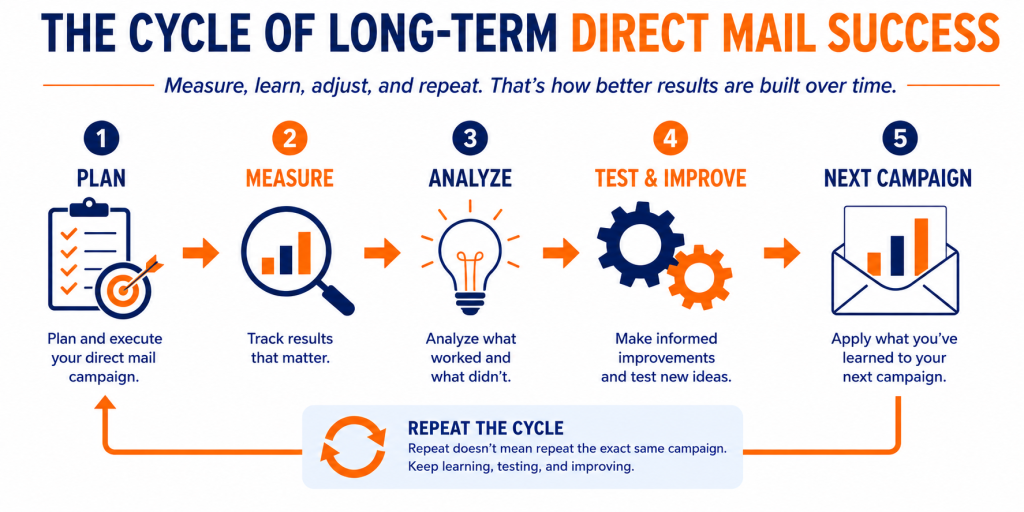
One of the most important aspects to finding long-term direct mail success is to make continuous improvement what your default mindset is after each campaign you conduct. Build a cycle where you plan, mail, measure, analyze, test, and improve before starting the cycle again with your next campaign.
FAQ
- Q: To achieve long-term direct mail success, how many direct mail campaigns do I need to do before I know what works?
- A: There’s not a universal, “one-size-fits-all” number to know what works for your direct mail campaign and what doesn’t to achieve long-term direct mail success. Every campaign that has been properly measured can provide data, and repeated tests can give stronger evidence about what audiences, offers, and approaches are performing well.
- Q: If a campaign is working, should I keep using it?
- A: If a campaign is working, you can keep using it. But it should have its performance measured. What works today might not continue to perform the same way indefinitely.
- Q: Should I use the same mailing list for every campaign that I conduct?
- A: Not necessarily. The path for improvement is a continuous one, and the mailing list that is working now might not be the best mailing list a few months down the road. Testing other mailing lists or other segments could identify additional opportunities for your company.
- Q: How important is it to maintain data hygiene for long-term direct mail success?
- A: Data hygiene is very important to achieving long-term direct mail success. Address and customer information is going to change over time, so maintaining your mailing lists can reduce the amount of wasted mail that you send and help to ensure that you’re making campaign decisions using high-quality, current information.
Conclusion
Building the foundation to maintain long-term direct mail success isn’t about finding one perfect mailing list or campaign and repeating that forever. Sustaining direct mail success is about creating a repeatable process for measuring results, maintaining and updating your data, experimenting with new ideas, keeping what works, and changing what doesn’t.
Return to Improve Your Next Campaign, or browse Geon’s Learning Center.
Recent Comments