
How to Choose Mailing List Selects for Direct Mail
Key Takeaways
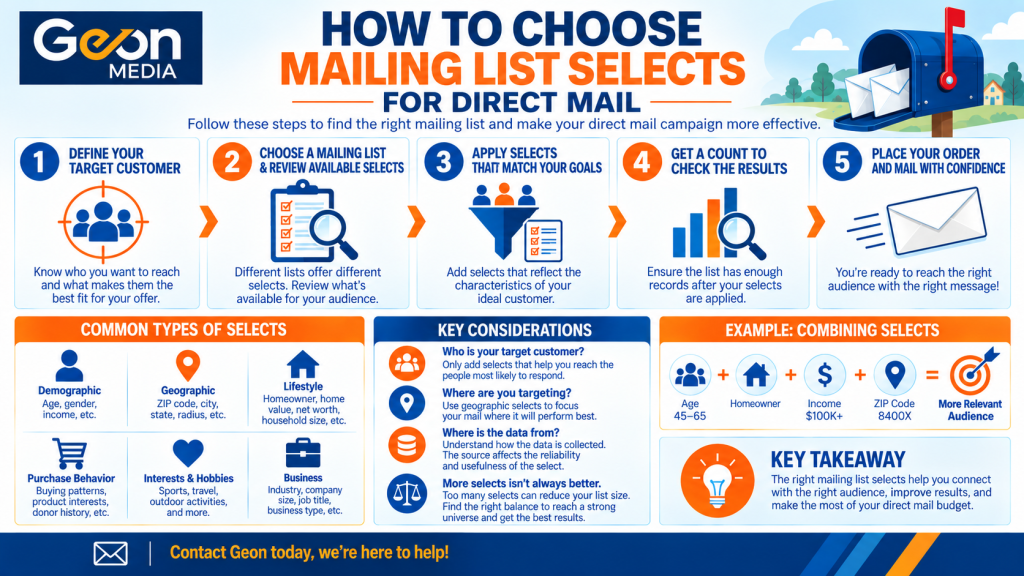
- Mailing list selects are additional pieces of criteria that can be used to narrow a mailing list down to a more specific target audience.
- What selects that are available depend on the mailing list and if you’re targeting consumers or businesses.
- The selects that you should choose depend on characteristics that have a connection to your target customer or campaign’s objective.
- Adding additional selects don’t improve a mailing list directly. Make sure that other signs of a good mailing list are present before renting the list.
- Before renting the mailing list, get a count to ensure that the mailing list can accommodate your chosen selects, as counts could fluctuate. Adding too many selects unnecessarily can heavily reduce the number of individuals that fit the criteria selected.
Introduction
Let’s say you’re running a babysitting service in a local area, and you’re looking for new clients. You decide to rent a mailing list that looks like the best fit, and now it’s time to decide who to mail to that is on the mailing list. Mailing every person on the list isn’t practical, so you decide to add selects on to your mailing list rental. A select is an additional criterion that a mailer can apply to a rented mailing list to help narrow its total universe down to just include records with particular characteristics. These traits can be anything from geographical location to age to net income and more.
After determining who your target customer is, you decide that you’re ready to place the mailing list order. You decide to add a select in to only target the city you’re living in, as well as only mailing to people with young children, and finally only mailing to those with a certain estimated household income. Because the mailing list that you’re renting from has enough of a total universe, you’re able to get the mailing list with the additional selects.
What Is a Mailing List Select?
A mailing list select is an optional, additional piece of criteria that a mailer can add to their rented mailing list order. If a mailing list has a large enough total universe, a mailer can add these additional characteristics to narrow down the total count so they can better target who their target audience is.
What selects you’ll find on a mailing list vary from list to list, and whether the mailing list consists of a business or consumer audience.
Some of the selects that you could find on a consumer mailing list include:
- Geography
- Age
- Interests
- Lifestyle
- Net worth
- Homeownership
- Presence of children
- Purchasing behavior
And some of the selects on a business mailing list that you could find include:
- Geography
- Company size
- Job title
- Number of employees
- Revenue range
- Sales
If multiple mailing lists offer the same selects, the source, definition, accuracy, and recency could vary, so be cautious when ordering from a mailing list that you’ve not rented from before.
Who Is Your Target Customer?
A good starting point in asking how to choose mailing list selects is finding who your target customer is. When looking at a mailing list, looking into their selects that they have available can help you to see if any of them can help you trim down the overall count of the mailing list to just your target customer.
If you are looking into potentially adding a select to your order, it’s recommended that you’re doing it because it helps you narrow down the count to just being who you believe would be most likely to be interested in your mailing list. Only add a select to your rented mailing list order when you have a reason to believe that the criterion will help you in reaching your intended audience. Adding criteria to just narrow the total count can unnecessarily exclude some potential prospects.
Where Are You Targeting?
Depending on the mailing list that you’re using, you might find a select that allows you to filter the area that you’re mailing to. You could find criteria such as state, county, ZIP Code, SCF, or other geographic selects.
Where Is the Source of the Select?
Depending on the mailing list and criteria for the select, the data for the select could be directly reported, observed or transactional, compiled from multiple sources, or modeled/inferred. A directly reported select is different from a select that has been modeled or inferred, so it’s important to understand what the select actually represents before adding it to a rented mailing list. For more information, read Geon’s article on how mailing lists are formed here.
Where the mailing list data comes from usually involves a variety of sources. Some mailing lists are compiled from multiple available data sources, whereas others are built from transactions, inquiries, subscriptions, previous purchases, or other responses. For a more detailed explanation on compiled vs. response mailing lists, read Geon’s article here.
More Selects Doesn’t Mean Better Targeting
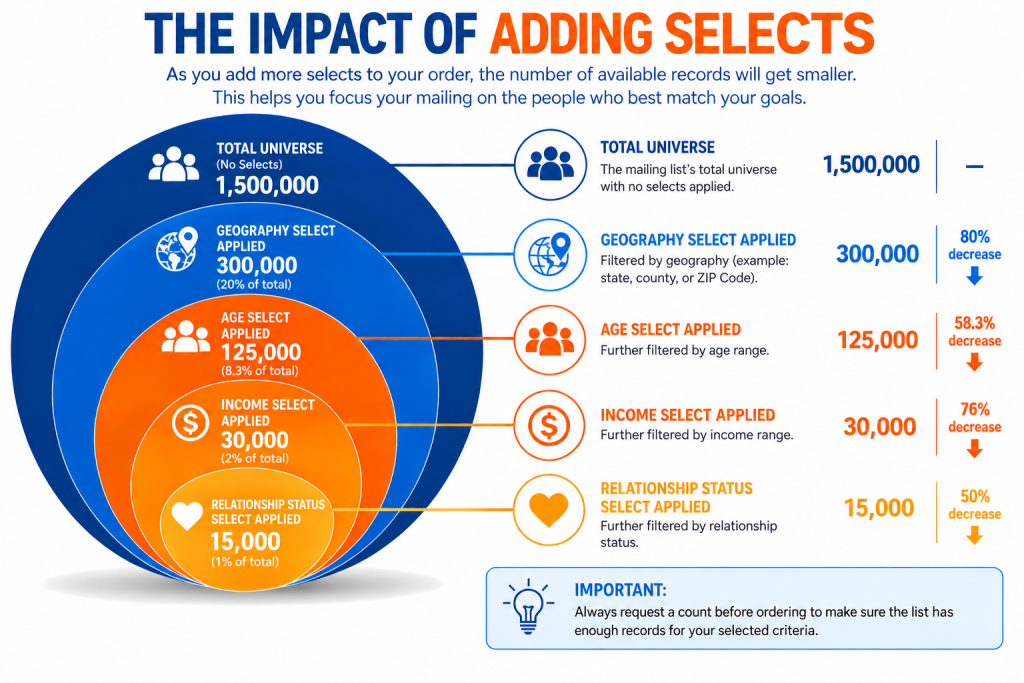
Just because you add a select in to your mailing list rental doesn’t necessarily mean that you’ll have a better targeted mailing list. Remember: as you add an additional requirement to your order, what your available universe is will generally become smaller.
For example, let’s say there was a mailing list with a total universe of 500,000 people. If a mailer only wanted to target individuals who owned a home, the total available count might drop to 300,000 people. If the mailer wanted to add an age range select to their order, the count might then drop to 100,000. If an income requirement was added on top of that, the count might drop to 25,000 people.
Now that the number of people is so small, have you created a better audience, or just a specific audience? This is where you could over-target your audience, which occurs when so many criteria are placed on an audience that what could be valuable prospects are excluded without having enough evidence that excluding them will improve your campaign’s performance.
What Is the Available Count?
Before ordering your rented mailing list, you can request a count with however many selects you would like. As an example, let’s say you would like a count on these selects:
The list’s total universe with no selects applied is 1,500,000.
Geography select applied: 300,000.
Age select applied: 125,000.
Income select applied: 30,000.
Relationship status select applied: 15,000.
If a particular select dropped the count to a number of people that is no longer large enough to run a large-scale direct mail campaign, you need to ask yourself: Is this characteristic important enough for my ideal customer to drop the number of prospects?
Consider the Cost of Selects
Most mailing lists that you’ll come across charge an additional select fee for adding them to a direct mailing list rental. What the fee costs isn’t consistent across every mailing list, it varies from list to list. If you add a select, the select should provide enough of a value in targeting that it justifies the reduction in audience size, as well as the additional cost for using it. For more information on the cost of mailing lists, read Geon’s article on how much it costs to rent a mailing list here.
Rather Than Assuming, Test Your Selects
If you’re asking yourself how to choose mailing list selects and you’re unsure whether adding in a certain select will improve your campaign’s performance, then consider testing the select against an audience without it while keeping the other major campaign variables as consistent as possible. You could then compare the metrics between the two campaigns, such as the:
Comparing these metrics and more can help answer questions that you might have on whether adding the additional select improves your campaign’s performance enough to justify adding it to future rented mailing list orders.
Be Careful with Highly Sensitive or Regulated Targeting
There are some industries, offers, data types, and targeting practices that could involve additional legal or compliance considerations. Mailers need to make sure that their usage of mailing data and targeting criteria is appropriate for their direct mail campaign. For more information regarding the legality of mailing lists, read Geon’s article here.
Ask What a Select Actually Means
A datacard that you might be looking at might have a select that has a vague definition. For example, you might see an available select called “investor”. That’s great and all, but what does investor mean? Is it someone that owns stocks, invests in real estate, responded to an offer relating to investing, or likely to invest? If you have any questions regarding the definition of a select that you might see, contact your list manager or list broker, and they should be able to answer your questions regarding the definition of a select, where the data comes from, how frequently data is updated, and more.
FAQ
- Q: What is a mailing list select?
- A: A mailing list select is an additional piece of criteria that a mailer can add on to their rental of a mailing list that can narrow down the larger mailing list universe to only records that include a particular characteristic, such as geography, age, hobbies, lifestyle, net income, or more.
- Q: Does every mailing list have the same group of selects?
- A: No. What available selects are on a mailing list depend on the list, data source, and list owner.
- Q: Does adding more selects create a better mailing list?
- A: Not always. When adding a select onto a mailing list, the number of individuals that fit every selected criterion will generally decrease as additional requirements are added.
- Q: How many selects should I use for my direct mail campaign?
- A: There isn’t a universal correct answer to the number of selects that a mailer should use. As most selects cost money, adding them could make the mailing list rental more expensive. Ask for counts regarding a particular select and weigh the benefits to a more narrowly defined audience against the cost of using the select.
Conclusion
Adding mailing list selects isn’t about attempting to add as many pieces of targeting criteria as possible. Adding selects is about finding characteristics that have a meaningful connection to your target customer, and deciding which of those criteria are going to be useful to your overall campaign. By having your starting point be creating your target customer, understanding what each select means, being informed about the counts and costs associated with the select, and testing different criteria, you can make the most informed decision as possible about which characteristics and criteria to use for your direct mail campaign.
If you’re having trouble deciding what selects to use for your direct mail campaign, or if you need assistance with finding a mailing list for your campaign, contact Geon here, and we would be happy to help you with your campaign.
Return to Mailing List Fundamentals, or browse Geon’s Learning Center.
Recent Comments