
How Do I Choose the Right Mailing List?
Key Takeaways
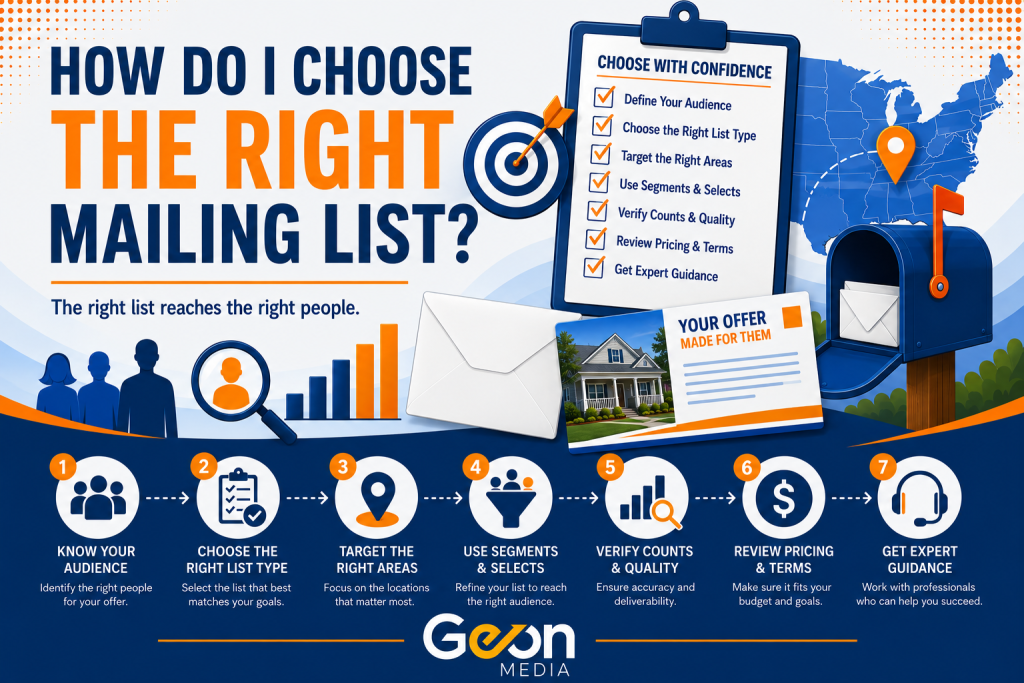
- Learning to choose the right mailing list is a challenge. There isn’t one “best” mailing list, as finding the best list should be on a campaign-by-campaign basis.
- There are several questions that a campaign manager needs to ask themselves before selecting a mailing list, as choosing the wrong mailing list could make the campaign be unsuccessful.
Introduction
Learning how to choose the right mailing list can be a difficult task. There isn’t one definitive “best” mailing list. What could be considered to be the best mailing list is going to be on a campaign-by-campaign basis. A mailing list targeting real estate investors isn’t going to be the best mailing list for a mailer wanting to target sports fans. There are quite a few criteria that should be considered when trying to find the right mailing list for your direct mail campaign.
Who Is Your Target Audience?
Before any other action should be taken, the first decision that needs to be made is who your target audience is. Find who your current best customers are, and jot down every demographic that they have, and consider doing an RFM analysis on your customer base. Find out your customer’s:
- Age
- Income
- Occupation
- Interests
- Purchasing behavior
- Geographic location
- Homeownership
By finding what your customers have in common, you can build an archetype of who your ideal customer is, and that is who you should be targeting with your mail piece. For more information on finding your target customer, read Geon’s article on how to define your target customer here.
Is My Target Consumer in a Consumer or Business Audience?
The next step on trying to choose the right mailing list is to consider what your offer is. Are you targeting a consumer audience, or a business audience? If your offer advertising a recently opened restaurant to nearby residents, or are you promoting a new piece of business software to company executives? Knowing this can help you decide what your offer needs to be, how to design your mail piece, and can help narrow down your target audience. Learn more about consumer vs. business mailing lists here.
Should I Use a Compiled or Response Mailing List?
Another consideration that needs to be made when trying to choose the right mailing list is asking how a mailing list was built. Compiled lists are assembled using information that was gathered from multiple data sources, whereas response mailing lists are typically built from people who have taken an action, such as purchasing a product, subscribing to a service, or responding to an offer. Depending on your campaign, using either a compiled or response mailing list could make more or less sense.
If demonstrated past behavior is an important aspect of the offer on your mail piece and a deciding factor as you try to choose the right mailing list, using a response list might be worth considering. Learn more about compiled and response mailing lists and when to use both types here.
Where Am I Mailing To?
Where are you mailing? Depending on your answer, you might need to find a mailing list that services a specific area of the country. Some mailing lists only serve a specific area or a limited amount of zip codes. Making sure that a mailing list will work with your geographical requirements ahead of time can remove the possibility of having wasted work as you try to choose the right mailing list if a mailing list doesn’t target the required areas you’re mailing to.
Should I Use a Segment or Select?
Segments and selects can be a deciding factor as you try to choose the right mailing list by turning a candidate into the correct mailing list if utilized correctly. Segments and selects can help narrow down the available universe of a mailing list based on additional requirements, and can be a deciding factor when trying to choose the right mailing list for your direct mail campaign.
Segments divide a mailing list into predefined groups as listed on the mailing list. Selects, on the other hand, allow mailers to narrow an audience using available characteristics, such as age, income, gender, hobbies, net worth, and more. Interested in learning more about segments and selects? Read more about segments and selects with Geon’s articles on those topics, as well as if you should add a mailing list segment to your rented mailing list order.
What Mailing List Count Do I Need?
Knowing the number of mail pieces that are going to be sent out ahead of time can ensure that you choose a mailing list that can be compatible with your campaign can help you choose the right mailing list. As you get more narrow with your target audience, the number of people that fit every desired trait decreases. Some mailing lists might not be able to hit the number of qualified individuals that are in your target audience. Ask the mailing list’s owner ahead of time to ensure that the mailing list can fit your needs.
A larger mailing list isn’t necessarily a better mailing list, as the names might not fit your target audience. If the right mailing list is chosen along with a solid mail piece and offer, direct mail remains to be an effective way to get information to potential customers. Mailing list counts also could change, as the mailing list’s owner gains or loses access to data, or consumer interests changing. Learn more about mailing list counts here.
Is This Mailing List of a Good Quality?
The quality of the mailing list can impact your decision on trying to choose the right mailing list. Mailing lists, if not actively being taken care of, can decay and become less accurate as time passes. This is due to factors such as people moving, people passing away, and more. Evaluating the accuracy and maintenance of a mailing list is an important part of deciding if the mailing list will be appropriate for your campaign or not.
While trying to choose the right mailing list, it could be worth asking the mailing list’s owner if they practice good data hygiene on their data to ensure that the names of the inaccurate users have been removed can help to ensure that your mail piece gets to the people who need it most.
Mailing lists are usually very accurate, but this can vary as the contents decay as mentioned above. If you are trying to choose the right mailing list and find a list that you like, it could be worth asking when the last time the mailing list was updated, what date the list counts through, and what processes are used to maintain the data from decaying. Address quality is also important when you’re preparing your mail to be sent out for mailing. The USPS provides tools and standards that can be used to improve your address quality, including CASS Certified address matching, and NCOA processing. You can learn more about those USPS tools here.
After using a mailing list multiple times, you might need to change to a new mailing list. To learn more about knowing when its time to use a new mailing list, read Geon’s article on that topic here.
What Are the Pricing and Rental Terms of This Mailing List?
Your direct mail campaign most likely has a budget attached to it. As mentioned, as you get more specific on your defining your target audience, the cost of renting the mailing list might increase. Making sure that your desired mailing list is within your budget can be overlooked, but it needs to be done if you want to choose the right mailing list. More specialized mailing lists can cost more to rent than more broad mailing lists, so the price of the mailing list should be considered alongside how well the audience of the mailing list fits your mailing campaign, and can help you to choose the right mailing list.
Should I Ask a List Broker for Help?
If you’re looking at several mailing lists and don’t know which list best fits your mailing requirement, budget, and audience, asking a mailing list broker for guidance could help you choose the right mailing list. Mailing list brokers can help to determine which mailing list will be the right list for your campaign, as they represent a multitude of different lists. If you’re curious on contacting a mailing list broker, read about Geon’s list brokerage service here.
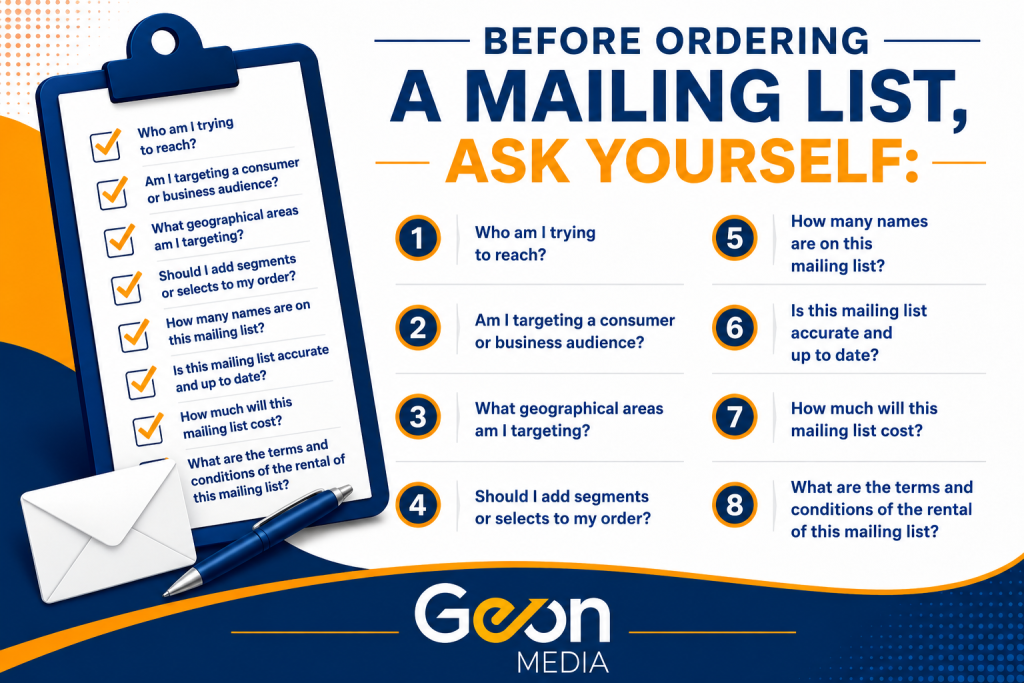
Before Ordering a Mailing List, Ask Yourself:
- Who am I trying to reach?
- Am I targeting a consumer or business audience?
- What geographical areas am I targeting?
- Should I add segments or selects to my order?
- How many names are on this mailing list?
- Is this mailing list accurate and up to date?
- How much will this mailing list cost?
- What are the terms and conditions of the rental of this mailing list?
FAQ
- Q: I’m trying to choose the right mailing list, but I can’t decide which list is the best for my campaign.
- A: No worries. Trying to choose the right mailing list can be a difficult task. With thousands of mailing lists being available on the market, it can be a difficult decision to make. Contact Geon today, and we can try our best to help with your situation.
- Q: Once I mail using a mailing list, can I reuse the list for another campaign?
- A: This should be something that you should discuss with the mailing list’s owner before rental. Some mailing lists allow for reuse, and some don’t. To combat misuse, list owners will often place seed names in their lists, which are fake names that belong to the list owner or a trusted contact of the owner who will receive the mail piece to ensure that mailing list misuse doesn’t happen.
- Q: Will the names that I get on my mailing list be 100% accurate?
- A: No, no mailing list is 100% accurate. Even if a mailing list’s owner practices good data hygiene and removes bad names from a mailing list, there are still going to be some names that fall through the cracks. As an example, someone on a list might fail to notify the USPS that they’re moving, and so their data does not get updated. If this happens, the list owner doesn’t know that this happened, so the bad data stays in the mailing list.
- Q: Is a larger mailing list always better than a smaller list?
- A: No, when trying to choose the right mailing list, the overall list size shouldn’t be considered heavily as you try to choose the right mailing list for your campaign. A mailing list that has a smaller universe could be a better fit than a large list, depending on who your target customer is. Your goal shouldn’t be to find the list with the most names, but the list that best fits who your target customer is.
- Q: The mailing list’s count has changed between me finding the mailing list and placing an order.
- A: That’s normal. As a mailing list’s owner gains or loses access to a data source, their pool of available names might increase or decrease, which causes the count to change.
Conclusion
Learning how to choose the right mailing list that will work best for your mailing campaign can be a difficult undertaking. Choosing a list with the right audience, geography, list type, selects, segments, counts, data quality, pricing, and rental terms can all have an impact on whether a mailing list is appropriate for your campaign, and improving all of these can help to improve your direct mail campaigns in the future. However, evaluating a mailing list on all of these factors, a campaign manager can systematically eliminate unqualified lists until a mailing list is found that best matches your ideal customer for your campaign.
If you have any additional questions on how to choose the right mailing list for you and your campaign, contact Geon today, and we would be happy to help with whatever we can.
Geon reviews your intended audience and mail piece to identify additional criteria that can help refine your mailing list selection. This helps us select names that more closely align with your offer and campaign goals.
Learn why mailers choose Geon Media.
How Ordering Works
1. Tell us about your campaign. Share your intended audience, quantity, and a sample of your mail piece.
2. Review your options. We help you choose a mailing list and any suitable selects or segments.
3. Confirm your order. Review and approve the final pricing and rental terms.
4. Receive your list. We prepare your selection and deliver you with a spreadsheet containing your mailing list.
Learn more about ordering a mailing list.
New to Direct Mail?
Are you running your first direct mail campaign?
Read Geon’s beginner’s guide for to direct mail here.
Return to Mailing List Fundamentals, or browse Geon’s Learning Center.
Recent Comments